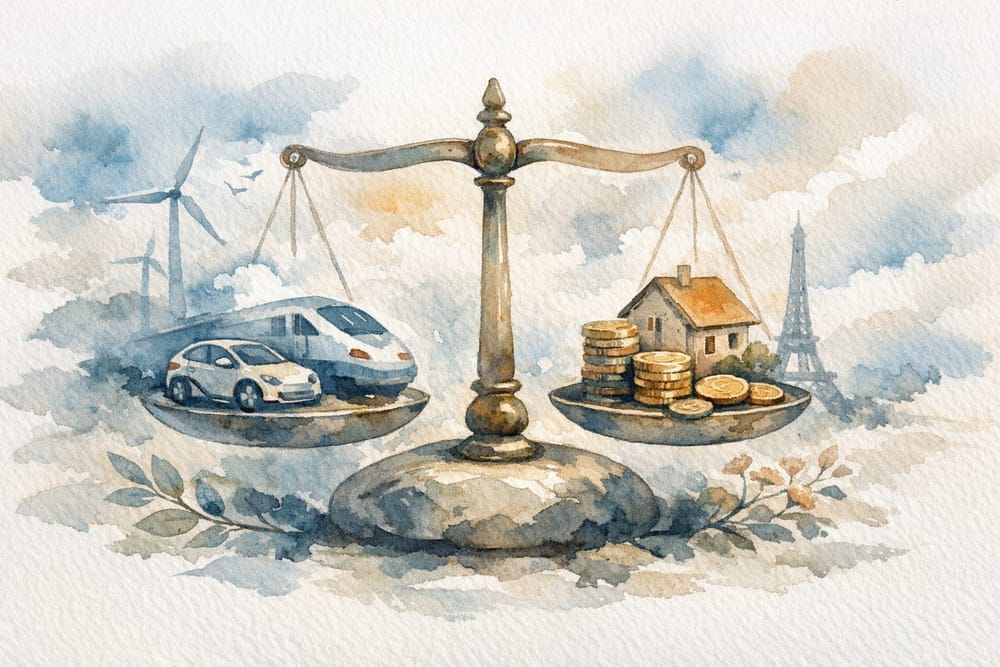
In 2024, French households spent 194.3 billion euros on mobility, of which 80% was devoted to cars (purchase, fuel and use including notably maintenance and repair, excluding insurance) and 10% to public land transport. These figures, published by the Data and Statistical Studies Service (SDES) in Key Transport Figures 2026, raise a question that carbon footprints do not exhaust. A reduction in emissions achieved through individual electrification, without reducing this budgetary dependence, risks constituting a burden transfer as much as an ecological transition.
The essentials
- In 2024, French households allocate 80% of their mobility budget to individual cars, against 10% to public land transport (SDES, Key Transport Figures 2026).
- Electrification of the vehicle fleet reduces emissions per vehicle but modifies cost items and can reduce total usage cost, while INSEE data establishes a decline in the share of disposable income devoted to transport, from 15.2% in 2005 to 13.6% in 2017.
- In sparsely populated territories, dependence on cars can impose high costs on modest households, while collective alternatives are more difficult and costly to organize.
- Paris, New York and Tokyo show that decarbonized mobility at a bearable cost requires a high-frequency public transport offer, built before households have to choose.
- In certain periurban and rural French territories, a decline in national emissions could coincide with lasting financial entrenchment in automobiles.
194 billion: what the expense structure conceals
The figure is crude. It takes on meaning when broken down. Of the 194.3 billion spent in 2024, approximately 155 billion finance individual cars. The remainder is divided among public transport, bicycles and taxis. For a household located forty kilometers from a major city, without a direct rail line, this structure is not a choice: it is a constraint.
The SDES distinguishes three automobile cost items: vehicle purchase, fuel, and use excluding fuel comprising notably maintenance, repair and parking. Together, they form what economists call a constrained cost, an expense that the household cannot reduce without changing residence or place of work. For households in the second and third income quintiles, that is the 40% of French people in the middle of the scale, this mobility item represents a significant share of disposable income, according to INSEE’s Family Budget surveys.
These figures reflect an absence of alternatives, not a cultural preference for cars. A household living in Châtellerault, Laval or Béziers and working in a peripheral business zone takes the car for lack of another option.
Electrification shifts cost items without lightening the bill
Electric vehicle registrations are increasing. According to the IEA in its Global EV Outlook 2026, the share of electric vehicles in new European registrations now exceeds 20% in several national markets. In France, the movement is real but uneven: electric vehicle buyers remain concentrated among wealthy households, homeowners with parking space to install a charging point.
Purchasing a new electric vehicle remained often expensive in 2024; as of December 2, 2024, the eco-bonus for a new electric car was capped at 4,000 €, whereas previously it could reach 7,000 € for the most modest households, and access to charging can be more complex in collective housing, without this making electric vehicles systematically inaccessible to renters. This household continues to finance a combustion engine vehicle, whose fuel taxes can increase variable cost when raised, while low-emission zones restrict its access to certain perimeters.
Electrification modifies individual transport costs and can reduce total cost over the vehicle’s lifetime. Fuel drops for those switching to electric; auto loan repayment and vehicle depreciation depend on the vehicle, financing, subsidies and residual value. For others, usage cost remains high while low-emission zones impose circulation restrictions on affected vehicles. This is the mechanism described by Daron Acemoglu and Simon Johnson in their work on capturing technological gains: an innovation that reduces costs at the aggregate level can simultaneously concentrate its benefits on already well-equipped households and increase the relative burden on others. Here we find a structural dynamic already documented on French infrastructure financing, climate bottlenecks remain without adequate funding in global logistics, and everyday mobility does not escape this constraint.
Infrastructure built in Paris, Tokyo and New York before the era of mass car ownership
Paris, Tokyo and New York have a dense and frequent public transport offer, built before the automobile became the dominant mode of travel. These networks structured urban forms, employment locations and residential habits.
In Tokyo, the car represents a minority share of commutes in the metropolitan area. Public transport represents 60.7% of commutes for active residents in Paris according to the 2022 census. In New York, the subway carries more than 3 million passengers on a working day.
These figures are real. They show that a dense and frequent network facilitates the use of public transport. Where the alternative exists, households use it, not out of ecological virtue, but by economic calculation and time savings.
Periurban and rural France is in an inverse configuration. A major wave of passenger line closures occurred especially between 1967 and 1973, then closures slowed considerably from 1981 onward. Interurban buses, often delegated to regions within decentralization reforms, generally offer limited frequencies. The car is largely dominant for commutes in Creuse and the alternative offer is less used there.
This observation aligns with the thesis developed by Ezra Klein and Derek Thompson in Abundance: the main brake on ecological transition in developed countries stems from the inability to build, quickly and massively, the collective infrastructure that would make this transition bearable for ordinary households. Klein and Thompson primarily target the United States and its tangle of zoning rules and legal proceedings. The diagnosis applies to France: a country that regulates combustion vehicles without building alternatives leaves modest households to finance their transition alone.
Low-emission zones: pressure without escape route
Since 2021, the legal framework has accelerated and extended the deployment of LEZs already underway in certain major conurbations. The principle is clear: reduce circulation of the most polluting vehicles in urban centers. The climate and health objective is legitimate. The distributive effect deserves to be examined squarely.
Vehicles classified Crit’Air 4 or 5, the oldest, the most polluting, the cheapest to buy, are overrepresented in low-income households. According to an INSEE survey cited in parliamentary work, 38% of the poorest households owned a Crit’Air 4 or 5 vehicle, compared to 10% of the wealthiest households. The LEZ thus creates an equipment constraint on households with the least budgetary margin to respond to it.
The government has implemented conversion subsidies: the eco-bonus and the scrappage premium. These schemes exist and they work for those who can advance funds or access credit. Access to subsidies can remain difficult, but a government-backed microcredit is provided for people excluded from conventional bank credit. The article on young people without qualifications and public financing already documented this mechanism in another domain: public subsidies benefit first those who already have the resources to mobilize the conditions for accessing them.
The acceptability of an LEZ depends notably on the existence of mobility alternatives and adapted accompanying measures.
Infrastructure choices in territories without trains by 2040
The forward-looking question imposes itself here, because infrastructure choices in the coming years will influence the structure of mobility spending.
Two trajectories are plausible, without any being inevitable.
In the first, electrification progresses, driven by European regulation and falling battery prices, the IEA projects continued decline in its Global EV Outlook 2026. Wealthy households switch to electric. Emissions per kilometer decline. But in 2024, the structure remains dominated by individual transport, despite stronger growth in public transport spending: a significant share of the mobility budget remains devoted to cars, for households with no other option. In this trajectory, a more electrified fleet is an essential lever, but it is not sufficient on its own in the official decarbonization trajectory for peripheral territories.
This would be a statistical success and a social failure.
In the second, regulatory constraints can be accompanied by mobility measures and subsidies, whose scale varies by territory and scheme. This requires reopening rail lines, increasing frequencies of regional buses, funding multimodal interchange hubs in medium-sized cities. The cost is real. The government has provided, within the investment plan for transport, a multi-year envelope for rail infrastructure. But the amounts remain limited relative to infrastructure needs in sparsely populated territories.
What would distinguish these trajectories by 2030 is the speed at which regions and the State manage to deploy high-frequency services outside major metropolitan areas. The signals to watch are concrete: the number of rail lines reopened, the occupancy rate of interurban buses funded by regions, and, most importantly, the evolution of car modal share in medium-sized cities of 50,000 to 200,000 inhabitants, which are the deciding ground. If this share begins to decline outside Île-de-France, the transition is real. If it stagnates or progresses, electrification will have done nothing but modernize entrenchment.
Jean-Marc Jancovici, whose work on energy constraint and mobility is a reference in this debate, has long emphasized that the electric car solves the carbon tailpipe constraint, not the space, cost and infrastructure constraint. A dense rail network is generally more energy-efficient than individual mobility, including electrified. The physical logic argues for public transport. Public policy must translate this into concrete supply.
Build the alternative before banning the car
Decarbonizing French transport will not be decided at the Auto Show. It will be decided in the budgetary trade-offs of regions, in state decisions on the rail network, and in the capacity of mobility authorities—local authorities charged with organizing transport in their territory—to offer sufficient frequency so that giving up the car is not a sacrifice.
The challenge is to give households the material means to change their travel mode. Where the train comes every twenty minutes and the bus every hour, people take the train. Where it comes twice a day, they take the car. The predominance of automobiles in sparsely populated territories reflects a structural constraint.
This shift in perspective, from vehicles to infrastructure, from unit emissions to household budget structure, is exactly what the analysis of rules blocking renewable energy in France showed in another sector: obstacles to ecological transition are often less technological than political and institutional. On mobility as on the electrical grid, the central question is who decides to build, at what pace, and who bears the cost of waiting.
Approximately 155 billion euros of household spending related to individual transport in 2024, excluding insurance. The day this amount begins to decline, not because people travel less, but because they have access to less expensive alternatives, that will be the sign that the transition is real. Until then, emissions can fall and entrenchment endure.
Sources
- Data and Statistical Studies Service (SDES), Key Transport Figures, 2026 edition, https://www.statistiques.developpement-durable.gouv.fr/chiffres-cles-des-transports-edition-2026
- International Energy Agency (IEA), Global EV Outlook 2026, https://www.iea.org/reports/global-ev-outlook-2026
- Ezra Klein and Derek Thompson, Abundance, Simon & Schuster, 2025, https://www.simonandschuster.com/books/Abundance/Ezra-Klein/9781668023488
- INSEE, Family Budget Survey, data on household expense structure by income quintile (no URL: data available at insee.fr, Statistics section, Income and Wealth)
- Economic Analysis Council, work on the distribution of Crit’Air vehicles by income quintile (no URL: reports available at cae-eco.fr)
- Daron Acemoglu and Simon Johnson, Power and Progress, PublicAffairs, 2023