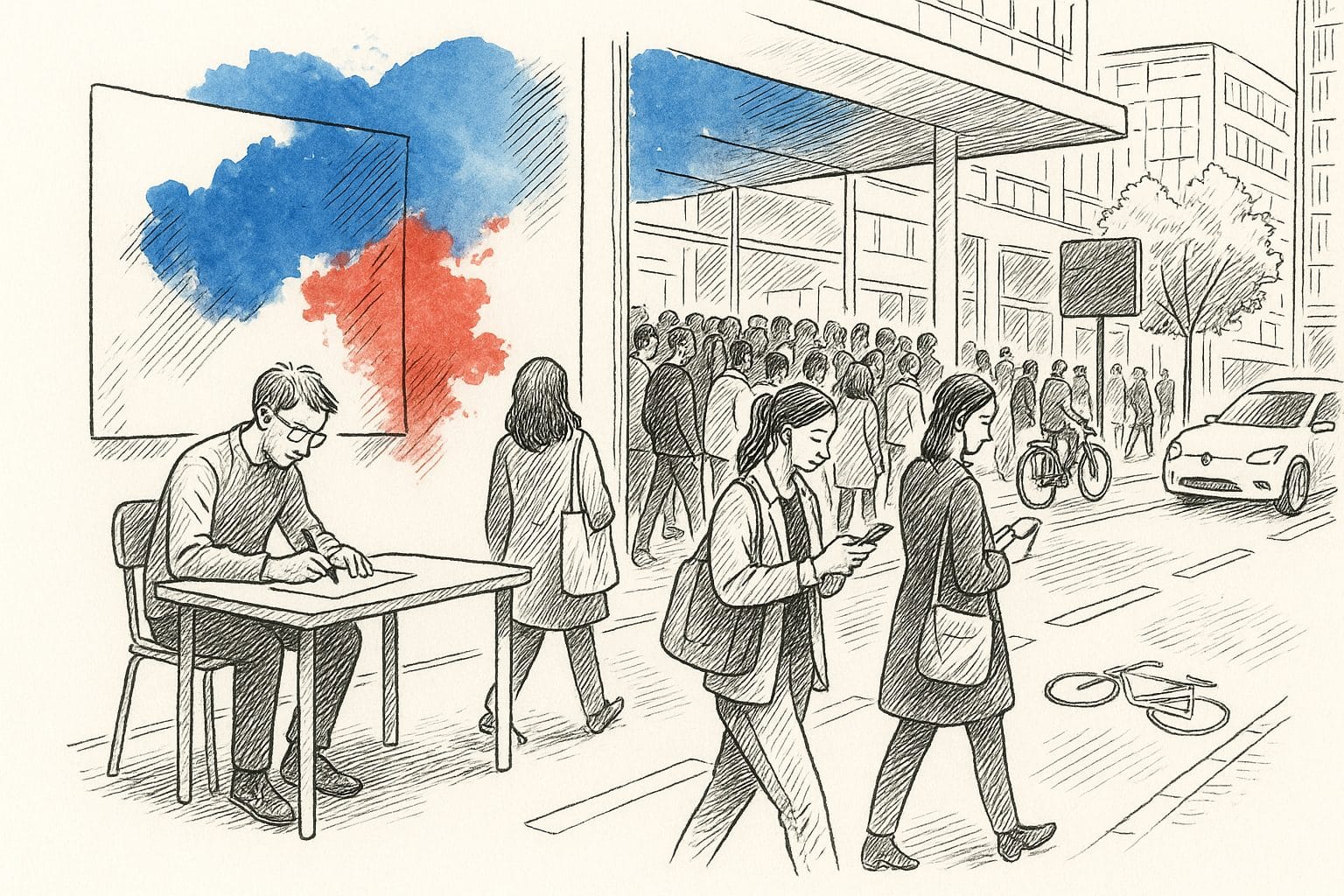
France ranks among the countries best represented on UNESCO’s intangible cultural heritage list, with practices as diverse as falconry, bobbin lace-making, or the knowledge of the Compagnons du Tour de France. International recognition coexists with an existing institutional framework, but judged insufficiently visible, monitored, and funded by the Senate: France has a participatory and evolving national inventory of intangible cultural heritage as well as aids for its preservation. Japan adopted its law protecting cultural property in 1950; the system for designating important intangible cultural properties was established in 1954. France has the Masters of Art program, inspired by the Japanese model, but with different scope and modalities.
The Essentials
- France recognizes its intangible heritage on the international stage but does not finance its transmission: the gap between the display window and ground reality is structural, documented, and deliberate by omission.
- The 2020 report of the Senate information committee on intangible cultural heritage policy documents the absence of a complete national inventory and a sustainable funding mechanism dedicated to transmitting know-how.
- Since 1950, Japan has guaranteed a salary to bearers of traditions designated as “Living National Treasures,” enshrining in law the principle that transmission is a public service.
- The disappearance of a master craftsman without a successor is irreversible: unlike a monument, a gesture cannot be restored.
- The open political question is whether France can still act before certain trades reach a threshold of irreversibility.
The Limits of UNESCO Inscription
Being inscribed on UNESCO’s intangible cultural heritage list is an act of symbolic recognition. The text of the 2003 Convention, ratified by France in 2006, provides that inscription does not automatically create a dedicated budget, requires signatory states to take necessary preservation measures, and states that they shall endeavor to adopt appropriate measures, including financial ones. It commits to “taking the necessary measures to ensure preservation,” a formula vague enough to authorize all interpretations.
France adopted a light interpretation of it. Listed practices receive diplomatic and tourist visibility, sometimes ministerial communication, without necessarily having a dedicated transmission budget. The master wickerworker of Morvan, the luthier of Mirecourt, the embroiderer of Lunéville can see their art classified as humanity’s heritage and continue alone to seek their apprentices, fund their workshop alone, and form their successors alone under economic conditions that discourage vocations.
The Senate information committee report, published in 2021, notes that the national inventory exists but remains insufficiently known, attractive, and monitored. Without consolidated data on bearers and apprentices, targeted interventions are less precise and harder to prioritize. France administers an evolving national inventory of intangible cultural heritage whose total coverage is not quantified.
This system can produce a dispersal of credits among regional cultural affairs directorates, private foundations, a few artisan residencies, and craft programs not designed for transmitting rare know-how. Governance is primarily the responsibility of the Culture Ministry, but interministerial coordination and monitoring of programs could be strengthened.
The Japanese Model as a Revealer of a Political Choice
Japan did not wait for UNESCO. The law protecting cultural property dates to 1950, while the system for designating important intangible cultural properties was established in 1954. The Japanese minister designates cultural properties and recognizes their bearers or groups on advice from the Council for Cultural Affairs; recognized individual bearers receive an annual subsidy, currently set at two million yen per year, approximately twelve thousand euros, and not a salary. The Japanese system aims at transmission; subsidies support individual bearers and training programs, without the source establishing an individual obligation.
Twelve thousand euros annually is modest. But the political signal is considerable. It expresses public support for mastering an endangered art and its transmission. Japanese law organizes the protection and transmission of certain intangible cultural properties.
South Korea followed in 1962 with a similar system. Bulgaria, Hungary, and the Czech Republic developed their own variants. France, which likes to present itself as a model of cultural exceptionalism, remained a spectator to these institutional constructions.
This delay is not a question of means. The French Culture Ministry budget exceeds three billion euros. The question is what it is directed toward. Monumental heritage constitutes an important item in the Heritage program, but it is not demonstrated that it primarily absorbs the ministry’s total budget. Cathedrals, castles, and museums mobilize a significant share of heritage credits.
This choice is legitimate: a listed building that deteriorates is expensive to restore and mobilizes public opinion. The fire at Notre-Dame de Paris in 2019 demonstrated France’s capacity to mobilize billions in a few weeks for a building. A Lyonnais silk weaver who retires without a successor produces no comparable image.
Transmitting Gestures Does Not Resemble Restoring Stone
Built heritage and intangible heritage differ by nature, not only by their cost. A degraded monument can be restored, sometimes reconstructed: stone-cutting and masonry techniques are recorded in manuals, taught on living worksites, and transmitted in craftsmen’s workshops. The know-how of restoration is itself a living intangible heritage, which illustrates the consistency of the problem.
But a gesture of high precision, the placing of a silk thread on a Jacquard loom, the treatment of a voice in the tradition of regional opera singing, the assembly of a bowed string instrument according to centuries-old methods, cannot be acquired from a book. It is acquired through imitation, repetition, correction, in direct relationship with someone who knows. When know-how is held by only one person and that person disappears without transmitting or documenting their practice, the transmission chain can be broken. Transmission can then be greatly compromised.
Certain traditional artisanal sectors are in this situation. Some traditional artisanal sectors sometimes count few active masters. The ministry indicates that nearly a quarter of concerned bearers is over 55 years old; no documented national average age exceeding 60 years is recorded. Existing systems of classical craft apprenticeship do not necessarily meet the economic conditions of training in these sectors.
This know-how is not unconnected to the economy. The textile industry carries in France a value of image and origin that conditions the international competitiveness of luxury and fashion houses. Lunéville embroidery is to a Chanel bag what terroir is to grand cru: a condition of authenticity that price reflects. But the market value captured downstream does not always flow back to the workshops that are its source.
Actors Acting in the Absence of Public Policy
Existing public systems do not prevent action by other actors. Several actors intervene with real but fragmented results.
The Compagnons du Tour de France maintain a system of intergenerational transmission that functions because it has been institutionalized for centuries and benefits from specific legal recognition. Their model is precisely the example of what durable institutionalization can produce: a chain of masters and apprentices that perpetuate themselves with a framework of internal organization.
The Foundation for Heritage finances preservation and transmission projects with private funds and patronage. The Masters of Art program, created by the Culture Ministry in 1994, has supported 149 Masters of Art since its creation, according to the ministry in 2026, and provides aid to finance a student in residence for two years. The program produces documented transmissions. The number of masters currently engaged in transmission should be distinguished from this cumulative total. The program has limited capacity; its adequate sizing would require a quantified assessment of needs.
Regional initiatives are also emerging. Some territorial collectivities have developed artisan residencies, transmission grants, and partnerships with trade chambers. These experiments are useful, but their scope remains local and their continuity depends on political mandates. The question of financing training for jobs in tension, whether new digital trades or old artisanal crafts, poses itself in structurally similar terms: the market alone does not cover these training costs.
The Window Closing by 2035
The question of irreversibility deserves to be posed directly, without artificial dramatization but without evasion either.
In the most fragile sectors, available data do not permit establishing a precise national distribution of the ages of active masters. Without a financed transmission mechanism, certain practices can become harder to transmit. Mastering an expert gesture often supposes years of cumulative practice.
Several trajectories are conceivable for the coming years. The first would extend existing systems without substantial strengthening of transmission means. It could further weaken certain sectors. The disappearance of a practice can make its later transmission more difficult.
The second trajectory would require a political decision and an assessment of transmission needs. It would imply three concrete things: improving the visibility and monitoring of the national inventory, creating a status of bearer of intangible heritage that opens rights to transmission funding, and evolving the Masters of Art program according to a quantified assessment of needs. The program has supported 149 Masters of Art since its creation; any target for scaling up must be justified by an assessment of needs.
The cost of this policy would be modest relative to the culture budget. The Japanese system of Living National Treasures concerns approximately one hundred fifteen individual designations and some dozens of groups, without a total annual cost specified here. France has institutions capable of conducting a similar policy: the Culture Ministry, the DRACs (Regional Cultural Affairs Directorates), trade chambers, and companionship organizations. Their mobilization and coordination of programs could be strengthened.
The elements allowing evaluation of a policy shift are identifiable: better monitoring of the national inventory, an evolution of the Masters of Art program, and the inscription of a budget line dedicated to transmission in the Culture Ministry’s annual performance project.
The Political Choice to Be Made
The 2021 Senate report notes the limits of the intangible cultural heritage preservation policy. The Japanese system offers a point of comparison. The Masters of Art program has limited capacity, whose adequate sizing would require a quantified assessment of needs. Funding choices and coordination of programs can be reexamined.
This default choice has an understandable political logic. Monumental heritage is visible, locatable, defensible before public opinion. It generates measurable tourism and direct jobs in restoration. Intangible heritage produces less tangible goods: excellence, authenticity, cultural depth. These goods have real economic value—ask luxury fashion houses what hand embroidery is worth—but this value is difficult to display in a budget arbitration.
A public policy that finances the transmission of rare know-how is neither nostalgia nor museification of the past. Economic and cultural progress requires choices about what we transmit and what we let disappear. The loss of rare know-how can have economic and industrial effects; qualifying it as an industrial choice requires documented budgetary and sectoral analysis.
The issue is less technical than political. France must decide whether it treats the transmission of its living know-how as a public investment, with the budget lines and institutional mechanisms that this supposes. Time can greatly reduce transmission possibilities; early intervention is preferable, without a universal threshold of irreversibility being asserted.
Sources
- Report of the Senate information committee on the policy of preservation, restoration, and enhancement of intangible cultural heritage, 2020
- Ministry of Culture, Annual Performance Project (PAP) 2026, program 175 “Heritage”
- UNESCO, Convention for the Safeguarding of the Intangible Cultural Heritage (2003), representative list, elements inscribed for France
- Japanese Press Agency / Japanese Agency for Cultural Affairs, Law for the Protection of Cultural Property (1950), system for Bearers of Important Intangible Cultural Properties
- Foundation for Heritage, annual activity reports, intangible heritage preservation program
- Ministry of Culture, Masters of Art program