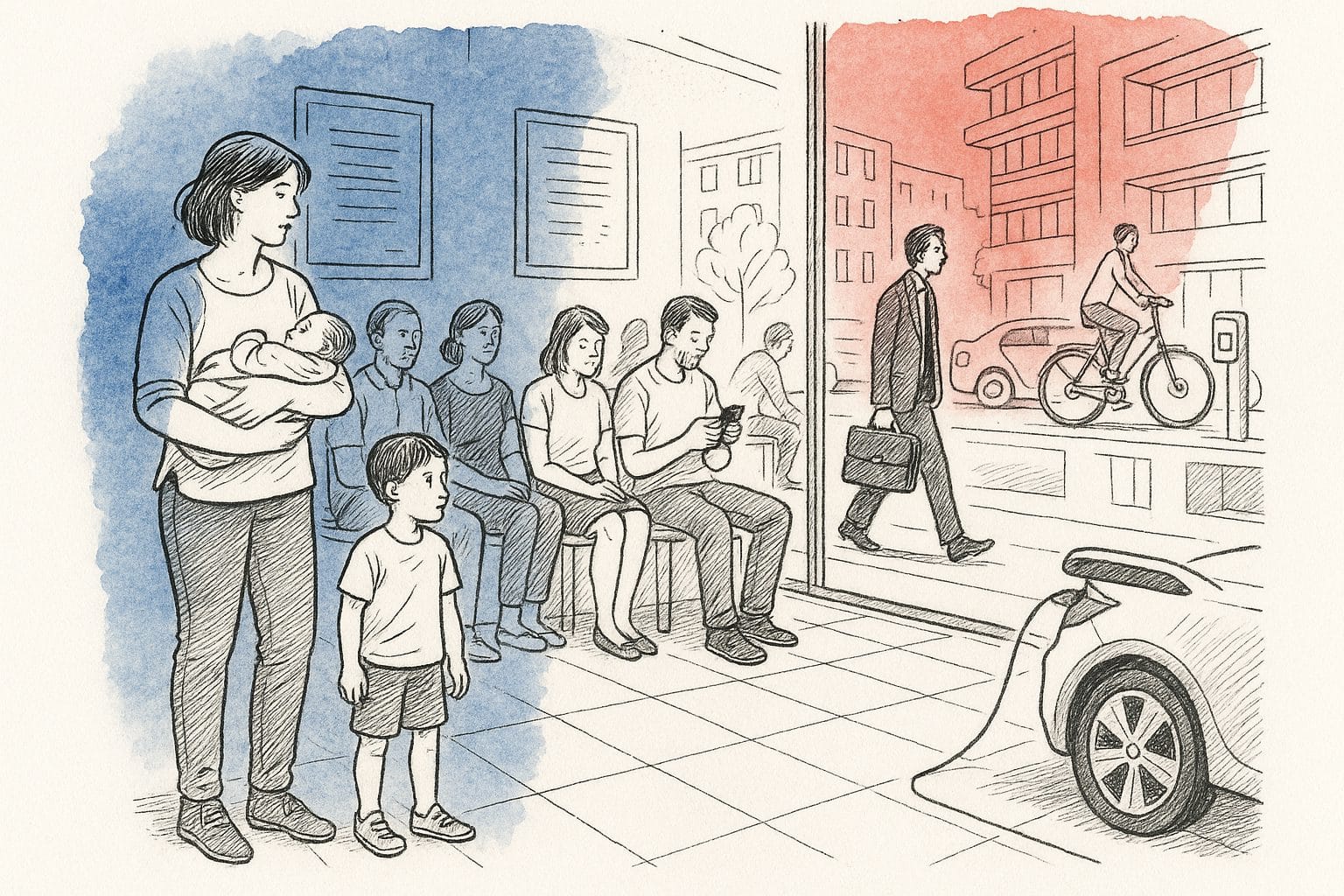
Singapore has a long-term care insurance system, but CareShield Life provides a flat monthly benefit that alone does not cover the full cost of dependency care. The article published in 2025 in Frontiers in Public Health concerns Nanning, China, not the coverage rate of CareShield Life in Singapore. A faster increase in care needs than in the contributor base puts pressure on a system; it may require adjustments to contributions, benefits, reserves, and public financing. Asia, which concentrates the world’s fastest demographic aging, will need to find other solutions. And Europe, which was thought to be better equipped, discovers it faces the same structural impasses.
The Essentials
- Singapore’s long-term care insurance, the most advanced in Asia, covers only 13% of actual costs for elderly men and 26% for women (Frontiers in Public Health, 2025); in Nanning, a medium-sized city in southern China, the population aged 65 and over will increase from 10.66% to 17.5% between 2020 and 2035, a rise of 84% in fifteen years, according to the same study.
- In Europe, the number of people needing long-term care in the EU is expected to rise from 30.8 million in 2019 to 38.1 million in 2050 (European Commission, 2026), while public spending stagnates at an average of 1.7% of GDP.
- The blocking mechanism is structural: when the duration and frequency of care needs increase faster than the number of active contributors, the equilibrium premium becomes socially unbearable before becoming actuarially viable.
- Two trajectories are emerging: a mixed financing model combining mandatory insurance, individual savings, and public investment in prevention, or a silent shift toward family responsibility, with women as the primary absorbers of costs.
- Key signals to monitor are the speed of adoption of home assistance technologies, the evolution of contributor-to-dependent ratios in China’s first pilot cities, and the budget trade-offs made by Singapore and major EU member states by 2030.
Singapore, Best Student in a Struggling Class
Singapore did almost everything right. CareShield Life automatically covers citizens and permanent residents born in 1980 or later from October 1, 2020, or from their 30th birthday, whichever is later; older cohorts are largely subject to voluntary enrollment. Premiums are progressive. The system distinguishes levels of dependency. Governance is public but mechanisms are insurance-based.
On paper, this is what social protection experts have recommended for thirty years.
According to a 2020 study on ElderShield, the limited-duration scheme covered approximately 13% of care costs; removing the duration limit would have raised this proportion to approximately 23% for elderly men and 26% for elderly women. This study does not directly measure CareShield Life.
Some social long-term care schemes rely partially on pay-as-you-go financing; CareShield Life is a pre-financed and actuarially adjusted premium-based system. Stable demographic flows facilitate management of pay-as-you-go schemes, but do not constitute an absolute condition for viability. Projections indicate strong demographic pressure on social protection systems in many Asian countries, without establishing a general and mechanical collapse.
The Arithmetic That Makes the Problem Unsolvable by Insurance Parameters Alone
Nanning is a medium-sized city in Guangxi province in southern China, with a developing economy and a modest tax base. Its population aged 65 and over would increase from 10.66% to 17.5% between 2020 and 2035, a rise of 6.84 percentage points, or approximately 64%, while its absolute number would increase by approximately 84%. This pace shows that aging affects ordinary territories, without those territories having the budget margins of large metropolitan areas.
China launched its first long-term care insurance pilot programs in 2016, then expanded the program to 49 pilot cities or zones in 2020; 49 pilot cities were active and recorded in 2021. Chinese social insurance pilots present contributory features but fall within a hybrid and territorial architecture; they are administered according to local arrangements, with a distinct fund and possible management delegation. On paper, rollout is rapid. In fact, the structural limitations of this model in China have already been documented: unequal coverage across cities, varying capacity for financing and benefit levels by territory, and persistent dependence on unpaid family caregivers.
What makes the Singapore situation particularly instructive is that it represents the glass ceiling of a purely insurance-based approach. Singapore is wealthy, disciplined in budgeting, with high administrative capacity and a deeply embedded culture of mandatory savings through the Central Provident Fund. Long-term care insurance must generally be integrated into a broader set of public financing, services, and support for caregivers.
The reason lies in the mechanics of long-term risk. Severe dependency is not a short-term risk like hospitalization. It can last a long time. It requires daily care, often at home, often non-medical but time-consuming. Extended care significantly increases the cost of contributory schemes and may require higher premiums, limited benefits, or complementary public financing.
Europe Facing the Same Wall, with a Generation’s Head Start
Europe long looked at Asian aging as a distant warning. The mirror is beginning to turn around.
Population aging in the EU is exerting increasing pressure on social protection systems, driving up demand for long-term care and revealing gaps in existing schemes. The number of people needing long-term care in the EU is expected to rise from 30.8 million in 2019 to 38.1 million in 2050. In 2022, average public spending on long-term care in the EU was 1.7% of GDP, with considerable gaps between member states, both in funding levels and in the balance between residential services, home care, and cash benefits.
These figures mask a darker reality. Despite the growing importance of the issue, long-term care policies and service frameworks remain less developed than other areas of social protection, such as health and pensions. In many countries, the supply of formal care remains limited, and the boundaries between health care, social assistance, and long-term care are often blurred, weakening social protection and straining public financing.
Demand for care already exceeds supply in many EU countries, creating a “care gap.” This gap is expected to widen, threatening the quality of life of the elderly, aggravating gender inequalities, and imposing significant economic costs. Root causes include demographic changes, insufficient public investment, workforce shortages, and heavy reliance on informal care.
National responses vary considerably. Germany illustrates both the path and its pitfalls. Its mandatory long-term care insurance — the Pflegeversicherung — has existed since 1995 and constitutes Europe’s oldest and most formalized system. Germany has significantly expanded the range of conditions covered by formal care, including recognition of psychological and mental disorders, which led to a 20% increase in the number of beneficiaries between 2016 and 2017. But this expansion has a cost. German social long-term care insurance ended the first three quarters of 2025 with a deficit of 550 million euros, covered by a federal loan. Structural reform of the system is now on the German political agenda for 2026, with painful trade-offs on deductibles, benefit levels, and the share of tax financing.
Slovenia attempted a different path. It launched a mandatory long-term care insurance scheme in 2023 with a new needs assessment tool, designed using eight criteria similar to those used in Germany. It is a step, but it also illustrates the difficulty of building robust systems from a restricted tax base.
France, for its part, remains in characteristic middle ground. In 2023, 2.6 million elderly people were in a situation of dependency; they will number 3.5 million by 2040, and more than one million of them will need enhanced support due to heavy dependency. The annual cost of dependency is approximately 30 billion euros — or 1.4% of GDP — and public spending could double by 2060 without deep reform. Yet the Grand Âge Plan, postponed indefinitely in early 2026, was supposed to launch structured debate on the future allocation of costs: national solidarity, intergenerational contributions, individual share, role of private insurance. Without arbitration, the risk of chronic underfunding persists.
This is not a French exception. It is the European rule. Aging democracies share the same difficulty in making explicit the redistributive choices that urgency nevertheless renders inevitable.
The Silent Burden Borne by Families, and by Women
Incomplete coverage leaves a major role for informal family care; women are more heavily represented, but the direct causality between non-coverage and increased female burden must be substantiated by specific study. The sociology of caregivers is documented across the region: in Japan, South Korea, China, and Singapore, women provide a significant share of informal care time.
This reality is not unique to Asia. In Europe too, many elderly people remain highly dependent on informal caregivers, whose personal, financial, and health burden is often absent from policy mechanisms and statistics and monitoring. Rising female labor force participation reduces their availability for informal care. Geographic distance between children and parents further complicates informal help. And the rise of blended families plays a role, with stepchildren being less likely to provide informal care than biological children.
This transfer of costs to families has direct economic effects. A woman who reduces her professional activity to care for a dependent parent loses years of contributions, reduces her own future pension, and exposes herself to financial vulnerability that will manifest in twenty or thirty years. The cost of dependency thus multiplies, producing chains of dependency.
The demographic question and the gender question converge on this point. Aging and care needs can weigh disproportionately on women, particularly through informal care and its consequences for employment and income. Care policies that ignore this dimension may underestimate their social cost.
The question of care work also joins that of robotization: home assistance technologies, exoskeletons, companion robots, monitoring systems, have long promised to relieve part of this burden. The reality of industrial deployment of these technologies remains dependent on institutional and economic ecosystems that Asia is building at highly variable speeds across countries — and that Europe, despite its industrial ambitions, struggles to deploy at large scale in the care sector.
The 2035 Horizon and Its Currently Unanswered Questions
The observation horizon lies in the coming decades. Between 2030 and 2040, cohorts born in the 1950s and 1960s will be approximately 70 to 90 years old. This timeline is identical on both sides of Eurasia.
In the study scenario for Nanning in 2035, the projected ratio is approximately 156 contributors for one severely dependent person. A low ratio of contributors to beneficiaries exerts extreme pressure on schemes, but its viability depends on their financial design and public support.
In France, the 2030s will see the fastest increase — baby boomers reaching 85 — with more than 50,000 new dependent people each year and the dependency rate among seniors rising from 14% in 2025 to 18% in 2035. The parallel with Nanning is not incidental: wealthy countries and middle-income countries are converging on the same shock, at very different resource levels.
Three trajectories are emerging, none of which is sufficient alone.
The first is mixed financing. Mandatory insurance covers a fraction of the cost, say, the risk of severe dependency from a defined threshold, while individual savings (via dedicated accounts, like Singapore’s CPF) finance the rest. The State intervenes as a last resort for households without reserves. This model distributes risk across multiple bases: wages, savings, general taxation. It is politically complex to steer because it requires explicit intergenerational trade-offs.
Mixed financing is a frequent and often robust option, but long-term care systems can also rest primarily on taxation or social insurance.
The second trajectory is prevention of dependency itself. Aging in better health reduces the duration of the period of severe dependency, even if it does not eliminate it. Investments in public health, nutrition, physical activity, early detection of chronic diseases, have documented returns on this horizon. Japan has made preventive gerontology explicit state policy since the 2000s, with measurable results on home-based care. South Korea has committed to a similar direction. In Europe, providing earlier access to formal care to a larger number of people suffering from an expanded range of conditions can also serve as a preventive measure, reducing future demand for care as these people age.
Some prevention and autonomy maintenance measures can be cost-effective and delay recourse to institutional or intensive care, without necessarily being less costly in all cases.
The third trajectory is technological. Robotic assistants, home monitoring sensors, and AI-powered care coordination platforms can reduce the unit cost of care. Singapore and Japan are both investing in this area.
Technology can lower the cost of an hour of care, but it does not finance all the hours necessary over ten years. Its large-scale deployment in middle-income countries like China or India remains highly uncertain. In Europe, the challenge is different but symmetrical: technologies exist, purchasing power is there, but care systems — often fragmented between the State, local governments, and supplementary insurance — struggle to make it a systemic lever.
The Bets Countries Are Making, and Their Different Approaches
The contrast between Singapore and China owes less to a difference in means than to a difference in betting on the timeline for reform.
Singapore chose early, built rigorously, and today discovers the structural limits of its choice. The advantage is real: the system exists, data are available, adjustments can be parametric. CareShield Life has already been modified since its launch: benefits have been revalued, subsidies for low-income households increased. It is a system that can learn, because it is formalized.
China is making a different bet: deploy quickly and widely, accept considerable heterogeneity between pilot cities, and let adjustments happen in practice. This choice has the advantage of speed and the disadvantage of fragmentation. The 49 pilot cities operate under different rules, with highly variable benefit levels and financing arrangements that notably account for financial capacity and local development level. Nanning is aging, but 2020 census data show a level and progression of aging below the Guangxi average and the national progression between 2010 and 2020. The Nanning pilot is deliberately limited to eligible insurees and severely dependent persons; its future adequacy must be evaluated against these objectives, dependency rates, and available resources, not against the total number of elderly people alone.
Europe, for its part, is playing a third score. It has formal systems, often old and legitimate, but structurally underfunded in the face of demographic acceleration. Germany, pioneer with its thirty-year-old Pflegeversicherung, finds itself needing to negotiate its overhaul in a context of budget constraint. France accumulates reports and postpones trade-offs. According to Eurostat projections, the share of people aged 65 and over will rise from 21.3% in 2023 to 32.5% in 2100. With this rapid aging of the population, all European countries face a major challenge: ensuring dignified and sustainable care for dependency linked to advanced age. The population over 80 — often associated with loss of independence — is expected to double, rising from 6% to more than 12% by 2050.
India, Indonesia, and Vietnam are experiencing a sharp increase in their elderly population in the coming decades, but the timeline and speed of aging differ significantly across countries; Vietnam and Indonesia are already facing marked acceleration around or before the 2040s. They have time to choose a model. The administrative capacities of India, Indonesia, and Vietnam must be evaluated on a country-by-country basis; China’s development of long-term care insurance happened gradually, from 2016 pilots to national launch in 2026.
What Financing Remains Viable When Dependency Expands Faster Than Income
The issue posed by this data is political as much as technical.
Large-scale long-term care requires explicit social agreement on who pays what. Mandatory insurance says: the working pay for the dependent now, because they will in turn be financed by future workers. Individual savings says: everyone prepares for themselves, the State intervening only in case of insufficiency. General taxation says: intergenerational solidarity is a collective burden, not just a wage-based one.
These three logics do not exclude each other, but they imply very different redistributive choices. Asian societies, which have long externalized care toward the family, and toward women in particular, will have to make this debate explicit. European societies, which believed they could settle it once and for all in the 1990s, discover that the compromise of then is no longer sustainable by the 2035-2050 horizon. Accelerated aging leaves no latitude to continue avoiding the question.
The precise signals to monitor in the coming years are: the speed at which China’s first pilot cities publish their financial statements and make them comparable; the decisions Singapore makes by 2028 on revaluation or overhaul of CareShield Life; the structural reform of German Pflegeversicherung in 2026 and the budget trade-offs France can no longer indefinitely postpone beyond 2030. On these fronts, demographics act as a revealer of political choices that societies have avoided making as long as time allowed. Asia and Europe now share the same timeline.
Available data on CareShield Life can illuminate system adjustments. This clear diagnosis is the condition for any useful adjustment. A system with data on its benefits and costs can decide on its adjustments.
Sources
- Frontiers in Public Health (2025), Long-term care insurance and demographic aging in Asia: https://www.frontiersin.org/journals/public-health/articles/10.3389/fpubh.2025.1454037/full
- Asian Development Bank, Long-Term Care in Asia and the Pacific (thematic report, no guaranteed stable URL)
- United Nations, World Population Prospects 2024: https://population.un.org/wpp/
- Singapore Ministry of Health, CareShield Life: https://www.careshieldlife.gov.sg
- European Commission, Long-term care settings for older people in Europe: a comparative overview (March 2026): https://employment-social-affairs.ec.europa.eu/news/long-term-care-settings-older-people-europe-comparative-overview-2026-03-17_en
- Bruegel, Prepare now: Europe must get ready for the coming long-term care surge (Policy Brief 02/2025): https://www.bruegel.org/policy-brief/prepare-now-europe-must-get-ready-coming-long-term-care-surge
- Institut Santé, Loss of autonomy: the urgency of systemic reform: https://www.institut-sante.org/perte-dautonomie-lurgence-dune-reforme-systemique/