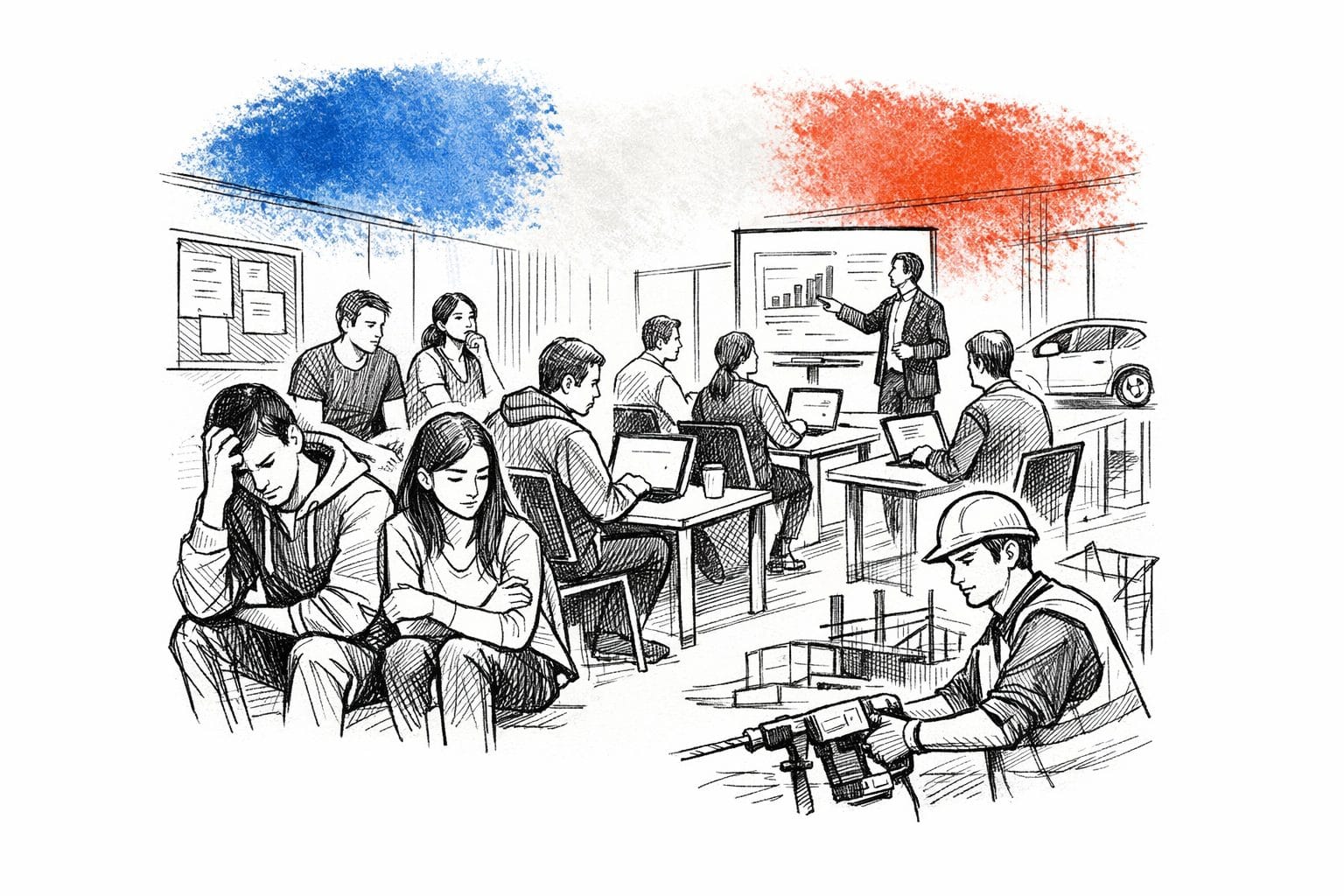
Between 2018 and 2022, robots created 2 million skilled jobs in five Southeast Asian countries and displaced 1.4 million unskilled workers. The net balance is positive. But this comfortable arithmetic conceals a widening fracture: the winners and losers are not the same people. For industrial robots, the estimate extrapolated to five ASEAN countries indicates opposite effects according to qualification level, based on empirical analysis conducted in Vietnam, without demonstrating a general rule across all automation.
The Essentials
- In ASEAN, automation created more jobs than it destroyed between 2018 and 2022: +2 million skilled positions for -1.4 million unskilled positions (World Bank Future Jobs Report).
- This positive net balance conceals a structural inequality: the jobs created require skills that displaced workers do not possess.
- Economist Carl Benedikt Frey argues that institutions and their capacity for adaptation determine the distribution of technological gains.
- The World Bank identifies needs for strengthening skills policies and social protection, which vary by country, conditioning the distribution of macroeconomic gains.
- The financing question remains open: who bears the cost of transitioning the 1.4 million displaced workers, and on what timeline.
The Positive Net Balance That Doesn’t Tell the Whole Story
The figures are clear about what they measure. In five Southeast Asian economies—Vietnam, Thailand, Indonesia, Philippines, Malaysia—robot density increased significantly between 2018 and 2022, according to World Bank estimates based notably on robot data from the International Federation of Robotics. Between 2018 and 2022, the World Bank estimates approximately 2.04 million formal jobs created for workers with tertiary education, representing 4.3% of qualified formal employment. Approximately 1.4 million formal workers with low qualifications performing routine manual tasks were displaced, with some likely shifting to informal employment.
The balance is therefore positive: 600,000 more jobs, in net terms. This is the figure that automation advocates readily advance. And they are right about the accounting. Where the argument collapses is when one asks who obtained these 2 million new positions. The answer is: workers who already had qualifications.
Data suggests that displaced low-skilled workers, particularly in Vietnam, move toward the informal sector; it does not demonstrate the individual trajectory of all 1.4 million people. They have shifted toward informal employment, underemployment, or inactivity.
This asymmetry is not a statistical detail. It is the political heart of the problem. An economy can create jobs in net terms and simultaneously worsen inequality, as long as the jobs created and jobs destroyed do not address the same populations.
ASEAN as an Observatory of This Mechanism
Southeast Asia is a particularly revealing laboratory for this phenomenon, for two structural reasons.
The first is the speed of adoption. China is flooding Southeast Asia with cut-price robots, which has sharply lowered the entry cost for automation among SMEs in the region. Sectors such as textiles, electronics assembly, and agro-industry, which employed large numbers of low-skilled workers, experienced accelerated automation adoption. Vietnam and Thailand rank among Southeast Asian countries that increased their robot density between 2018 and 2023, according to the IFR.
The second reason is the starting employment structure. In these economies, a significant portion of the workforce occupied repetitive, physical positions with low cognitive content: precisely the positions that robots replace most efficiently. It is exactly here that the transition is most abrupt, because the jump between an unskilled assembly position and a position supervising an automated line is enormous, in terms of required training, learning time, and transition cost.
This configuration creates a dynamic where low-skilled positions decline while high-level positions develop. Robotization blocks median wages and concentrates gains at the top, a mechanism documented in the West that is now reproducing with accelerated speed in ASEAN, in social protection systems that are often less robust.
Technology Does Not Decide Alone: What Industrial History Teaches
In How Progress Ends, Carl Benedikt Frey shows that technological waves do not automatically produce shared progress: institutions determine who captures the gains. Industrial history is replete with innovations that enriched a few for decades before diffusing their benefits, when they did diffuse them. The steam engine took a century to improve the living standards of British workers. Electricity took forty years to cross the border between large factories and medium-sized workshops.
The mechanism, according to Frey, is always the same: dominant firms and monopolies control the diffusion of technology and concentrate gains. Inequality can intensify in the absence of redistribution policy.
Applied to ASEAN, this framework is illuminating. World Bank data confirm that net employment growth is real. But they do not document systematic and continuous reskilling systems. Robotic adoption produces documented productivity gains. Governments in the region perceive variable tax revenues, but mechanisms to support displaced workers exist in some countries with unequal coverage and adequacy.
This institutional reading enters into tension with a more optimistic position, carried notably by economists of Schumpeterian growth, of whom Philippe Aghion, winner of the 2025 Nobel Prize in Economics, is the most rigorous representative. For Aghion, creative destruction generates efficiency gains that, via growth, ultimately benefit the entire economy: the problem is one of speed and support, not structure. Polarization would be transitory, and countries that maintain competition and openness, rather than protecting threatened jobs, will fare better in the long term.
World Bank estimates show aggregate gains unevenly distributed in ASEAN-5: the transition involves costs and calls for strengthened skills policies, mobility, taxation, and social protection. The medium-term trajectory of displaced workers remains uncertain: their integration into a more productive and more inclusive economy depends on current and future political decisions.
Concrete Trajectories of Displaced Workers
Aggregate data conceal very different individual trajectories across countries and sectors. In Thailand, some displaced textile workers have shifted toward the informal economy or precarious forms of employment, with limited reintegration into comparable formal employment.
In Vietnam, job creation in certain other sectors has accompanied automation, according to available sectoral data. Industrial free zones have opened simultaneously with the automation of existing lines, offering opportunities to those able to relocate geographically. But this geographical displacement itself carries a cost: separated families, loss of community networks, residential precariousness.
In Indonesia, digital platforms have expanded certain employment opportunities, particularly as delivery and online sellers, without established proof that they have absorbed workers displaced by automation. This form of employment is often insufficiently covered by insurance and pensions, but the source does not demonstrate the absence of all prospect for progression. AI Blocks IT Outsourcing Markets shows an analogous mechanism at the scale of qualified white-collar workers: technology displaces toward more fragmented forms of employment, even when it creates jobs in net terms.
These divergent trajectories show that the same technological shock produces very different results depending on local economic structure, labor mobility, and the existence of protection mechanisms. Political and institutional choices, not technology alone, determine these outcomes.
Corporate Gains and Their Limited Redistribution
Companies automating in the region document substantial productivity gains. Thai automakers like Aapico Hitech have published internal reports, taken up by sectoral associations, indicating efficiency gains of 15 to 25% on automated lines. Electronics manufacturers in Vietnam working for Samsung and Intel supply chains have significantly reduced their unit costs, which strengthened their competitiveness against less automated competitors.
A portion of productivity gains is captured by shareholders and executives, while mechanisms for worker participation in gains remain limited. Collective agreements are weak in most ASEAN countries, union rights are limited—particularly in Vietnam and Thailand—and mechanisms for worker participation in productivity gains remain limited and poorly structured at the economy-wide level. The fiscal policies of the region’s states direct only partial shares of productivity gains toward retraining programs.
This is precisely the configuration that Frey identifies as the most dangerous: a technological wave that benefits enterprises and already-qualified workers, without mechanisms for diffusion to those bearing the cost of transition. In the short term, macroeconomic growth can mask this fracture. In the medium term, it produces political tensions, rising populism, distrust of economic elites, demands for protectionism, which ultimately threaten the momentum of progress itself.
By 2030, Who Finances the 1.4 Million Displaced?
The financing question is the most concrete, and the least resolved. By 2030-2035, the five ASEAN economies in question will continue to automate. The IFR projects strong increases in robot density in Southeast Asia over the next ten years, driven by falling costs of collaborative robots and by competitive pressure. The flow of displaced workers will not dry up.
Two trajectories are emerging. In the first, regional governments act proactively: they finance large-scale reskilling programs, impose employer contributions linked to automation, and develop effective unemployment insurance systems. Malaysia has sketched this path with its Human Resources Development Fund, which levies 1% of payroll to finance continuous training, but coverage remains partial and informal workers are excluded from it. If this model scales up and extends to other countries in the region, the transition could be managed without lasting fracture.
In the second trajectory, states remain on the sidelines, convinced that overall economic growth will absorb the shock through spontaneous job creation. This position is defensible as long as growth remains sustained—Vietnam proved this between 2018 and 2022. It becomes risky if growth slows, if automation accelerates faster than job creation in expanding sectors, or if the jobs created require qualification levels beyond the reach of displaced workers without massive investment in education.
The signal to watch is the share of formally displaced workers who regain formal employment. Available data, with unequal coverage, show partial and variable reintegration across countries.
The real constraint is fiscal. Large-scale reskilling programs are expensive. In economies where government revenues represent between 12 and 18% of GDP, versus 40 to 50% in Europe—budgetary space is limited. The contribution of enterprises that automate and capture productivity gains is the most economically coherent avenue: those who benefit from technological progress participate in financing its diffusion. But it presumes a political balance of power that displaced workers, poorly organized and often informal, struggle to constitute.
Technology created 2 million jobs. It displaced 1.4 million. The positive balance will transform into shared progress only if institutions make it possible. This condition requires strengthening public policies in the region. It could be achieved by 2030, if governments choose to build it.
Sources
- International Federation of Robotics, IFR World Robotics Report: https://www.therobotreport.com/ifr-reports-robot-density-increase-across-europe-asia-americas/
- Carl Benedikt Frey, How Progress Ends: https://www.carl-benedikt-frey.com
- World Bank Future Jobs Report, ASEAN data 2018-2022 (World Bank, Future of Work report)
- International Federation of Robotics, robot density data by country, 2025 edition