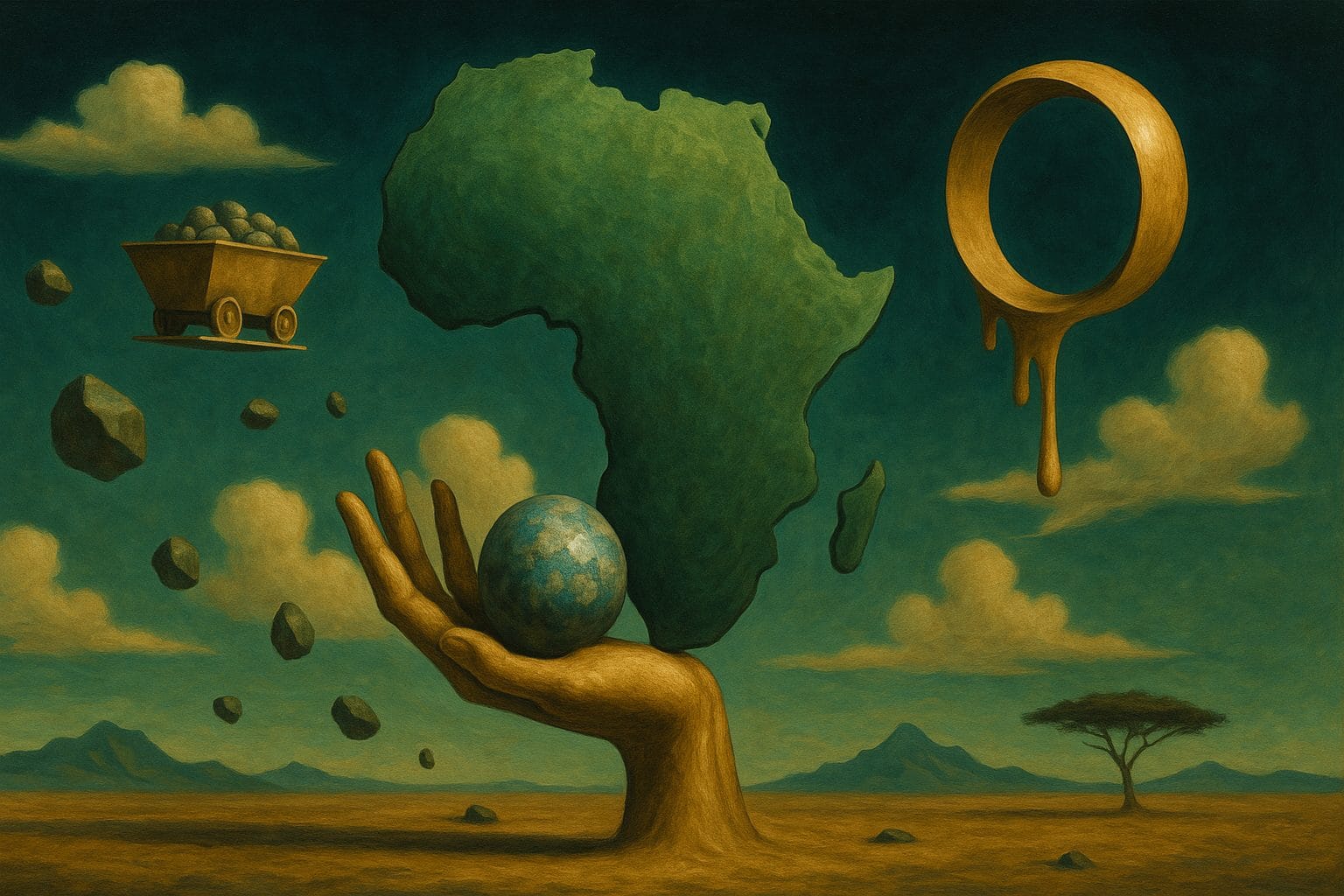
The Democratic Republic of Congo produces 70% of the world’s cobalt and exports mostly minimally processed cobalt, generally after an initial treatment stage. The global energy transition has been built on African minerals, but value creation happens elsewhere. With China handling roughly 60 to 70% of global lithium and cobalt refining according to the IEA, Africa is replaying the oil scenario in reverse: this time, it doesn’t even have cartel prices. The absence of local processing leads to a significant loss of added value for the continent.
The essentials
- The DRC supplies 70% of global cobalt and Zimbabwe exports 100% of its lithium to China, without significant local processing.
- China handled roughly 60 to 70% of global lithium and cobalt refining according to the IEA, giving it major leverage over the battery value chain.
- The absence of local processing leads to a significant loss of added value for the African continent.
- Two blocs are competing to capture this chain: China through direct mining investments, the United States and Japan through the Lobito and Nacala corridors, with local processing conditions.
- Three trajectories are possible by 2035: extractive status quo, raw export ban on the Indonesian model, or structuring corridors—each depends on political choices that Africa is beginning to take into its own hands.
The value chain that subsoil alone cannot control
Owning a resource and controlling it are two different things. The DRC has learned this the hard way over the past twenty years.
Its cobalt feeds the batteries of electric cars made by Tesla, BMW and BYD. But the ore leaves Kolwezi as a concentrate, crosses the ocean, and it is in the refineries of Zhejiang or Shandong that it becomes the cobalt sulfate that battery makers buy at premium prices. S&P Global highlights the difficulties of local value creation, but does not quantify in this publication a specific annual loss for Kinshasa.
The mechanism is precise. Refining cobalt requires substantial capital investment, sophisticated metallurgical expertise and guaranteed industrial outlets. China built these three conditions over thirty years of patient investment: it handled roughly 75% of global cobalt refining in 2023. Africa has still-limited processing capacity and insufficient large-scale infrastructure to absorb this step in the chain, although the DRC and Zambia possess a solid resource base to develop processed materials. Extraction therefore remains African; value remains Chinese.
For Zimbabwean lithium, the situation is even starker. All exports go to China. Harare banned raw lithium ore exports in December 2022, then eased the ban under investor pressure, and the concrete result remains marginal: the few treatment units that opened are mostly held by Chinese operators, who repatriate added value to their own supply chains.
The same chokepoint as semiconductors
In his analysis of semiconductors published in 2026 in the Revue Défense Nationale, Mathieu Duchâtel describes a mechanism that critical minerals reproduce: China derives its advantage not from raw resources, but from control of the transformation step that is hardest to replicate. In semiconductors, this advantage rests on mastery of advanced etching equipment. In cobalt and lithium, it rests on large-scale refining capacity.
This mechanism says something important about the nature of power in global industrial chains. Controlling a deposit gives a negotiating advantage, but a limited one, especially when the extracted ore is a commodity that multiple countries produce. The DRC is dominant in cobalt, but Australia, the Philippines and Russia also produce it. The real chokepoint, as with electronic chips, is downstream: where raw material becomes the component that final industry cannot do without buying.
Europe is discovering this dependency with a time lag. It built its electric vehicle policy—internal combustion engine ban in 2035—without securing its battery supply chain. Today, German, French and Swedish automakers depend on Korean or Chinese cells, themselves fed by cobalt and lithium refined in China. Europe regulates a digital market it did not build, and it finds itself in an analogous position with critical minerals: dependent on industrial infrastructure it has not developed.
A competing reading nevertheless deserves serious attention. Institutionalist economists, close to Dani Rodrik’s thinking on industrial policy, stress that the “Chinese refining model” was not built on coercion, but on decades of state subsidies, forced technology transfer and captive domestic markets. Replicating this model in Africa is possible—Indonesia did it with nickel—but requires state capacity and regional coordination that most African mining states do not yet have. The chokepoint analysis is correct; it does not alone say how to unlock them.
Indonesia as precedent and its lessons for Africa
In 2020, Indonesia banned the export of raw nickel ore. Western investors protested, the European Union filed a complaint with the World Trade Organization. Jakarta held firm. Four years later, the country has a booming local processing sector, massive Chinese investments shifted toward refineries built on Indonesian soil, and tax revenue from processed nickel rose substantially.
The model is not perfect. A significant share of new plants is owned or operated by Chinese companies: value is partially captured. Industrial pollution in some processing zones is documented and serious. And Indonesia benefited from a more developed domestic market and more solid administration than the DRC. But the principle worked: forcing local processing changes the incentives of foreign investors.
Zimbabwe tried a version of this bet with its 2023 ban. It partially failed because it was not accompanied by preexisting local treatment capacity or financing alternatives to China. A country that bans raw exports without the refineries to absorb production simply ends up selling less, and cheaper. The sequence matters as much as the decision.
The DRC presents an even more complex case. Its electrical infrastructure is insufficient to power large-scale refineries; cobalt refining is energy-intensive. Its transport network is among the least developed on the continent. And mining sector governance, despite reforms undertaken since 2018, remains fragile. Banning cobalt raw exports tomorrow without addressing these structural constraints would not produce the Indonesian miracle.
Two corridors, competition over the value chain
Growing geopolitical competition has developed around African critical minerals. It plays out primarily on two railway corridors.
The Lobito corridor crosses the DRC and Zambia to reach the Angolan port of Lobito on the Atlantic. The United States has announced major funding under the Partnership for Global Infrastructure. The corridor is presented as supporting critical raw material value chains and local jobs, without published conditionality imposing local processing.
The Nacala corridor, to the east, links Malawi and Zambia to the Mozambican port of Nacala on the Indian Ocean. Chinese financing has been present there longer, through the China Development Bank and state enterprises. Beijing’s logic is different: invest in infrastructure to secure mineral access, not to organize local processing.
These two corridors are not merely logistical projects. They embody two visions of what Africa should be in the global value chain: improved raw materials supplier for one, emerging industrial partner for the other. Competition between these two visions is playing out now, and its results will be durable.
Africa’s room for maneuver by 2035
According to IISD, three trends—supply security, cost parity of clean energy and more equitable partnerships—are reconfiguring options for mineral-rich countries.
The first is the status quo. Without structural change, African refining would remain marginal in global chains, dependence on China would intensify, and local value capture would stay limited. This scenario is likely if African mining states remain competing with each other to attract foreign investors at any price.
The second possibility is export bans, an instrument used by some countries to promote local processing, though this approach is not presented by sources as the second in a set of coherent African trajectories. It requires regional coordination that the African Union has not yet achieved in the mining sector, but that several states are beginning to demand. If the DRC, Zambia and Zimbabwe align their export policies, their combined control of cobalt and lithium could strengthen their position in negotiations with international investors. The condition is that this coordination be accompanied by public investment in processing capacity and access to financing alternative to China.
The third trajectory is that of corridors with effective conditionality. If the Lobito corridor delivers on its promises of local processing—and it is a big if, because infrastructure conditionality has often been diluted in final negotiations—it could create a replicable precedent. Refineries financed by American, European or Japanese capital, built in the DRC or Zambia, directly feeding battery plants of Volkswagen or Panasonic: this scheme is technically and financially possible. It is less so politically, because it requires sustained will from buying countries to pay a premium for locally processed minerals rather than buy cheaper from China.
This last point is the crux of the problem. European and American automakers are pushing for diversified supply chains, but Chinese batteries enjoy a significant cost advantage, and purchases depend on other factors too. Public money sometimes feeds the dependency it claims to combat: European electric vehicle subsidies were not conditioned on mineral origin, which indirectly funded Chinese refining dominance.
Several indicators will allow evaluation of developments by 2027-2028: the share of African refining in cobalt-lithium chains, the volume of diversified processing investments in the DRC and Zimbabwe, and the price gap between raw and processed exports. If this gap widens, under pressure from battery demand or differentiated tariff policies, it will become financially rational for African mining states to demand local processing, even without perfect coordination.
The possible coordinating role of the African Union
Regional coordination is missing from all favorable scenarios. It has a precedent, imperfect but instructive: OPEC. Oil-producing countries succeeded, from the 1970s on, in coordinating production to influence prices. African mining countries could, over a ten-year horizon, build something analogous for critical minerals: coordination on export prices, investment conditionality and environmental standards, distinct from a cartel proper.
The African Union adopted the Africa Mining Vision in 2009; the African Minerals Governance Framework serves to track its implementation. It largely remains on paper. Transforming it into an operational instrument would require member states to accept sacrificing some of their individual competition for investors, a sacrifice politically costly in the short term, potentially highly profitable medium term.
A few encouraging signs exist. Zambia and the DRC have begun bilateral discussions on a common cobalt value chain. South Africa is developing a platinum and rare earth processing sector that could serve as a model. And negotiations on the Lobito corridor have, according to Africa Center accounts, included local content clauses more substantive than standard mining agreements.
Financing is the other condition. An inter-state African refining fund, fed by current mining revenues and conditional external contributions, would allow sharing the infrastructure costs that each individual state cannot absorb alone. The idea has circulated in African Union circles for several years. It runs up against governance questions: who controls the fund, how are revenues redistributed, and how can powerful states be prevented from capturing benefits at the expense of smaller ones.
These questions are not unsolvable. They are political, not technical. And that is precisely why they can be resolved, if African governments, external partners and multilateral institutions decide that local processing is a real priority rather than a rhetorical objective.
The global energy transition needs African minerals and it will proceed with or without local industrial development. The stakes lie in the institutional choices that Africa and its partners will make in the next five years.
Sources
- S&P Global Market Intelligence, Africa Critical Minerals: Reshaping Global Supply Chains and Geopolitics, August 2026. https://www.spglobal.com/market-intelligence/en/news-insights/research/2026/08/africa-critical-minerals-reshaping-global-supply-chains-geopolitics
- Mathieu Duchâtel, “Semiconductors: The Chinese Marathon,” Revue Défense Nationale, no. 892, July 2026. https://shs.cairn.info/revue-defense-nationale-2026-7-page-46?lang=fr
- International Institute for Sustainable Development (IISD), Critical Minerals and the Energy Transition, 2026 report.
- Africa Center for Strategic Studies, Lobito Corridor and Nacala Corridor analyses, 2025-2026.
- International Monetary Fund, Commodity Market Outlook, 2026 edition.
- Zimbabwe Ministry of Mines, decree banning raw lithium ore exports, 2023, and subsequent revisions.