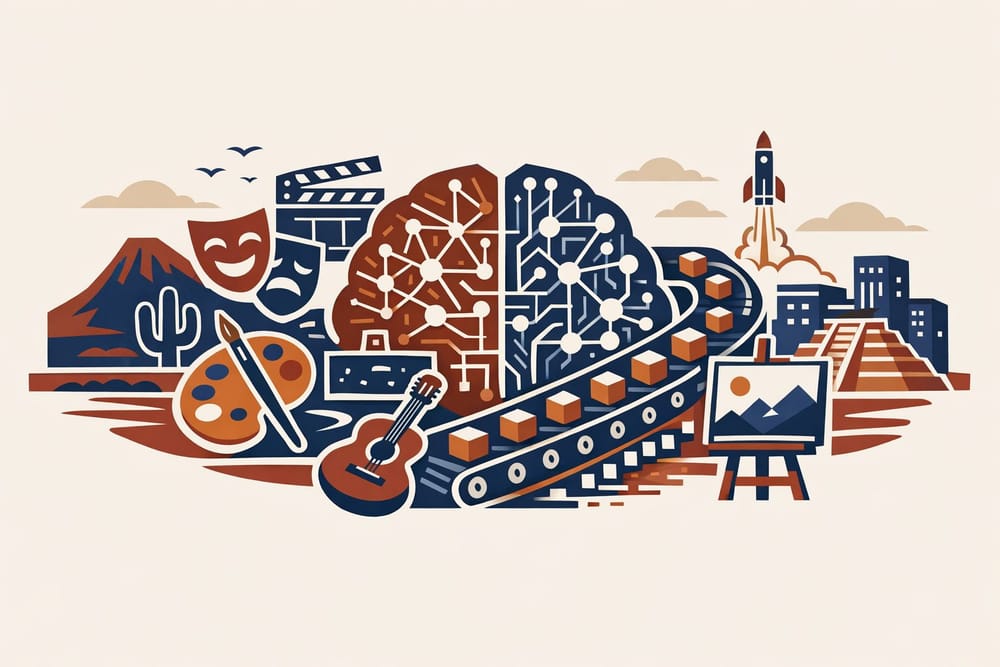
A musician from El Salvador composes a cumbia, publishes it online, and his style potentially ends up in a generative model without his knowledge. On July 31, 2026, UNESCO and the Central American Educational and Cultural Coordination published a regional diagnosis documenting this mechanism for the cultural industries of Central America. A survey conducted by the Alliance of Musical Creators of Latin America among over 1,000 artists documents the impact of this absence: the lack of detailed traceability greatly complicates consent and usage-based compensation, without making them technically impossible in all cases.
The essentials
- Without traceability obligations, some works can enter training models before their authors can negotiate.
- The diagnosis highlights several needs, including technical capacities, training, and governance frameworks protecting rights and intellectual property.
- Surveys of Latin American musical creators document demand for public registries of sources and compensation mechanisms.
- Several regulatory and contractual paths are possible, including transparency, licensing, and opt-out or exception rules.
- Concrete leads exist—auditable public registries, cultural compensation funds—but their adoption depends on regulatory decisions being made now.
The effects of generative models on world music
The asymmetry between local creators and model operators stems partly from the nature of machine learning processes. A work absorbed into a corpus does not contribute to a model’s value in isolation: its contribution is diluted, aggregated, rendered inseparable from millions of other sources. This technical dissolution makes individual claims structurally difficult, even in jurisdictions where copyright is best protected. For musical genres carried by restricted communities, the effect is amplified: their weight in the corpus is marginal, but their stylistic singularity may be precisely what the model captures and delivers on demand, without this extraction being visible or quantifiable to those at its origin.
Generative models learn by ingesting massive corpora of existing works. Texts, images, sounds: everything accessible online constitutes potential raw material. For Latin American music industries, this means that various Latin American musics—cumbia, salsa, vallenato, música norteña—can feed systems capable of reproducing these styles on demand, without knowing whether their creators were systematically consulted or compensated.
All creation draws inspiration from other works. An author generally lacks a universal and reliable mechanism for verifying works piece by piece across all models. Many models do not provide work-by-work transparency on their sources, though some are subject to obligations to document and publicly summarize training data. The absence of traceability makes exercising and controlling the right to withdrawal or opposition much more difficult, without legally eliminating it. It severely limits compensation proportional to works actually used, without making all compensation impossible.
This opacity particularly affects creators in lower and middle-income countries. They lack the legal resources to pursue proceedings, nor the critical mass to weigh in negotiations with major platforms. Platforms already decide formats in place of creators on streaming markets. With generative models, the asymmetry widens further: platforms can now produce content imitating local styles without resorting to local artists.
The UNESCO-CECC/SICA diagnosis
The diagnosis published on July 31, 2026 by UNESCO and the Central American Educational and Cultural Coordination covers eight countries: Guatemala, Belize, Honduras, El Salvador, Nicaragua, Costa Rica, Panama, and the Dominican Republic. It examines how the region’s cultural industries—music, film, visual arts, crafts—are positioning themselves in the face of generative AI adoption.
The finding is precise: adoption is progressing while governance and rights protection frameworks must be strengthened. Creators in the region use AI tools to compose, edit, translate, distribute. Simultaneously, their works can enter the training corpora of these same tools, without their consent being documented systematically. Traceability mechanisms remain incomplete and may not allow work-by-work verification, but the EU’s AI Act already imposes transparency on training content of general-purpose models.
The report shows a structural imbalance: generative model operators are generally based outside the region, subject to different jurisdictions, and have no clear obligations to account to local creators for how their works are used. National copyright legislation in these countries was drawn up before the generalization of large-scale machine learning. It covers mainly direct reproduction. In several jurisdictions in the region, laws do not explicitly address generative training, although some national provisions address data mining or copyright compliance by AI.
Declarations from 1,000 musical creators in 2026
The survey conducted by the Alliance of Musical Creators of Latin America among over 1,000 artists adds a human dimension to the institutional diagnosis. Respondents come from across the region—Mexico, Colombia, Argentina, Central American countries—and cover genres, levels of fame, and very diverse economic models.
The demands expressed by respondents concern transparency and control: access to information about how their works are used, the ability to consent or refuse, and compensation linked to commercial use of their works. These demands concern rights that the legal framework recognizes, but whose exercise is made very difficult by the absence of traceability.
The survey also reveals concern about cultural representation. If generative models learn primarily from corpora dominated by English-language production or by the most-streamed genres, their outputs will tend to reproduce these dominances. Minority musics, oral traditions, regional genres risk being underrepresented in models, or represented through the filter of works already filtered by the recommendation algorithms of major platforms.
Two possible trajectories by 2035
The current situation is not fixed. Two distinct paths open for creators in Latin America and, more broadly, for all cultural industries outside the centers of generative model production.
The first rests on adopting legal traceability obligations, which could preserve creators’ negotiating capacity. If regulators, at national, regional, or international level, impose on generative model operators the requirement to publish a public and auditable registry of their training sources, organizations like ALCAM could exercise their rights concretely. A registry or summary of sources can help identify content or datasets used and establish a basis for collective compensation mechanisms, without automatically establishing the proportion of use of each work. This trajectory is technically practicable: several regulatory proposals in Europe and the United States move in this direction, though none has yet been adopted at this level of precision.
The second path is inaction. Prolonged absence of traceability could widen the share of cultural heritage absorbed into future models. Negotiating capacities could weaken as models accumulate training data. In this scenario, cultural diversity risks becoming a free resource for AI operators: a common good extracted without compensation.
These two scenarios are not symmetric in time. The window for negotiation could narrow. AI expertise concentrated in a few major cities reinforces the same dynamic: decisions about training corpora are made where Latin American creators are not.
What would make the first scenario practicable
Collective management offers an additional path often underestimated. Existing management societies already have infrastructure for identifying works and redistributing rights at scale. Extending their mandate to cover uses in automatic training contexts would not require creating entirely new institutions, but adapting proven mechanisms to a type of use their statutes did not anticipate. This extension would nonetheless require model operators to accept negotiating with these organizations; a declaration of sources can improve collective management tied to training uses, but it is not a prerequisite for any form of collective management.
Two concrete mechanisms would make traceability operational, according to paths identified by the UNESCO-CECC/SICA diagnosis and the ALCAM survey.
A public registry of training sources, auditable by creators’ organizations, would constitute a possible tool. Generative model operators already have information about their corpora; making this information accessible imposes a legal obligation and may also raise technical or documentary difficulties, particularly for already-trained models. The European Union has laid the first groundwork in this direction with its AI regulation, which provides for transparency requirements on training data for general-purpose models. Known requirements address a sufficiently detailed public summary of sources and data collections, without guaranteeing work-by-work verification.
A cultural compensation fund, financed by a levy on generative model revenues and redistributed according to the geographic and linguistic origin of works absorbed, could constitute a second mechanism. This model draws on existing mechanisms in other sectors: neighboring rights in recorded music, collective management societies in publishing. It presents real difficulties, particularly attributing value to each work’s contribution in a corpus of billions of files. These difficulties remain surmountable, but suppose a political will that current negotiations have not yet produced.
The signals to watch are readable: the number of countries adopting legal traceability obligations, and the share of creators reporting having received compensation or formal consent for use of their works. These two indicators remain poorly visible for Central American creators.
Measures regulators can still take
Central America is not alone in this diagnosis. The situation of Latin American musical creators is that of all creators located outside jurisdictions where generative model production concentrates. The stakes are identical for African musics, literatures in minority languages, visual arts from regions underrepresented in English-language corpora.
The UNESCO-CECC/SICA report provides a structured regional diagnosis capable of feeding international negotiations. UNESCO has a mandate on cultural diversity; its 2005 Convention on the Protection and Promotion of the Diversity of Cultural Expressions provides the reference framework. This convention recognizes states’ sovereign rights to support their cultural industries. It was not designed for generative AI, but it can serve as a basis for claims in multilateral forums.
Central American governments can act at several levels. They could adopt national legislation imposing traceability on operators who distribute their models on their territory. They can coordinate their positions in regional and international forums. They can support creators’ organizations like ALCAM in their efforts to document and negotiate. Economic growth concentrated in certain sectors reminds us that the benefits of technological transformations are not distributed spontaneously.
Cultural industries are no exception to this rule.
The calendar of coming years will determine whether generative model operators render their corpora traceable before the negotiating capacity of local creators is structurally weakened.
Sources
- UNESCO and CECC/SICA, Regional Diagnosis on Artificial Intelligence and Cultural Industries, July 2026
- ALCAM, ALCAM 2026 Report: Survey of over 1,000 Latin American musical creators
- UNESCO, Convention on the Protection and Promotion of the Diversity of Cultural Expressions, 2005
- European Union Regulation on Artificial Intelligence (AI Act), provisions on transparency of training data for general-purpose models