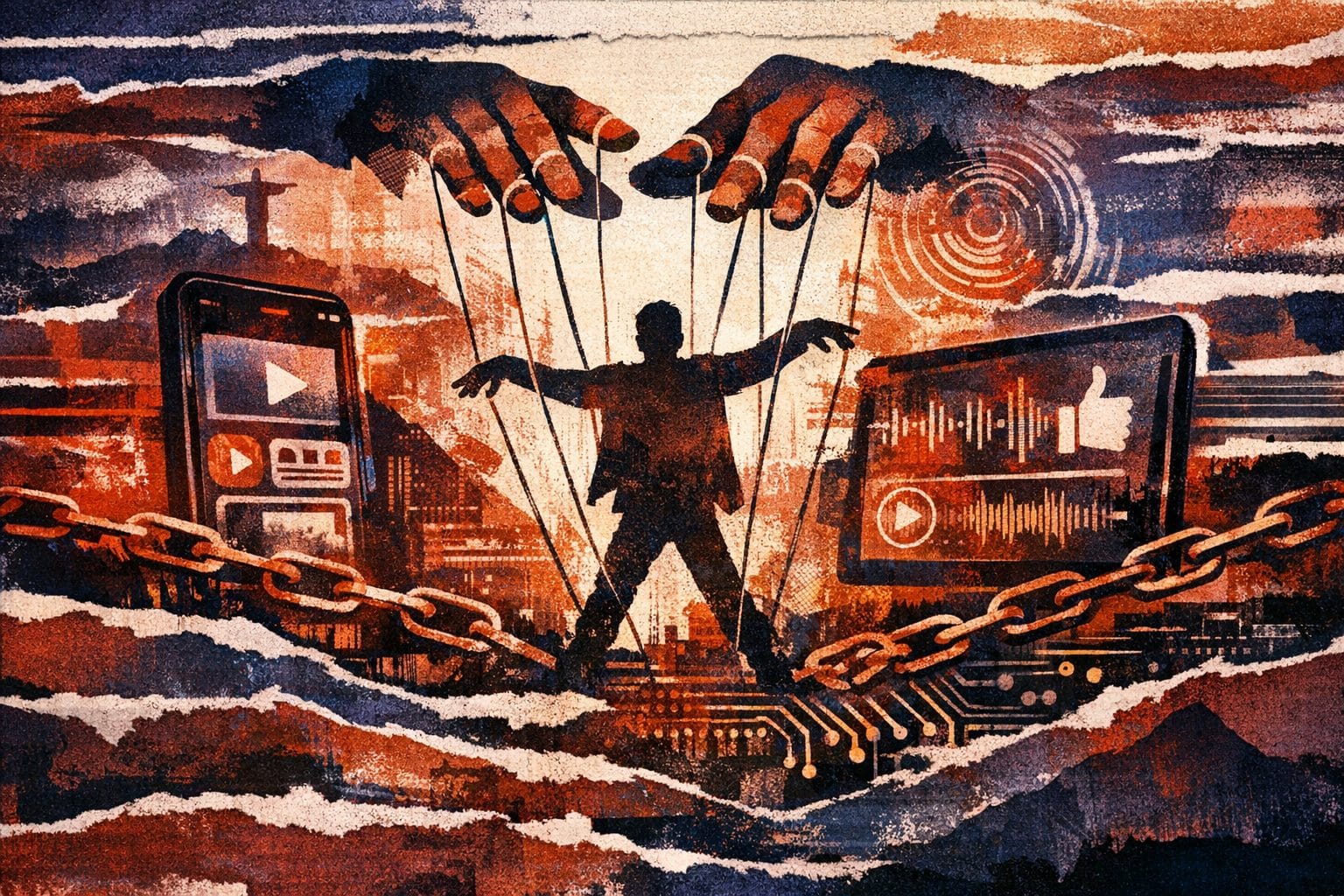
Dunlop argues that conflicts are instrumentalized by political and media systems and energized by market economics. This is the central thesis of Tim Dunlop’s essay published in October 2026, which traces the history of Australian value conflicts from Federation to the era of digital platforms. By treating identity controversies as a market, Dunlop shifts the diagnosis toward the incentives of the actors who profit from them, rather than toward citizens’ opinions.
The essentials
- Dunlop describes real social issues that can be deliberately simplified and instrumentalized by political and media actors.
- The essay traces this mechanism from Australian Federation (1901) to social media, identifying direct circulations between the United States and Australia.
- Media audience concentration and engagement economics constitute, according to the author, structural levers for understanding the intensification of conflicts.
- The framework is exportable: democracies with concentrated media reproduce, according to Dunlop, similar conditions of amplification.
- The book poses an institutional question: what structures still allow value conflicts to be transformed into deliberation rather than permanent spectacle.
Tim Dunlop and the long patience of a researcher
Tim Dunlop is an Australian author, blogger, and essayist whose work has focused for twenty years on democracy, media, and digital public space. He has published several books on contemporary Australian politics, including Why the Future is Workless (2016) and The Future of Everything (2019). His trajectory is that of a public intellectual rooted in Australian liberal-left thought, concerned with the structural conditions of democratic debate rather than its ideological contents. The Culture Wars continues in this vein: Dunlop does not seek to settle debates about identity, gender, or colonization. He seeks to understand why these debates take the form they take, and for whom this form is profitable.
The thesis: controversy as an economic model
Dunlop’s central argument comes down to one proposition: Australian culture wars concern real issues, but are amplified and instrumentalized by political and media systems in which identity controversy generates substantial revenue. Concentrated media—and Australia ranks among democracies with the highest concentration of media ownership in the world—have a structural interest in amplifying confrontations rather than facilitating mutual understanding. Digital platforms subsequently industrialized this mechanism, with algorithms that favor the circulation of content provoking emotional reaction.
Dunlop explicitly cites the attention economy to characterize this phenomenon. The thesis is not entirely new—work on media polarization in the United States preceded it—but its contribution lies in its historical grounding. By tracing back to Australian Federation in 1901, he shows that culture wars are not a product of the digital era. They have precedents in debates over immigration, language, religion, Aboriginal rights. What changes with the internet and platforms, according to him, is the speed of circulation, the scale of amplification, and the precision of monetization mechanisms.
This historical depth is one of the book’s strongest assets. It avoids the trap of presentism—believing that everything appearing new really is—and allows Dunlop to distinguish what belongs to long-term structure (media concentration, political inequalities, contested national narratives) from what belongs to recent acceleration (algorithms, virality, engagement economics).
Transatlantic circulation of culture wars
One of the most illuminating chapters concerns circulations between the United States and Australia. Dunlop traces the influence of American culture wars on Australia, amplified by media with cross-Pacific interests. The influence of certain American pressure groups on Australian debate around education, gender, or “wokism” is traced carefully.
This circulation is not incidental. Culture wars are internationally franchised: the same controversies, the same formulations, sometimes the same actors, reappear from one continent to another with a speed explained by convergence of media economic models and transnational influence networks that Dunlop maps with precision.
For a French or European reader, this framework is immediately recognizable. Debates over “Islamo-leftism,” the “great replacement,” or gender studies in France follow similar trajectories: importation of American frameworks, amplification by media whose economic model depends on engagement, instrumentalization by political actors who find electoral rent in them. Platforms decide formats in place of creators: the diagnosis applies here to creators of political content as much as to artists.
Institutions of compromise as infrastructure
The essay’s second major contribution is its rehabilitation of deliberative institutions as political objects in their own right. If culture wars are a market, then institutions that allow value conflicts to be transformed into deliberation are structural counterweights, as much as competition regulation or protection of public goods.
Dunlop has in mind very diverse institutions: civic education, public media, parliamentary commissions, citizen consultation mechanisms. What they have in common is creating spaces where disagreements can be named and discussed without being immediately monetized by engagement platforms. Their gradual weakening, through budget cuts, institutional distrust, and platform competition, is therefore not a minor political detail. It is the terrain that makes culture wars possible.
This part of the book is the most prescriptive and, in places, the least developed. Dunlop states his diagnosis forcefully but remains vague on the concrete mechanisms by which these institutions could be strengthened. He alludes to possibilities, such as regulating media concentration and publicly funding civic mediation spaces, without examining their political feasibility. The essay persuades more through its diagnosis than through its program.
Blind spots: what the book does not address
Three limitations deserve mention. The first is diagnostic asymmetry. By emphasizing media concentration and engagement economics, Dunlop tends to minimize the responsibility of political actors themselves in producing culture wars. Parties and movements that instrumentalize these conflicts are also active architects, not simply relays of the media market. Economic analysis would benefit from being complemented by a political analysis of identity entrepreneurship.
The second limitation concerns the audience. The book clearly addresses readers already convinced that media concentration poses a problem. Those who do not share this starting point will find little argument to reconsider their position. It is a book of mobilization as much as analysis.
The third limitation is geographic. While the Australian framework is exportable, Dunlop applies it almost exclusively to his own national context. A systematic comparison with other democracies with concentrated media—the United Kingdom with News Corp, France with its recent press and television concentrations—would have strengthened the general scope of the thesis. Distorted perception of opinions in political debates is a phenomenon French data confirms independently: international comparison would have been solid support.
What institutions can contain confrontations (2026-2040)
Dunlop raises implicitly the most difficult question: if culture wars are structurally profitable for the actors feeding them, what institutions capable of containing them remain to be identified and built.
Two trajectories emerge from the book’s diagnosis, without either being inevitable. In the first, democracies with concentrated media treat their deliberative spaces as essential infrastructure, like roads or hospitals, and introduce media concentration rules that reduce the profitability of identity controversies. The concrete signals to monitor for this trajectory are: the evolution of rules on cross-ownership of media, the funding of independent civic mediation instances separate from platforms, the share of advertising revenue captured by controversy content compared to informational content.
In the second trajectory, media concentration and engagement economics remain largely unregulated. Educational and political institutions protecting compromise progressively lose their capacity to contain confrontations, and the Australian mechanism reproduces itself in all similar democracies. Comparative values surveys, particularly successive waves of the European Values Study and World Values Survey, would allow measurement of whether value divergences between groups actually widen, or remain stable but amplified by media. This distinction is decisive: if real divergences remain modest while their media representation spirals, this confirms Dunlop’s diagnosis and strengthens the argument for regulating amplification.
The most concrete path the book suggests is also the least noticed: fund independent civic mediation institutions separate from engagement platforms, designed to give value conflicts a framework where they can be named without being immediately monetized. Experiments exist—citizen assemblies in Ireland, citizen juries in Canada, citizen conventions in France—suggesting that structured deliberation can reduce polarization on highly contentious subjects.
Digital platforms themselves are a signal to monitor. Cultural creation absorbed into AI models raises a similar question for cultural content: who controls distribution algorithms, and in what direction are they oriented. For political and identity content, the same issue arises. Algorithmic modifications, like those Meta tested on Facebook in 2021 then quickly abandoned under advertiser pressure, show that platforms have the technical capacity to reduce amplification of controversy content.
It is precisely there that external regulation can make a difference.
Reasons to read this essay
The Culture Wars addresses three types of readers. Australians first, who will find a long and documented history of their own public debates, repositioned within a structural logic rarely explained with this clarity. Comparative scholars next, who work on polarization, media, and democracy: Dunlop’s framework is an analytical instrument that travels, provided its limits are accepted. Engaged citizens finally, who seek to understand why public debates so often seem impossible to untangle: for Dunlop, divergences concern real issues but are often amplified and simplified by actors with political interest.
The book does not resolve the question it poses. But it poses it better than most that preceded it. And for institutions, regulators, and citizens seeking to think about rebuilding deliberative spaces, that is already a great deal.
Bibliographic information
The Culture Wars, Tim Dunlop Melbourne University Press, October 13, 2026
Sources
- Melbourne University Press, The Culture Wars, Tim Dunlop, https://www.simonandschuster.net/books/The-Culture-Wars/Tim-Dunlop/9780522882490