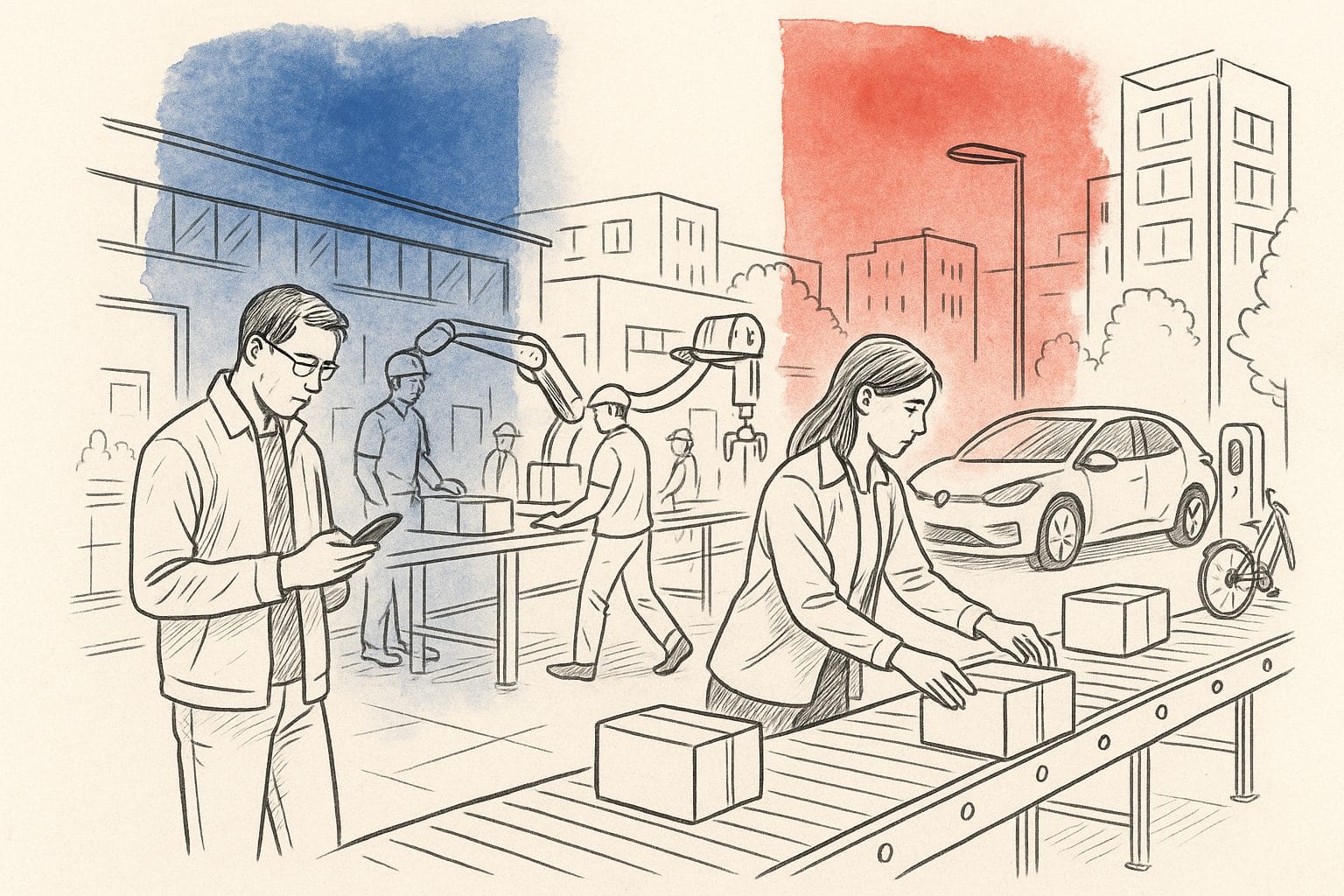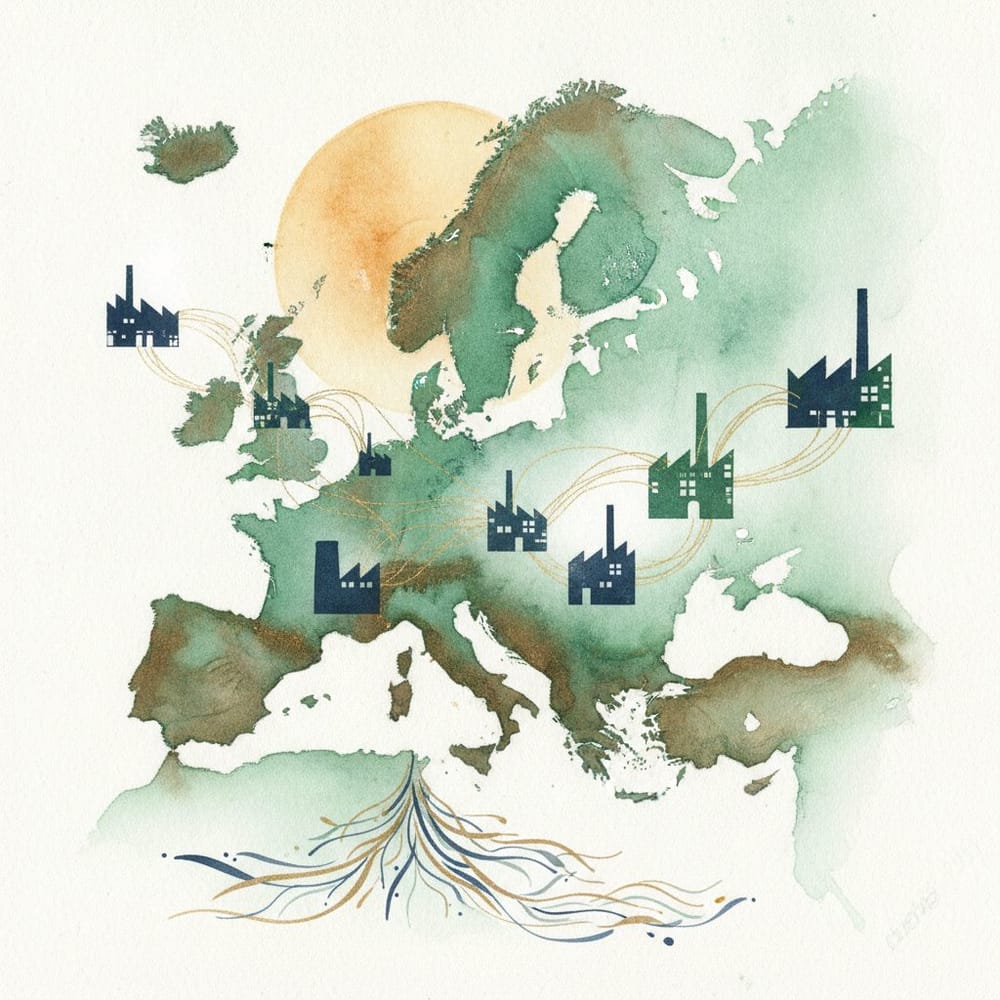
Over three years, European ammunition production has increased sixfold. In 2022, factories across the continent were producing 300,000 shells per year. By the end of 2025, they were producing approximately two million. This spectacular increase did not require the construction of dozens of dedicated factories: it relied largely on converting existing industrial capacities, mobilized on a contract-by-contract basis. The European Commission has drawn a doctrine from this. It is now called manufacturing-as-a-service. And it raises as many questions as it resolves.
The Transformation Roadmap published on November 19, 2025 (COM(2025) 845 final) explicitly inscribes this concept into the Union’s industrial rearmament strategy. The idea: rather than requiring EU member states or industrialists to build new dedicated capacities, Europe can orchestrate dispersed and reconvertible capacities — factories that produce automotive parts today and ammunition components tomorrow. The model exists. It has worked in pharmaceuticals for twenty years. But its application to defense raises a question that the Commission’s text does not resolve: who captures value in this new system?
The Essentials
- European ammunition production increased 6.5-fold between 2022 and the end of 2025, rising from 300,000 to approximately 2 million shells per year, according to the European Commission.
- The Transformation Roadmap (COM(2025) 845 final, November 19, 2025) makes manufacturing-as-a-service an official pillar of the EU’s defense industrial doctrine.
- Only approximately 19 to 20% of European defense contracts are awarded to suppliers from other member states, revealing the fragmentation that this model is meant to correct.
- The main risk: actors capable of certifying and orchestrating these dispersed capacities can capture value at the expense of executing SMEs, reproducing the uberization pattern that public doctrine has not yet neutralized.
- Success conditions are identified by European institutions: standardization of qualifications, auditable orchestration platforms, working capital financing. None are yet operational at the European scale.
Pharma Has Already Partially Solved This Problem
Manufacturing-as-a-service is not a concept that emerged from Commission offices. It has structured the global pharmaceutical industry since the 2000s under the acronym CDMO: Contract Development and Manufacturing Organization. Lonza, Samsung Biologics, and Catalent produce for laboratories that prefer to outsource manufacturing to focus on research and market launch. According to Grand View Research, the global pharmaceutical CDMO market was estimated at approximately $155.5 billion in 2024, with projections around $235 billion for 2030. The Covid-19 pandemic accelerated this dynamic: several large factories were converted within weeks to produce mRNA vaccines, demonstrating industrial flexibility that few other sectors can claim.
What pharma built over two decades was an ecosystem of qualification. Each CDMO operates according to precise certification standards, from Good Manufacturing Practices to ISO standards specific to biotechnology. These certifications are interoperable: an American lab can contract with a Swiss CDMO without reinventing specifications. And crucially, contracts include mechanisms for financing working capital needs: the client advances some financing so the subcontractor can purchase raw materials and manage cash flow while production is manufactured, delivered, and paid for.
This is precisely where defense encounters problems. The pharmaceutical industry spent twenty years building these standards. European defense does not yet have them. And the geopolitical context does not offer the same luxury of time.
Persistent Fragmentation of European Defense Markets
The ramp-up in ammunition is real. But it masks a structural reality that available data on European defense public contracts makes clear without ambiguity: according to TED data and ECIPE analyses, only approximately 19 to 20% of European Union defense contracts are awarded to suppliers from other member states, while the remaining 75% or so remain national. Each country purchases from its own industrialists, according to its own standards, its own security clearances, and its own qualification procedures.
This figure is not an accident. It is the product of decades of national industrial policy, defense secrecy, and legitimate sovereign considerations. A French factory qualified to produce propellants is not automatically authorized to work on a German program. A Polish subcontractor cannot respond to a Belgian tender without going through an accreditation process that sometimes takes several years.
Manufacturing-as-a-service cannot function without removing these barriers. Yet the Transformation Roadmap identifies them without proposing a binding mechanism to dismantle them. It invites the promotion of “standardization” and “facilitation of mutual recognition of qualifications.” The conditional mood remains appropriate regarding the effectiveness of these commitments in a Union where defense remains constitutionally a national prerogative.
It is not without echoing the syndrome of digital infrastructures: Europe knows how to build its data centers, but struggles to interconnect them according to common standards. The diagnosis of fragmentation is made. The governance solution is less clear.
The Risk of Industrial Uberization That the Doctrine Has Not Yet Neutralized
The CDMO model has created value for major pharmas. For the subcontractors themselves, the picture is more nuanced. Large CDMOs — Lonza, Samsung Biologics — succeeded in building strong positions because they held both manufacturing competencies and certification capabilities. Smaller ones often remained dependent on their clients: value is captured where certification and flow orchestration power is exercised, not where physical work is done.
The uberization mechanism follows a precise logic. A platform aggregates dispersed supply, certifies its quality according to its own standards, and makes itself indispensable as an intermediary. Executors — delivery drivers, drivers, or here subcontracting factories — retain assets and fixed costs but cede the client relationship and the ability to set prices. Transportation and hospitality have experienced this. Manufacturing could follow.
In the defense sector, this dynamic takes a specific form. Actors capable of obtaining and maintaining security clearances, managing the auditable information systems required by NATO or EU programs, and orchestrating multi-country supply chains are rare. These are generally large defense groups — Thales, Leonardo, Rheinmetall, KNDS — or specialized digital platforms that these groups are developing. SMEs that convert their production lines to manufacture ammunition components risk finding themselves in the same position as craftspeople joining Amazon Marketplace: access to an expanded market, but reduced margins and increased dependence.
Available institutional analyses identify this risk. It emerges that the conditions for value sharing between orchestrators and executors must be framed to prevent the model from reproducing capture dynamics observed in other sectors. But no concrete mechanism has yet been proposed: no margin-sharing rule, no obligation of transparency regarding contract allocation algorithms, no SME oversight of the platforms that aggregate them.
This is a blind spot that the Draghi report had already pointed out in another register: Europe excels at making diagnoses, less so at building governance mechanisms that actually change power relationships.
Three Technical Conditions for the Model to Work
The Commission is not without answers. The Transformation Roadmap and ongoing work on the EDIP instrument identify several operational conditions on which the viability of manufacturing-as-a-service at European scale depends.
The first is standardization of qualifications. For a German factory to receive a subcontracting order on a French program without going through two years of accreditation procedures, there must be common standards. The work is underway through the European Defence Agency, which has been piloting since 2024 a working group on mutual recognition of defense industrial certifications. Progress has been made on electronic components and materials. Propellants and guidance systems remain to be addressed. Negotiation is slow because it touches on well-organized national industrial interests.
The second condition is the creation of auditable orchestration platforms. If SMEs dispersed across twelve countries must coordinate their production on the same program, there must be a common, secure, accessible information system controllable by public authorities. The Commission proposes relying on EDIP, the European Defence Industry Support Instrument, to finance these platforms. The question of who operates them remains open: a European public body, an industrial consortium, or a private provider that would become the de facto indispensable intermediary.
The third condition is financing of working capital needs. An SME that converts a production line for a defense contract must purchase specific raw materials, train its operators, sometimes invest in equipment. It will only be paid upon delivery, several months later. Without prefinancing or public guarantee, the cash flow risk is prohibitive for most SMEs. The European Investment Bank has announced a guarantee mechanism dedicated to the defense supply chain within the ReArm Europe program. The concrete terms of access for subcontracting SMEs remain to be clarified.
These three initiatives are identified, budgeted, and underway. None are complete. And their articulation with the mechanics of manufacturing-as-a-service has not yet been tested in real conditions.
What the Ammunition Ramp-Up Proves — and What It Does Not Prove
Returning to the starting figure is useful for measuring what the model can actually accomplish. Multiplying shell production by 6.5 in three years is a significant industrial achievement. It proves that converting existing capacities works, that European industrialists can respond to massive public orders when they exist, and that clear and fundable demand unlocks latent capacities.
But this ramp-up was obtained mainly through two mechanisms: mobilization of existing capacities at major defense industrialists (Rheinmetall, Nexter, BAE Systems) and increased volumes in already-qualified factories. This is not manufacturing-as-a-service strictly speaking. Nor is it mobilization of industrial SMEs outside the defense sector converting their lines. It is rather classical ramping up in an existing industrial base, accelerated by public funding and pooled orders.
The real test of the model the Commission defends will come when it involves bringing into the chain subcontractors who have never worked for defense, with clearances to build, procedures to invent, and contracts to negotiate with orchestration platforms whose rules have not yet been written.
The question that deserves to be asked is this: is manufacturing-as-a-service a model of industrial sovereignty, or is it a model of flexibility that shifts risks toward SMEs while concentrating value with orchestrators? The answer depends entirely on platform governance, margin-sharing rules, and prefinancing mechanisms. These are political choices. The doctrine is laid out; they remain to be made.
Sources
- European Commission, EU Defence Industry Transformation Roadmap (COM(2025) 845 final), November 19, 2025 — Official Link
- European Commission, DG GROW, Repurposing European idle industrial capacities for defence production, March 2026 — document cited in the Transformation Roadmap, available via the DG Defence, Industry and Space portal
- European Commission, 2nd Implementation Dialogue on Defence, June 17, 2026 — press release available on the defence-industry-space.ec.europa.eu portal
- Grand View Research, Pharmaceutical CDMO Market Report — market data, Grand View Research Link
- European Defence Agency, working group on mutual recognition of defense industrial certifications, 2024-2026 — available on eda.europa.eu
- European Parliament Think Tank, European defence industry, February 2026 — EP Think Tank Link
- ECIPE, Openness and Fragmentation in EU Defence Procurement, December 2025 — ECIPE Link
- Le Grand Continent, From 2027 onwards, German Rheinmetall will produce more artillery shells than all of American defense industry, January 2026 — Le Grand Continent Link
- EDIP, Manufacturing as a Service in EDIP calls — EDIP Link