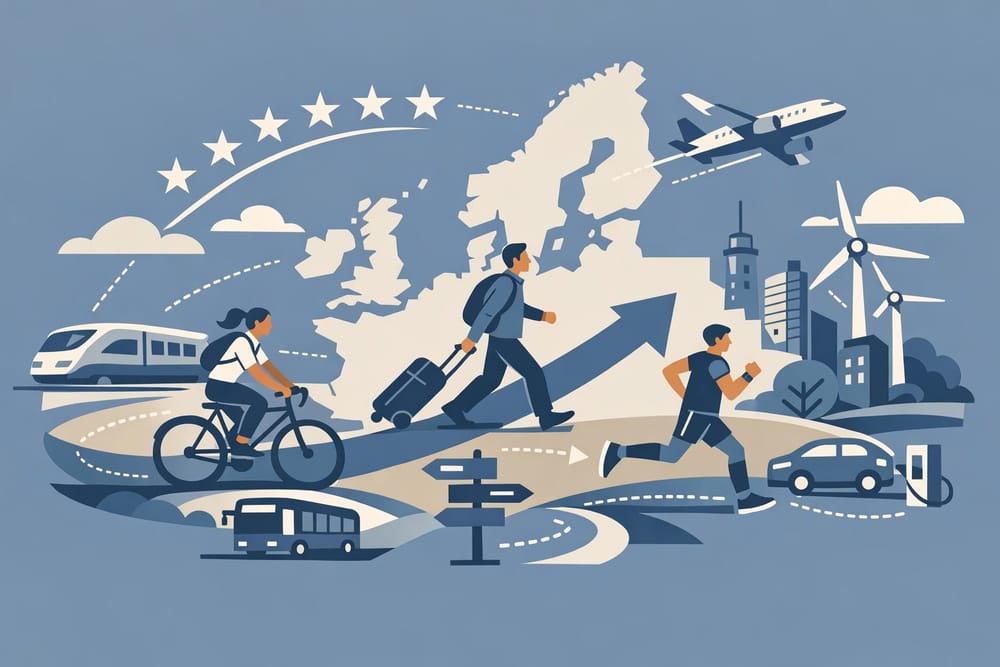
Six percentage points in four years: the share of Europeans who never do sport fell from 45% to 39% between 2022 and 2026, according to the Eurobarometer on sport and physical activity published this year. This decline is real and measurable. But it masks an almost unchanged social geography: in an analysis adjusted for 2022 data, holders of a master’s or doctoral degree had a participation odds ratio of 2.10 compared with people with secondary education or less, being a woman was associated with a participation odds ratio of 0.72 compared with men. Sport is growing in Europe; how this growth is distributed among social groups remains to be documented.
The Essentials
- The share of Europeans who never do sport fell from 45% to 39% between 2022 and 2026, and 38% practice several times a week (Eurobarometer 2026).
- In 2026, 57% of EU practitioners belong to no club: the observed increase is accompanied notably by strong growth in active mobility and higher attendance at fitness centres.
- In the 2022 analysis, the adjusted odds ratio was 1.50 for college/bachelor and 2.10 for master’s/doctorate, compared with secondary or less; being a woman was associated with an adjusted odds ratio of 0.72.
- Nordic countries show high overall participation, while inequalities by gender and education are established at the aggregate level of the European Union.
- The data justify recommending targeted action toward less participating groups, without allowing us to assert that it is necessary to reduce health disparities.
Six Points of Progress, a Deeper Trend
The figure of 39% non-practitioners is not a minor statistical variation. It represents several million additional Europeans who have integrated some form of physical activity into their daily lives. The trend is durable: the Eurobarometer measures this progress across several successive waves, and the movement has accelerated after 2022.
Several factors explain this decline in sedentary behaviour. Urban cycling has become widespread in major Dutch, Danish and German cities. Walking, jogging and sports practised without heavy infrastructure have grown everywhere. The Netherlands has deployed physical activity programmes integrated into low-income neighbourhoods since 2019, with results documented by their national evaluations.
Denmark has made part of its sports subsidies conditional on public-widening objectives since 2021.
The 57% of physically active people surveyed who are members of no club does not alone tell us about the digital, urban or autonomous nature of their practice. The 57% of physically active people who belong to no club indicate a growing share of autonomous practices. This development brings opposing effects. It lowers the barrier to entry: no membership, no fixed schedule, no hierarchy of skill level. It also deprives practitioners of coaching that could keep them consistent, protect them from injury and help them improve.
Education, the Most Powerful Passport for Sport
In the adjusted analysis of 2022 data, master’s/doctoral level is associated with an odds ratio of 2.10 of participation compared with secondary or less.
Several reinforcing mechanisms explain why education predicts sports participation so strongly. Qualified jobs offer more structured free time, flexibility and disposable income. Those with degrees more often live in neighbourhoods better equipped with sports facilities. Cultural capital weighs even more than economic capital: social norms in educated circles integrate sport as a marker of lifestyle, discipline and self-care.
Sports participation is also, in these circles, a social network and a status signal.
For those without degrees, constraints accumulate differently. Physically demanding jobs leave less energy for additional activity outside work. Staggered schedules make it difficult to access club time slots. The symbolic cost of participation—attire, equipment, self-image in a sports space—can be as discouraging as financial cost. These barriers are not eliminated by building a sports hall nearby.
This is precisely what the analysis of inequalities in access to sport in terms of health shows: infrastructure is not enough. Physical access to a facility does not automatically translate to regular practice when social norms, time constraints and cultural resources are lacking.
Women, 28% Behind Men Across Europe
A female odds ratio of 0.72 corresponds approximately to a reciprocal male odds ratio of 1.39 in this model, without representing a count of practitioners. This gap is observed at the aggregate level of the European Union.
In Scandinavia, infrastructure is accessible, public funding is high, inclusion policies exist on paper. 2022 data indicate that men are more likely to practice regularly. This shows the gap does not stem only from supply or income. It stems from gender norms that organise free time differently for women: unshared domestic and parental burden reduces available time, collective sports remain culturally masculine in many countries, and non-gender-segregated sports spaces remain rare.
The positive momentum deserves to be noted. The data indicate a rise in female participation in several countries, without precisely quantifying how many countries or the relative magnitude of this increase compared with men’s. This differential progression suggests the gap could narrow if conditions permit, but the movement is slow, and programmes explicitly targeting women in non-gender-segregated environments remain a minority.
A woman without higher education qualifications accumulates several factors of under-participation and remains hard to reach for public policies based on clubs and federations.
Distinctive Practices in Progressive Countries
Three countries merit attention: Germany, the Netherlands and Denmark. Their national evaluations available for 2025-2026 converge on several points.
Since 2019, the Netherlands has developed a national programme promoting physical activity that funds “sport-employment combinations” in priority neighbourhoods. The principle: sports educators paid by municipalities intervene in public spaces, parks, streets, school playgrounds, without requiring membership or appropriate attire. Dutch evaluations show an increase in practice among low-income populations in intervention zones, with a particularly marked effect among women of immigrant background.
Germany invested heavily in Sportstätten, municipal sports facilities, from 2020 onward, with a 2 billion euro renovation programme over five years. But German evaluations note that use of these renovated facilities remains concentrated among middle and upper-income households. Investment in infrastructure is not enough without social support.
Denmark attempted something more structural: making part of public subsidies to sports federations conditional on quantified objectives for widening the public, including indicators for gender and educational qualification of new members. This mechanism is young and its results remain preliminary, but it points toward a new logic: public sports money should not automatically reproduce the sociology of existing practitioners.
These three experiments converge on the need to prioritise targeting groups with the lowest participation rates, testing different approaches.
Two Trajectories for European Sport in 2040
Between 2035-2040, the question remains open: will the six-point gain in participation translate into a measurable reduction in health disparities between classes and genders, or will it remain average progress concealing stable stratification?
Two trajectories are possible, depending on policy choices in the coming years.
In the first, public policies continue to fund primarily existing federations and clubs, which tend to recruit from populations already possessing educational, cultural and time resources. Overall participation may continue to grow, driven by autonomous practices like cycling or walking. Participation gaps by education and gender would persist, without changing the odds ratios observed in 2022.
In the second trajectory, several conditions must be met. Subsidies to federations are made conditional on quantified recruitment targets among non-graduates and women, following the Danish model. Unstructured physical activity programmes, without membership, no required level, no imposed attire, are funded in workplaces and low-income neighbourhoods, to reach physically active people who belong to no club. Longitudinal data linking sports practice and health indicators by social group are systematically collected, enabling genuine evaluations rather than raw participation accounts. In this trajectory, the drop from 45% to 39% of non-practitioners is the start of a movement, not its conclusion.
The distinction between the two trajectories lies in which indicators governments choose to measure and fund. A country that subsidises sport measuring only total members reproduces existing biases. A country measuring the social composition of its new practitioners begins to correct them.
The signals to watch in upcoming Eurobarometer waves are precise: the evolution of the female participation ratio, the education-related multiplier, and above all, the share of regular practitioners belonging to no club. If the latter continues to grow without education gaps narrowing, it will confirm that deinstitutionalisation of sport first benefits those already possessing the cultural resources to practise alone.
The same logic of accumulating disadvantages is observed in other domains. Young people without qualifications are losing ground while public money funds others in vocational training: the same mechanism, public aid captured by the better-equipped, operates in sport as in employment.
Current Limits of the Eurobarometer
The 2026 survey documents participation and stratification. It does not yet measure health effects. This missing link is politically most important: if the increase in overall participation does not translate into reduced health disparities between social groups, then the public health argument justifying public funding for sport loses part of its legitimacy.
Global health organisations recommend 150 minutes of moderate physical activity per week for adults. In Europe, the 38% who practise several times a week do not necessarily represent the 38% who reach this threshold: the intensity and duration of sessions vary considerably between a daily twenty-minute walk and an hour swimming session. German and Dutch national evaluations attempt to measure this intensity, but comparable European data do not exist systematically for all practice and health indicators necessary to measure inequalities.
The challenge for coming years is therefore twofold. To continue advancing overall participation, which current trends make possible. And to build measurement tools allowing verification of whether this progress translates where it matters most: in reducing health gaps between the most exposed groups and the rest of the population. Without these tools, European sports policies will long navigate blind, celebrating averages that mask very different realities depending on whether one has studied, whether one is male or female, whether one lives in a well-equipped neighbourhood or not.
The next Eurobarometer wave will need to establish whether the six points gained between 2022 and 2026 have narrowed the gap or merely inflated the middle.
Sources
- EU Eurobarometer on Sport and Physical Activity 2026, European Commission
- WHO Global Action Plan on Physical Activity 2018–2030, World Health Organization (no link: WHO page)
- National evaluations of the Sport and Neighbourhoods programme, Dutch Ministry of Health, Welfare and Sport, 2025 (no link: administrative document)
- Report on Sportstätten renovation programme, Bundesministerium des Innern und für Heimat, 2025 (no link: administrative document)
- Evaluation report on sports subsidy conditionality mechanism, Kulturministeriet Danmark, 2026 (no link: administrative document)
- Social disparities in sport participation, Springer 2026 (no link: academic article)