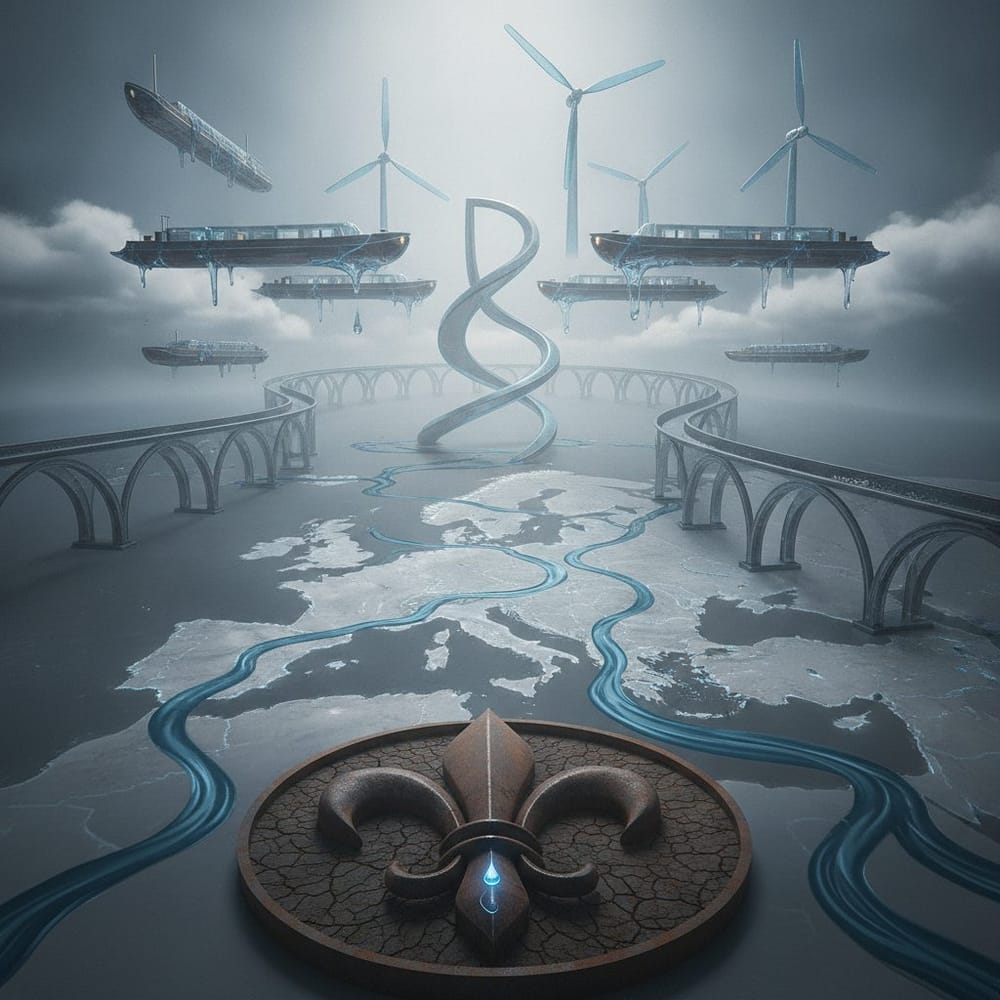
France possesses 8,500 kilometers of navigable waterways, the most extensive river network in Europe. On this network, freight represents only 2.4% of ton-kilometers transported. In the Netherlands, this figure reaches 43%.
The gap is not geographical. It is not technical. It is political.
The Essentials
- The modal share of river freight oscillates between 2% and 3.7% depending on the year in France, compared to 43% in the Netherlands and approximately 10.7% in Germany in 2019 (less than 7% in 2022 according to the CCNR), according to the CESER Normandy report published in April 2026.
- France has Europe’s largest navigable network (8,500 km), of which approximately 1,700 km are large-gauge, allowing heavy convoys.
- Voies navigables de France (VNF) manages this network with a budget insufficient to maintain its condition, while the national river strategy launched in 2024 has still not been adopted two years later.
- The modal shift of freight toward waterways is one of the only proven levers for decarbonizing land transport, with established efficiency over decades, yet France experiences structural stagnation in its river modal share over the past twenty years.
A river barge of 3,000 tons replaces 150 trucks on the road. It consumes four times less energy per ton transported than road transport. It does not clog highways. It does not damage bridges. Yet in France, it sits idle at the dock.
This is not a question of unfavorable geography. The Seine, the Rhône, the Moselle, the Rhine and their tributaries form a network connecting the country’s major industrial and port cities. The Port of Le Havre opens onto the Atlantic, Strasbourg onto the European Rhine corridor, Lyon onto the Mediterranean axis. The connections exist. What is missing are the decisions to activate them.
43% versus 2%: The Gap Has Nothing to Do With Geography
The Netherlands has 6,500 kilometers of navigable waterways. France has 8,500. Yet Rotterdam alone handles more river freight than the entire French network. The comparison is embarrassing, and it should be.
Germany, with its Rhine network and connections to Central Europe, posted a river modal share of 10.7% in 2019 according to VNF, falling below 7% in 2022 according to the CCNR. Belgium exceeds 10%. France, the country with Europe’s largest network, oscillates between 2% and 3.7% depending on the year and metrics used—with a downward trend in recent years, to 1.7% in 2024 according to the ART. This structural long-term stagnation, without real progress, says everything about the absence of policy.
The CESER Normandy report, published in April 2026 and based on an analysis by the Regional Court of Audit, documents the mechanisms of this decline. There are three of them: a network in chronic underinvestment, taxation that penalizes waterways compared to roads, and fragmented governance between Voies navigables de France, ports, and regions, with no coherent national steering.
VNF manages 6,700 kilometers of navigable waterways and 4,000 structures. Its annual maintenance budget is structurally insufficient to keep the network in proper condition. The result: aging locks, recurring technical shutdowns, insufficient water depths that prevent full-capacity loading. A barge operator planning a rotation on the Seine cannot be certain the lock will be operational on the scheduled date. This uncertainty alone is enough to swing the decision toward trucking.
Why Trucking Always Wins
The road has an advantage that neither rail nor waterways can match without deliberate policy: total flexibility. A truck goes door-to-door, without cargo transfer, without lock appointments, without gauge constraints. Against this flexibility, waterways are competitive only on long distances, heavy goods, and bulk flows.
But this competitiveness is not natural: it is built through fiscal and tariff choices. In France, the axle tax on heavy goods vehicles is among the lowest in Europe. It captures only a fraction of the external costs of road transport: infrastructure wear, emissions, congestion, accidents. Germany has a much higher per-kilometer fee for heavy goods vehicles. Switzerland and Austria apply Alpine tolls that have effectively shifted freight to rail and waterways. France attempted to establish a heavy goods vehicle eco-tax in 2014 and abandoned it under pressure from the Bonnets Rouges. Since then, nothing.
The absence of pricing for external road costs is an implicit subsidy to trucking. It distorts intermodal competition to the detriment of waterways, which themselves bear VNF network use fees.
On European regulatory advances in pricing transport externalities, the “Eurovignette” EU framework has allowed member states since 2022 to incorporate CO2 emission costs into road tolls. Most Northern European states have done so. France, again, waits.
What the Netherlands Did That France Did Not Do
The Netherlands do not have a better river network than France. They have a port policy built on fifty years of continuity. Rotterdam functions as an integrated logistics hub where multimodality is not an option but the operational norm: every terminal is designed for direct barge-rail-road connection. River barge operators benefit from favorable fuel taxation, real-time digital signaling on waterway status, and guaranteed network maintenance funded by port dues.
This model did not come from sudden revelation. It results from long-term political consensus among the state, ports, communities, and private actors, built after the 1970s when the Netherlands decided their logistics competitiveness would be their national comparative advantage. This decision produced massive and continuous investments in river infrastructure, port equipment, and mariner training.
In France, the equivalent could have been the “Seine-North Europe” plan: a large-gauge canal linking the Seine to the Scheldt and the Belgian and Dutch river network, connecting the ports of Le Havre and Rouen to the Rhine corridor. This project has existed on paper since the 1990s. The first excavator began work in 2023. Commissioning is scheduled for 2030, with recurring delays. The current cost is €7.3 billion according to the Seine-Nord Europe Canal Company (January 2026), confirmed by the Court of Audit (April 2026), with a risk of exceeding €10 billion when including borrowing costs—roughly double the 2017 estimate (€4.5 billion) and more than double the earliest estimates from 2006 (€3.17-3.52 billion).
When operational, Seine-North Europe will effectively change the game for freight between the Paris basin and Benelux ports. But thirty years of delay have meant thirty years of additional trucks on national roads.
The National River Strategy That Isn’t Arriving
In 2024, the government announced a national strategy for developing river freight, supposed to set modal shift targets for 2030 and 2050, with budget commitments for VNF and tax incentives for shippers. As of early 2026, this strategy has still not been officially adopted. It awaits budget arbitration.
This is a structural symptom. River transport suffers from a political visibility deficit. It does not have the electoral weight of road transport, which directly employs 400,000 people in France according to the National Road Transport Federation. It lacks the symbolic force of rail, to which successive governments devote billions through high-speed rail networks. Waterways are perceived as a mode of the past, when they are precisely the mode of the future for heavy goods and bulk flows that energy transition will generate.
Because the issue is not only logistical. The transport sector represents 34% of total national CO2 emissions in France according to CGDD/SDES data (2024), and road transport alone concentrates 94% of the sector’s emissions, roughly 32% of national emissions. Road freight represents a significant share. The shift toward waterways, whose carbon footprint per ton-kilometer is four to five times lower than trucking according to ADEME estimates, is one of the least expensive and most technically available decarbonization levers. It requires no technological breakthrough. It requires political will and budget continuity.
This is precisely what is missing. As with many long-term infrastructure investments, the problem is not lack of knowledge of potential but the decision horizon of both public and private actors.
Chronically Low Modal Share: What Target for 2035?
The structural stagnation of France’s river modal share over the past twenty years is not a law of nature. It is the result of cumulative underinvestment and transport taxation that has remained favorable to roads. What long-term data shows is that absent a shock in public policy, this figure will not move on its own.
The CESER Normandy, based on modal shift scenarios, estimates that doubling France’s river freight share is technically achievable by 2035, provided three simultaneous conditions: a VNF maintenance budget increased by approximately €200 million annually, the effective commissioning of Seine-North Europe, and the introduction of road external cost pricing. These conditions are neither extraordinary nor beyond budgetary reach. Their annualized cost remains lower than many high-speed rail infrastructure projects.
Reaching a 5% modal share by 2035 would represent approximately 15 billion additional ton-kilometers on waterways. At a substitution rate of approximately 70 to 80 road ton-kilometers per river ton-kilometer, depending on average loading parameters, this would remove hundreds of thousands of heavy goods vehicle trips annually from national roads. The effect on emissions and infrastructure wear would be measurable at the national scale.
The generational question is here: investments in river network maintenance have a lifespan of thirty to fifty years. Decisions in 2026 and 2027 on VNF budget condition the network available in 2040 and beyond. Deferring these investments means transferring rising costs to future generations while handing them a degraded network and a modal share that has not budged.
The Port of Le Havre Is Beginning to Believe
There are positive signals that deserve to be named. Haropa Port, which has unified the ports of Le Havre, Rouen, and Paris since 2021, has made river modal shift an explicit strategic priority. The Port of Le Havre is completing construction of new container terminals designed for direct transfer to river barges, with handling equipment adapted to convoy gauge. The stated goal is to increase the share of river transport in Le Havre’s hinterland from 7% currently to 15% by 2030.
This is modest ambition compared to Rotterdam, but it is a clear target, carried by a unified structure that did not exist before the three-port merger. Consolidation has reduced cargo transfer costs on the Seine axis and standardized information systems across the three sites. Operators like Sogestran and CFT have begun investing in boats with hybrid electric-LNG motorization for Le Havre-Paris routes, anticipating European regulation on inland navigation emissions that will gradually take effect between 2027 and 2035.
On Strasbourg and the Rhine corridor, connectivity with the European river network is already better, and the share of waterway traffic for Alsace freight is significantly higher than the national average. This proves that French geography is not the problem.
The French river network will exist in fifty years. The question is whether it will be active or whether it will continue waiting for a sustained budget decision to allow it to function. The Netherlands resolved this question in 1975. France posed it anew in 2024. It still has not answered.
Sources
- CESER Normandy — Developing River Freight (April 2026): https://www.ceser.normandie.fr/sites/default/files/2026-04/D%C3%A9velopper%20le%20Fret%20fluvial.pdf
- Voies navigables de France (VNF) — network and traffic data: no certified URL
- Haropa Port — strategic plan 2021-2025: no certified URL
- Seine-Nord Europe Canal Company — project progress: no certified URL
- ADEME — CO2 emissions comparison by transport mode: no certified URL
- National Road Transport Federation (FNTR) — sector employment data: no certified URL
- European Commission — revised Eurovignette Directive 2022/362: https://eur-lex.europa.eu/legal-content/EN/TXT/?uri=CELEX%3A32022L0362
- VNF — The navigable network (official primary source): https://www.vnf.fr/vnf/accueil/qui-sommes-nous-vnf/le-reseau-navigable/
- SCSNE — Cost and financing of the Seine-Nord Europe Canal (January 2026): https://www.canal-seine-nord-europe.fr/cout-et-financement-ou-en-sommes-nous/
- Court of Audit — Seine-Nord Europe Canal Report (April 10, 2026): https://www.boursedirect.fr/fr/actualites/categorie/economie/canal-seine-nord-europe-la-derive-des-couts-cree-un-risque-fort-pour-l-etat-selon-la-cour-des-comptes-afp-3da9e82d11048946372dda018c9a36b86c20ebf3
- Ministry of Ecology — Launch of national river strategy (February 16, 2024): https://www.ecologie.gouv.fr/presse/lancement-dune-strategie-fluviale
- SDES — Freight transport modal shares France: https://www.statistiques.developpement-durable.gouv.fr/tous-modes-de-transport-de-marchandises
- CCNR — River modal shares Netherlands and Germany: https://inland-navigation-market.org/chapitre/2-freight-transport-on-inland-waterways-3/
- CNR — Comparative European heavy goods vehicle taxes 2025: https://www.cnr.fr/en/european-comparison-road-taxes-and-charges-applied-heavy-goods-vehicles-2025