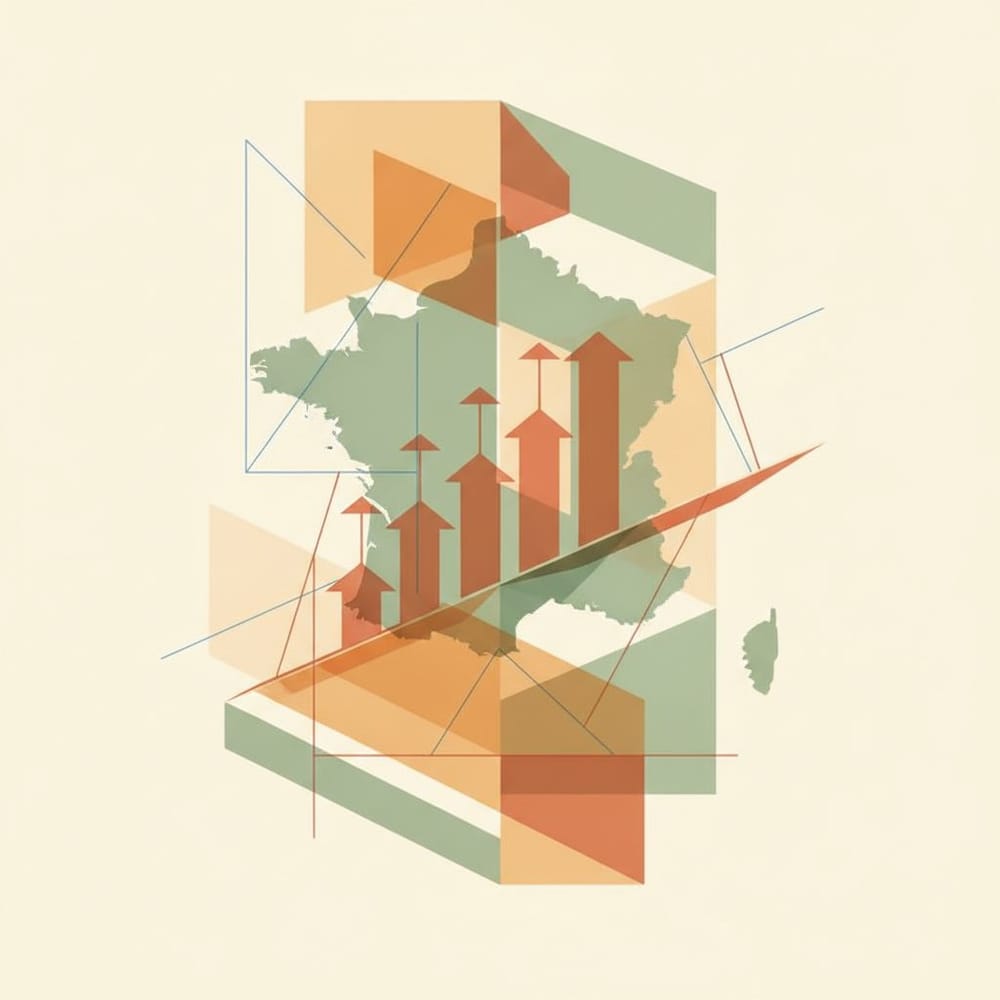
In 2021, France had approximately 39 people aged 65 or older for every 100 working-age people aged 20 to 64. According to INSEE projections from 2021, this ratio could reach between 46 and 70 by 2070 depending on the assumptions retained, with 57 as the central scenario — the 2026 projections revise this central figure to 62. Until 2040, INSEE indicates that aging varies little depending on fertility and immigration assumptions. However, after 2040 and until 2070, these assumptions significantly influence the trajectory, with INSEE explicitly noting that the evolution becomes much more uncertain. Nonetheless, demographics have already locked in the essential aspects of the medium-term movement.
This figure does not tell the whole story. It says that the burden of aging is calculable, predictable, inevitable in its broad outlines. What it does not say is who will bear it, in what form, and whether the generations concerned have anything to say about it. French public debate remains fixed on the annual balance of pensions, as if the question were merely accounting. It is political, in the deep sense of the term: it is about deciding how a society distributes its resources between those who produce and those who no longer produce, or not yet.
The Essentials
- France’s demographic dependency ratio (65+/20-64) stood at 38.6 in 2021. According to INSEE projections from 2021, it could reach between 46 and 70 by 2070 depending on scenarios (central: 57), with the 2026 projections revising this central figure to 62. The range is wide, particularly after 2040.
- Intergenerational transfer accounts, developed within the framework of National Transfer Accounts (NTA), make it possible to measure what each age group receives or pays to the rest of society, beyond the sole scope of pensions.
- France dedicates more public resources to elderly people than to children and youth, an imbalance that is documented and growing, which is not unique to the country but among the most pronounced in Western Europe.
- By 2040, the dependency of the very elderly (85 years and older) should constitute a growing factor of pressure on public finances, progressively adding to the pension question alone.
- The central choice is not to increase or decrease total transfers, but to decide their structure: who pays through taxes, who pays through work, what share each generation absorbs.
A Ratio That Cannot Be Negotiated
Demography is, among all social sciences, the one whose projections fifty years ahead are the most reliable. The children who will be 65 in 2070 are already born. Those who will be 50 are mostly already born. The uncertain variables—fertility and immigration—play at the margins over the period until 2040, when aging is nearly certain and varies little depending on assumptions. Beyond that, their influence becomes significant.
According to Social Security data and INSEE projections, France’s demographic dependency ratio stood at 38.6 in 2021. According to INSEE 2021 projections, it would be in a range of 46 to 70 by 2070 (central scenario: 57); according to INSEE 2026 projections, the range is approximately 50 to 78 (central scenario: 62). The range is wide, reflecting real uncertainty after 2040. The baby-boom generation has entered old age. It will remain there until the middle of the century. The following generation, more numerous than commonly believed in France, will take over.
This shift from 39 to values between 46 and 70 represents a substantial increase in the number of elderly people per hundred working-age people. Translated into crude economic terms, this means that each worker will need to produce more or transfer a larger share of their income to maintain an equivalent level of public services and pensions. The question is not whether this transfer will happen: it is inscribed in the age curves. The question is how to organize it.
What Transfer Accounts Make Visible
The tool that makes this debate objective is called intergenerational transfer accounts, or National Transfer Accounts (NTA). Developed since the 2000s by an international network of researchers, it measures, age by age, what each individual consumes, what they produce, and the difference between the two filled by public and private transfers.
Applied to France, this tool reveals several realities that the debate over pensions obscures. First, people over 65 consume more than they produce, which is the very definition of economic dependency, but the gap widens significantly after 75 years, due to health and care expenditures. Second, children and young adults are also, by definition, net consumers of collective resources: education, family allowances, training. The median-age worker simultaneously bears both these burdens.
Third, and this is the politically sensitive point, France allocates proportionally more public resources to its elderly than to its youth. This imbalance is documented by the OECD, which regularly compares countries on the structure of their social spending by age group. France is not an isolated case in the continental European country group, but it ranks among the most pronounced in this regard.
Hippolyte d’Albis, an economist specializing in the economics of life-course stages, has developed part of his work around this question: how to measure economic flows between generations, and how to anticipate the tensions that their distortion will provoke. His central contribution is to show that these flows are not merely a matter of public accounting, but that they reflect societal choices about the value accorded to different phases of life. Investing in childhood and education is also an intergenerational transfer, deferred in its effects but real in its consequences for future productivity.
Pensions Are Only the Visible Part
The French debate over pensions, relaunched violently by the 2023 reform, had the merit of placing demography at the center of public debate. It had the flaw of reducing it to a single question: at what age does one stop working, and how much does old-age insurance cost per year.
This framing is too narrow. The real challenge of the coming fifty years comprises at least three distinct dimensions.
The first is indeed that of pensions. The report of the Advisory Council on Pensions (COR) documents the system’s evolution every year. The 2023 COR report projects a balance ranging from +0.5% of GDP (1.6% growth scenario) to -1.6% of GDP (0.7% growth scenario) by 2070. The 2025 report, meanwhile, adopts a single reference scenario of -1.4% of GDP by 2070, which represents a real financing need, even if it remains at a manageable scale according to the growth assumptions retained.
The second dimension is that of dependency. According to DREES (October 2025), there were already more than 2 million people aged 60 or older experiencing loss of autonomy in France in 2021. This number should reach approximately 2.8 million around 2050, an increase of about 700,000 additional people (+35%). The cost of care, today partially borne by families and partially mutualized through the Personalized Autonomy Allowance, represents a considerable financial commitment for which no sustainable source of funding has been stabilized to date. The law on advanced age, promised for years, remains incomplete.
The third dimension, paradoxically underdiscussed, is that of education and training. When the population pyramid inverts, pressure on social budgets tends to squeeze spending on younger generations. This is an trade-off that is rarely made explicitly, but can be read in budget curves. Maintaining a high level of investment in education, vocational training, and early childhood while absorbing the rise in dependency—this is the real equation for the decades to come.
Two Readings of the Same Trajectory
Liberal economists and institutional economists do not read this challenge in the same way. The distinction is useful because it is not rhetorical: it corresponds to two different diagnoses of what blocks adjustment.
For the first school of thought, represented notably by economists close to Agnès Verdier-Molinié or Nicolas Baverez, the central problem is that of labor costs and productivity. A high dependency ratio is only sustainable if each worker produces more. The solution lies in structural reforms that increase employment rates, particularly among seniors and low-skilled young people, reduce niches that protect market segments against competition, and allow the economy to allocate its resources more efficiently. In this reading, the question of intergenerational transfers is resolved mainly through growth.
For the second school, of which Hippolyte d’Albis’s work is representative, growth is necessary but insufficient. It does not resolve the question of how gains are distributed between generations. Even in a sustained growth scenario, nothing guarantees that workers in 2050 will agree to finance retirement levels built on conventions from 1970, in a labor economy that will have been transformed by automation and career precarity. The question is not simply how much we produce, but who appropriates what, according to which rules, negotiated when and with whom.
These two readings are not incompatible: they point to different levers of the same problem. The tension between them is fruitful precisely because it forces both questions to be posed simultaneously, without sacrificing one to the other. The French economy has moreover shown, through reforms over the past thirty years, that productivity logics and redistribution logics can advance in parallel, even if coordination remains difficult.
The Instruments Exist, Their Use Remains Timid
The hopeful point in this picture is that the analytical toolkit has progressed faster than political debate.
National Transfer Accounts are now available for about forty countries. They allow France to be compared to its neighbors and make it possible to measure the effect of different policies on the intergenerational distribution of resources. This is no longer a confidential academic exercise: the NTA network is recognized by the United Nations and its methods have been integrated into economic policy reports by several governments.
In France, recent work by the National Institute for Demographic Studies (INED) and the Center for Strategic Analysis have used these accounts to document the structure of transfers. Their conclusions converge: France is a country where the mutualization of age-related risks is strong, but where this mutualization is structurally asymmetrical in favor of the oldest generations.
This diagnosis is not a condemnation. It is a mapping. Once one knows precisely where resources are going, one can discuss their reallocation differently. And this discussion is all the more urgent because it must precede the acceleration of aging, not follow it.
Several approaches are documented and the subject of serious study. The creation of a fifth risk of Social Security dedicated to dependency, mentioned since the Libault report of 2019, would make it possible to isolate and explicitly finance this transfer, rather than leaving it to family burden or allowing it to slide into already-strained local budgets. Reform of inheritance taxation, a politically inflammatory but economically defensible subject, is another lever of redistribution between generations that avoids putting everything on wage contributions. The development of employee shareholding and long-term savings, which still struggles to find its place in French economic culture, is a third path that diversifies mechanisms for building and transmitting wealth between generations.
2040, the First Test of the Architecture to Come
The demographic trajectory offers a rather precise window on the timing of tensions. The main shock will not come in 2070: it will arrive much sooner, around 2035-2040, when the generation born between 1955 and 1965 reaches the 75-85 age group, the one that concentrates the heaviest health and care needs.
At this horizon, two developments will overlap. On one side, the rising costs of dependency, whose budgetary effects will begin to be felt from the end of this decade. On the other, the gradual entry into the labor market of generations that will have experienced more fragmented careers, more precarious, more hybrid between employment and self-employment, which will mechanically affect acquired rights and the contributory financing of the system. This movement of fragmentation of professional paths, first visible in the American technology sector, is gradually reaching European labor markets.
The window for action is the next decade. Not because decisions would be irreversible after 2030, but because the effects of institutional choices take time to materialize. A fifth risk created in 2027 would have been fully operational in time. One created in 2040 will arrive too late for the first influx.
The measurement tool is there. The projections are robust in their broad outlines, even if their uncertainty grows as the horizon recedes. The trajectory is known. What remains to be built is the political will to pose the question in intergenerational terms rather than in terms of annual balance: not “how much do pensions cost this year,” but “what society do we want to be when there are several dozen elderly people per 100 workers, and who will have decided how to share the burden.”
Sources
- Social Security / National Transfer Accounts — Population aging and dependency ratio: https://evaluation.securite-sociale.fr/home/retraite/1-5-vieillissement-de-la-populat.html
- INSEE — Population projections to 2070 (central scenario and variants): https://www.insee.fr/fr/statistiques/5894093
- Advisory Council on Pensions (COR) — Annual report on the French pension system, financial projections
- International NTA network (National Transfer Accounts) — Lee R. & Mason A., methodology and comparative data
- OECD — Society at a Glance, social spending by age group, comparative editions
- Libault Report — Consultation on advanced age and autonomy, Ministry of Solidarity, 2019
- INED — Work on intergenerational transfers in France
- INSEE — Population projections 2021-2070 (INSEE Première no. 1881): https://www.insee.fr/fr/statistiques/5893969
- INSEE — New population projections 2026 (INSEE Première no. 2108): https://www.insee.fr/fr/statistiques/9004289
- Social Security Evaluation — Dependency ratio 2021: https://evaluation.securite-sociale.fr/home/retraite/1-5-vieillissement-de-la-populat.html
- DREES — 700,000 additional seniors experiencing loss of autonomy by 2050: https://drees.solidarites-sante.gouv.fr/publications/700-000-seniors-en-perte-dautonomie-supplementaires-dici-2050
- COR — Annual report June 2025: https://www.cor-retraites.fr/sites/default/files/2025-06/Synth%C3%A8se_Def_.pdf
- COR — Annual report June 2023: https://www.cor-retraites.fr/sites/default/files/2023-06/RA_2023.pdf
- NTA Project website: https://www.ntaccounts.org/web/nta/show/
- Circle of Economists — Profile of Hippolyte d’Albis: https://lecercledeseconomistes.fr/presentation/membres-et-auteurs/membres/hippolyte-dalbis/
- France Strategy — When Baby Boomers Are 85: https://www.strategie-plan.gouv.fr/files/2025-05/sites_default_files_contenu_piece-jointe_2023_02_rapport_6_derniere_versio_du_8_fev.pdf