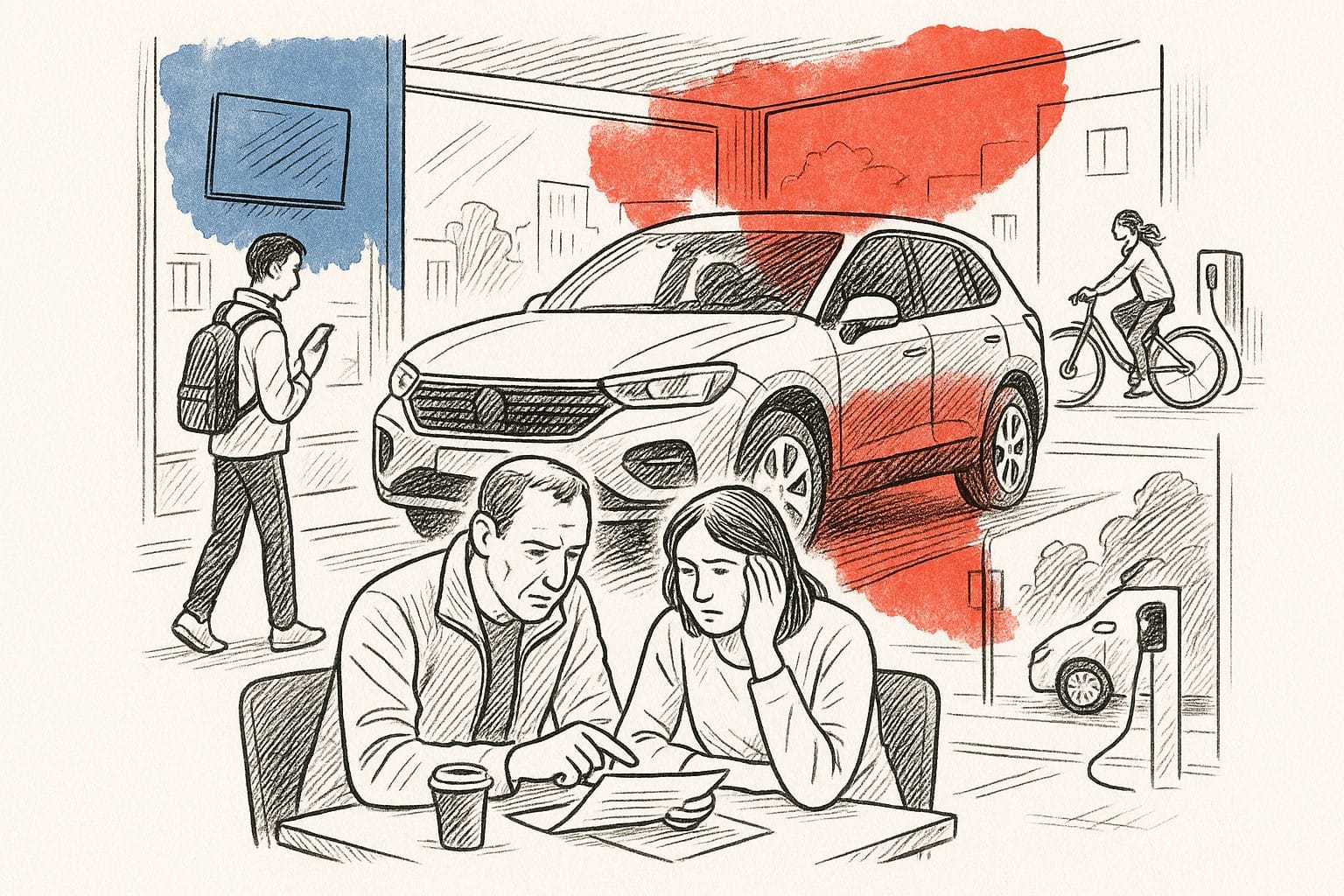
Ridership on Dunkerque buses jumped 85% after switching to complete free fares in 2018. This figure circulates in every debate on the subject. What is cited less often: according to the VIGS study, 48% of new users report having abandoned their cars — making it the mode most cited as forsaken. But in terms of aggregate modal shares, the decline in automobile use remains slight (roughly 3%), and both walking and cycling also decreased.
This is the paradox at the heart of the wave of free public transport sweeping French cities. A policy presented as a tool for road decongestion and ecological transition is being rolled out on a large scale, with several hundred million euros at stake, on the basis of studies whose results remain nuanced and often poorly communicated. And without most cities involved having put in place the tools to know what is actually happening.
The Essentials
- Several dozen French municipalities have switched to completely free public transport, including Dunkerque (2018), Aubagne (2009), Montpellier (December 2023), and Calais
- Available studies diverge by city: in Tallinn, the modal shift comes mainly from walking; in Dunkerque, cars are the most declaratively abandoned mode, even though the effect on aggregate modal shares remains weak; data for Aubagne is partial but suggests notable modal shift from cars
- Montpellier implemented complete free fares without an evaluation mechanism, and its last household travel survey dates back to 2014
- Free fares attract voters and cost local authorities dearly, but its impact on congestion remains undocumented as the 2026 municipal elections approach
A Movement Gaining Speed on the Eve of Elections
France is now among the world’s most advanced countries in terms of free public transport. Aubagne led the way in 2009. Châteauroux, Niort, and Compiègne followed. Dunkerque switched to complete free fares across its entire network in 2018, including weekends, serving as a laboratory for larger cities. Montpellier took the step in December 2023, becoming one of the largest metropolitan areas to adopt this policy. Nantes and other agglomerations have launched partial experiments. On a national scale, several dozen networks are now entirely free according to data compiled by the Association of Transport Authorities (GART).
The acceleration is as much political as philosophical. With the 2026 municipal elections approaching, free public transport has become a readable, popular, and easy-to-announce campaign promise. It addresses multiple concerns simultaneously: household purchasing power, social inclusion for populations unable to afford subscriptions, and ecological transition. On paper, the combination is almost unbeatable.
What is less beatable is the logical chain from “transport is free” to “cars disappear from roads.” This step is rarely publicly questioned. Yet it lies at the heart of the ecological justification for the measure.
What Studies Actually Say About Modal Shift
Serious data on the effect of free fares on car use is rare and recent, and results vary by context.
The most-cited study concerns Dunkerque. The field survey was conducted by the VIGS association (led notably by Maxime Huré), drawing on field surveys. Researchers from LAET (Laboratory for Economics of Transportation, Lyon 2 University / CNRS), Charles Raux and Yves Crozet, subsequently produced a critical analysis of these results. The picture that emerges is more nuanced than it appears: 48% of new users report having abandoned their cars, making automobiles the mode most cited as forsaken. However, the effect on aggregate modal shares remains modest — the car’s share declined by only roughly 3% — and both walking and cycling also declined.
Tallinn, the Estonian capital, which introduced free fares for residents in 2013, offers another observation point. A study published in Case Studies on Transport Policy measured effects over ten years: here too, free fares mostly benefited people who were already walking or using paid public transport. Automobile traffic did not measurably decline.
Aubagne, in France, had anticipated as early as 2009. Ridership increased substantially. Regarding modal shift, the data are partial: a 2013 study indicated that 35% of users came from modal shift from cars, which is far from negligible. However, GART (2019) notes the lack of data comparable to household travel surveys allowing for definitive conclusions. Well-documented beneficiaries remain low-income residents who gained access to previously unaffordable mobility.
Studies thus diverge by city, and the situation is more complex than simple convergence toward a single outcome. What does emerge consistently across contexts is that the price of a bus ticket is not the primary reason why drivers don’t take the bus. What stops drivers is service quality: frequency of service, reliability, geographic coverage, door-to-door travel time. Making the bus free doesn’t make it faster, more frequent, or more convenient. The fare barrier disappears, but the others remain intact.
Montpellier: Policy Worth Hundreds of Millions Without a Meter
The Montpellier case is particularly instructive in showing how this policy deploys concretely.
The metropolitan area implemented complete free fares in December 2023, driven by Mayor Michael Delafosse. This is a decision involving significant sums: the lost ticket revenue for Montpellier Méditerranée Métropole is estimated at several tens of millions of euros per year, offset by an increase in the mobility tax levied on businesses.
What stands out is the absence of an evaluation mechanism put in place simultaneously. To measure a policy’s effect on travel behavior, you need household travel surveys that capture habits before and after. Yet the last survey of this type conducted in the Montpellier area dates back to 2014, according to available data. Nine years before free fares. This means there is no recent baseline allowing measurement of any change.
The metropolitan area’s argument is understandable: these surveys are expensive (several hundred thousand euros), time-consuming, and their short-term political utility is low. But this is precisely the calculation that poses a problem. A public policy whose stated objective is to reduce car use and CO2 emissions should, to be credible, equip itself from the outset with tools allowing verification that it achieves its targets.
Without these tools, it is impossible to say whether free fares work in Montpellier. You can count fare validations, which are increasing. You cannot know where these new travelers come from.
Social Inclusion, a Real But Under-Claimed Benefit
If the ecological balance remains uncertain, the social effects of free fares are better documented and more compelling.
In cities that conducted serious surveys, one phenomenon returns consistently: free fares benefit disproportionately those in the most precarious situations. Carless households, often with low incomes, who renounced certain trips because they couldn’t afford to pay, resume traveling. This is a form of right to mobility that paid fares had partially confiscated.
In Aubagne, this result was so clear that the municipal authority ended up centering its communications on the social argument, partially abandoning ecological reasoning. Free fares as a tool for emancipating poor populations — that is a promise the data support.
There is also an effect on marginal uses: short trips you don’t make because “it’s not worth the fare.” Free fares lift this psychological barrier. People board the bus for a two-stop journey they wouldn’t make by car anyway, but that they previously made on foot. This is where the decline in walking is partly explained: not an abandonment of ecology, but new convenience for short distances.
The problem is that this social argument is rarely presented as the measure’s primary objective. Political communication insists on traffic reduction and ecological transition. If social inclusion is the real benefit, it should be stated clearly.
What Free Fares Cannot Do Alone
The question of modal shift is linked to a structural reality that free fares do not change: in many medium-to-large French cities, the transit network is simply not in a position to capture drivers.
A Montpellier suburb resident working in a poorly served business district will not switch to the bus because the fare is free. They will switch if the bus comes every ten minutes, if it arrives on time, if total travel time remains reasonable. These conditions depend on network investment: new routes, increased frequency, dedicated bus lanes to avoid traffic congestion.
Yet free fares and network investment are partially in competition for the same resources. Local authorities that eliminate fare revenue must find alternative financing. The mobility tax, levied on employers, can partially compensate. But budgets remain constrained, and some elected officials acknowledge privately that free fares have absorbed resources that could have gone to service improvements.
This is a tension that public debate carefully avoids. It is simpler to promise free fares than to explain that a bus coming every thirty minutes in the suburbs will not be chosen by a driver, regardless of its price.
This logic is not without reminiscence of other transition policies where one funds the accessibility of a solution without correcting its structural weaknesses. Aviation is betting on sustainable fuels without ensuring these fuels will exist in sufficient quantity at the right time. Free public transport bets on the fare lever without ensuring that the service lever accompanies the movement.
Political Decision Without Evaluation, a Textbook Case
What makes the French case singular is less free fares themselves than the way they spread without evaluation infrastructure.
In countries where public policy is subject to rigorous evaluation requirements, large-scale deployment of an expensive measure generally happens in two stages: experimentation over a limited area with built-in measurement tools, then scaling up conditional on results. This is the clinical trial model applied to public policy, championed notably by development economists and Nobel laureates Abhijit Banerjee and Esther Duflo.
In France, free public transport has deployed differently. Local experiments exist (Aubagne, Dunkerque), but their lessons have not produced national doctrine or shared evaluation protocols. Each city decides alone, often for local political reasons, without relying on solid evaluative work and without putting in place tools to contribute to this body of work.
The result is a public policy spreading on a large scale in an almost complete evaluation void. Available studies point to a nuanced and sometimes contradictory picture regarding the central hypothesis: free fares’ capacity to significantly reduce car use. But these studies remain little known, rarely cited in political debate, and do not modify ongoing decisions.
This is not inevitable. Several cities and metropolitan areas have begun integrating more serious monitoring mechanisms. Cerema (Center for Studies and Expertise on Risks, Environment, Mobility and Planning) has published methodological guides for evaluating mobility policies. Transport science researchers are working on protocols that could be adopted by local authorities. The question, as the 2026 municipal elections approach, is whether candidates promising free fares also commit to the means of knowing whether it works. The question of how to measure public policy effectiveness at scale indeed crosses debates well beyond transportation.
What Would Make Free Fares Truly Useful
Nothing in available data condemns free public transport. What is in question is the ecological justification presented as certain when it remains hypothetical, and the absence of tools to verify it.
A serious free fares policy would look like this: a household travel survey conducted before switching to free fares, to establish a baseline; a commitment to repeat this survey three and five years later; honest communication about objectives, distinguishing social inclusion (documented) from modal shift away from cars (whose aggregate effects remain modest and variable by city); and parallel investment in network quality, without which free fares will never sustainably capture drivers.
Some local authorities are moving in this direction. Academic debate on the subject is lively: transport economists like Yves Crozet at LAET/Lyon 2 University have published critical analyses beginning to inform political debate. Associations of local elected officials are calling for a national evaluation framework.
The real question as the 2026 municipal elections approach is not “for or against free fares.” It is: which cities commit to knowing whether their policy works, and how?
Sources
- The Conversation / Vert — “Municipal elections 2026: understanding free public transport in graphs”: https://theconversation.com/municipales-2026-comprendre-la-gratuite-des-transports-en-graphiques-273304
- Cerema — Center for Studies and Expertise on Risks, Environment, Mobility and Planning: https://www.cerema.fr
- Association of Transport Authorities (GART) — data on free networks in France: https://www.gart.org
- Yves Crozet, Laboratory of Transport Economics, University of Lyon — analyses published on free public transport
- Tallinn study — Case Studies on Transport Policy, Cats et al., effects of free fares over ten years
- Dunkerque Urban Community official website — free fares since September 1, 2018: https://www.communaute-urbaine-dunkerque.fr/vie-pratique/la-mobilite-et-le-transport/se-deplacer-en-transports-en-commun
- European Commission — Dunkerque Dk’Plus Mobility project: https://ec.europa.eu/regional_policy/fr/projects/France/bus-service-overhaul-in-dunkirk-includes-free-travel
- Observatory of Free Transit Cities — VIGS Dunkerque study 2019: http://www.obs-transport-gratuit.fr/travaux-164/etudes-175/dunkerque-effets-de-la-gratuite-totale-septembre-2019-billet-281.html
- Court of Audit report — free transport (Sept. 2025): https://france3-regions.franceinfo.fr/hauts-de-france/nord-0/dunkerque/gratuite-des-transports-en-commun-la-cour-des-comptes-sceptique-on-fait-le-bilan-a-dunkerque-et-calais-3218075.html
- Wikipedia — Aubagne public transport: https://fr.wikipedia.org/wiki/Transports_en_commun_d’Aubagne
- TaM Montpellier — free fares since December 21, 2023: https://www.tam-voyages.com/presentation/?rub_code=72
- Open Data Montpellier Métropole — 2014 household travel survey: https://data.montpellier3m.fr/nouvelle-donnee-en-open-data-lenquete-menages-deplacements-de-2014
- Cats et al. (2017), Transportation (Springer) — Tallinn study: https://link.springer.com/article/10.1007/s11116-016-9695-5
- Case Studies on Transport Policy — “Decrypting fare-free PT in Tallinn” (2017): https://www.sciencedirect.com/science/article/abs/pii/S2213624X17300858
- Court of Audit — Montpellier report (Nov. 2025): https://lepoing.net/montpellier-la-cour-des-comptes-interroge-le-bilan-de-la-gratuite-des-transports/
- GART — Study on free public transport (Oct. 2019): https://www.gart.org/wp-content/uploads/2020/02/Recueil-de-positions_%C3%89tude-Gratuit%C3%A9_Octobre-2019.pdf
- LAET/Lyon 2 University — critical analysis of the Dunkerque experience (Raux & Crozet, 2020): https://tmt.hypotheses.org/465