In February 2024, Indonesians elected their president in an information environment that no one had yet mapped at that scale. A study published on November 19, 2026 in Data & Policy analyzes AI-assisted rebranding of candidates during the 2024 Indonesian presidential campaign. When producing political fiction costs less than printing a leaflet, the rules of electoral competition change, and existing safeguards were not designed for this pace.
The essentials
- The 2024 Indonesian election is a documented case of AI-assisted political rebranding, according to a study published in Data & Policy (November 2026).
- The study raises concerns about electoral integrity, democratic discourse, and polarization dynamics in Indonesia.
- The low cost of manufacturing a synthetic political image shifts the problem: the issue is no longer access to technology, but institutional capacity for response and verification.
- Labeling synthetic content remains the dominant response from platforms, but its effectiveness depends on detection and the good faith of operators.
- Two trajectories are emerging for 2027-2035: regulation by platforms, or certification by independent third parties with access to electoral archives.
Indonesia as an involuntary laboratory
Indonesia is the world’s third most populous democratic country. Its 270 million inhabitants, spread across 17,000 islands, have highly unequal levels of access to local media. This geography of information makes it particularly vulnerable to what researchers from Data & Policy call “digital information pollution.”
The 2024 campaign opposed three candidates, including Prabowo Subianto, a former general associated in collective memory with dark episodes of the 1990s. Images generated or retouched by AI presented him with softened features, almost benevolent, a kawaii aesthetic, according to several local observers. These images circulated on TikTok and Instagram without systematic labeling. Prabowo won the election in the first round with roughly 58% of the vote.
The study does not claim to establish a direct causal link between these images and the election result. It documents a usage pattern and its conditions for propagation. That is already considerable: no one had yet produced such a precise analysis of this mechanism in a major non-English-language election.
The effects of zero production cost
This linguistic asymmetry redistributes democratic risk. Detection tools work better where institutions are already strongest, that is, where the threat is proportionally lesser. In media ecosystems where local newsrooms are few and underfunded, the absence of reliable detection prolongs the lifespan of synthetic images in the information space. Vulnerability lies in the absence of counterbalancing powers capable of responding at the same speed as manipulation tools. The elimination of the economic barrier to producing political fictions thus transfers the challenge to institutional capacity for response—a capacity distributed very unequally across national contexts.
For a long time, manufacturing convincing false political images required resources. Studios, graphic designers, time. This barrier to entry effectively limited the actors capable of running large-scale visual manipulation campaigns.
That barrier has diminished considerably. Consumer-grade software tools now make it possible to produce high-quality synthetic images. This technological shift has lowered entry barriers for the production of synthetic visual content.
The consequence goes beyond volume alone. When producing falsehood becomes as fast as sharing truth, verification delay becomes the central challenge. Automated detection tools for synthetic images show performance disparities depending on linguistic contexts and available resources for training.
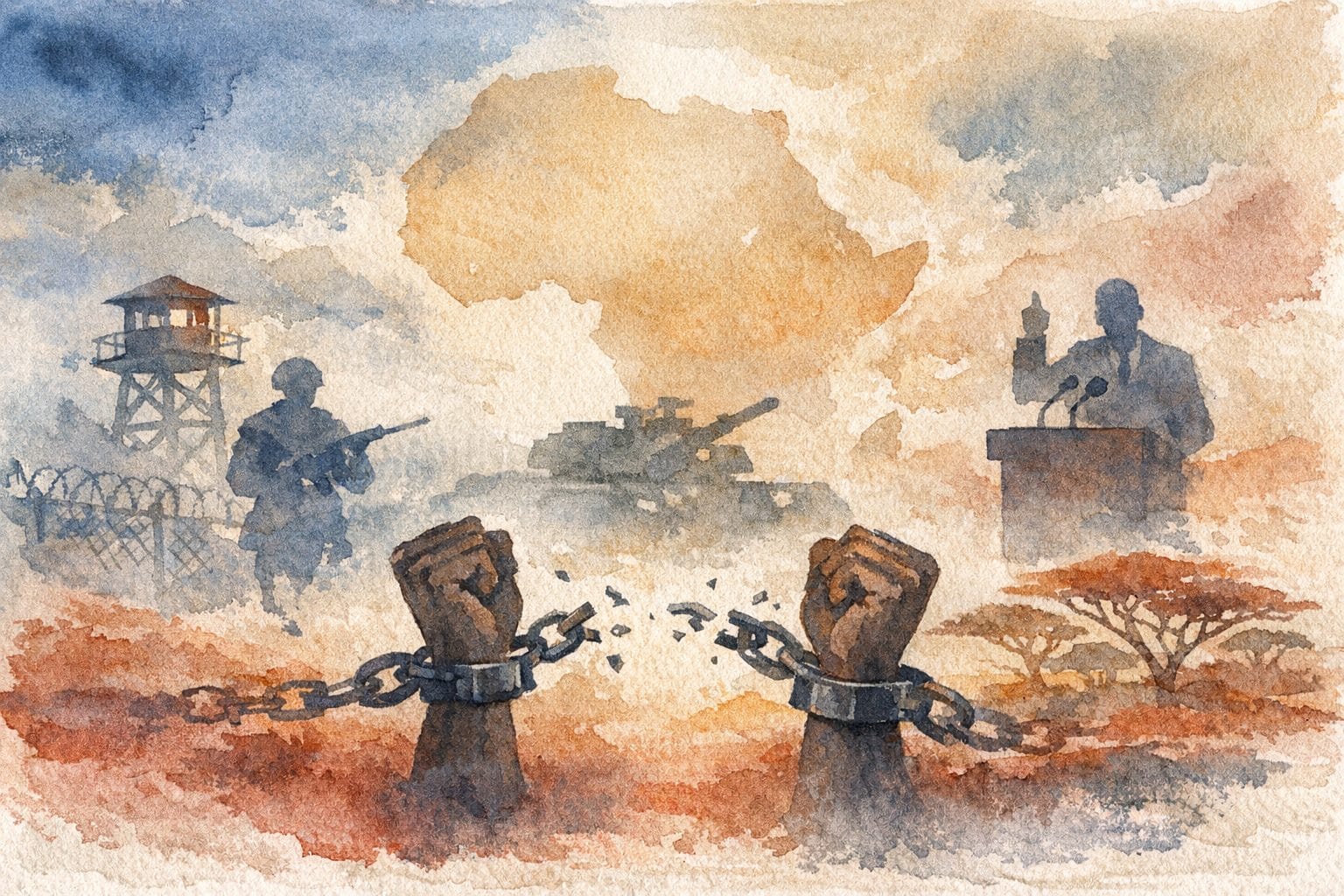
The same mechanism operates in other contexts of democratic fragility. The dynamics of eroding trust in institutions observed in sub-Saharan Africa follow a comparable logic: where local media are weak and archives poorly accessible, falsehood fills the void left by truth.
The limits of labeling
The dominant response from platforms consists of labeling AI-generated content. Meta, TikTok, and YouTube have all announced policies to this effect. The idea is straightforward: informing users that an image is synthetic allows them to modulate their trust.
But this logic depends on several conditions rarely met. It first assumes the image is detected as synthetic before massive diffusion, which requires reliable tools in all languages. It then assumes the label is visible and read, something social media user attention studies render improbable at scale. Finally, it assumes labeling is systematic rather than selective, which depends on the commercial policy of platforms, which varies by market.
The OECD, in its report Reforming Government Communication for the Age of Algorithms, emphasizes that algorithmic platforms and information fragmentation complicate reliable public communication and constructive debate.
The Indonesian study thus raises an issue deeper than labeling: strengthening control institutions, media, fact-checking, prebunking, and media literacy. This requires archives, journalists, tools, and institutions capable of funding and protecting them.
Two scenarios for organizing traceability without censorship
The forward-looking challenge is both political and technical: organizing traceability of electoral content without giving governments power to censor the campaign.
Two trajectories are emerging for the 2027-2035 period, and they are not equivalent.
The first scenario entrusts regulation to platforms. Operators label, moderate, and archive synthetic content diffused during campaigns. The advantage is speed: platforms already have the technical infrastructure. The limits are real. Detection remains uneven across languages.
Moderation decisions are opaque and susceptible to influence from commercial or political considerations. In countries where governments exert pressure on operators—which includes several major Asian democracies—dependence on platforms can turn against campaign freedom.
The second scenario entrusts certification to independent third parties: electoral authorities equipped with technical means, autonomous public media, certified fact-checkers. These actors would have a right of access to diffusion archives and a binding certification capacity, legally recognized. This scenario is more robust democratically, but it requires public investment and political will that few countries currently possess. It also requires resolving a real tension: giving public institutions access to campaign archives means giving them a potential lever of control. The governance of this access is an unresolved problem.
These two scenarios are not mutually exclusive. Most realistic trajectories combine them: labeling by platforms as a first filter, independent certification as a recourse. But the combination requires coordination that non-English-speaking democracies, with unequal institutional resources, struggle to organize.
Non-English-speaking democracies facing their own constructions
Indonesia reveals a blind spot in discussions about AI and democracy: they are held primarily in English, on American or European cases, with tools calibrated for those contexts. The major Asian democracies—Indonesia, India, Bangladesh, the Philippines—concentrate hundreds of millions of voters and very different media ecosystems.
Three collective needs emerge from the analysis. The first is the creation of public archives of electoral content diffused during campaigns. Without traces, verification is impossible. Access to these archives must be conditioned on guarantees of independence from the sitting government. The second is verification capacity in local languages.
Funding fact-checkers in Bahasa Indonesia or Hindi is not a cultural luxury: it is a condition for the functioning of democratic deliberation in these countries. The third is the adoption of technical traceability standards for synthetic images diffused during campaigns, the equivalent of a digital signature that would allow tracing back to the source.
These needs are not new. What is new is their urgency. The 2024 Indonesian campaign took place without systematic public archives, without sufficiently funded local language verification capacities, and without technical traceability standards for synthetic images. The next major election in the region—in India, the Philippines, Thailand—will take place under the same conditions, unless something changes in the meantime.
The signals to watch are precise: the volume of synthetic content detected during campaigns (which measures problem diffusion), the average delay between diffusion and verification (which measures response capacity), and the penetration rate of synthetic images in local media (which measures the extent of information space contamination). These three indicators do not yet exist in standardized form. Building them would already be measurable progress.
The dynamic of AI deployment in professional and institutional contexts, as observed for example in Europe in the world of work, shows that uses almost always precede frameworks. Indonesia in 2024 illustrates the same mechanism in the electoral field, with more direct stakes for democratic sovereignty.
The study’s limitations
The indeterminacy about intentionality has a direct consequence for the design of future regulations. If a significant share of synthetic images comes from autonomous supporters rather than structured campaign teams, obligations placed on political parties are insufficient to cover the phenomenon. Existing electoral legal frameworks rest on the notion of organized responsibility, difficult to apply to diffuse uses of consumer tools. This limitation reveals a structural gap between legal categories inherited from an era when producing visual propaganda required organization, and a reality where this act has become individual and nearly instantaneous.
The Data & Policy study documents the usage and its vectors of propagation; it does not measure the effect on voting. This distinction matters: massive use of synthetic images can saturate the information space without altering voting intentions, if voters have other reliable sources. The study attributes the general strategy to political teams without detailing proof of authorship for each image. The chain of responsibility between structured campaign and autonomous supporters remains unclear.
These blind spots do not diminish the study’s contribution. They define the necessary further research. And they recall that the capacity of states to manage digital flows without reverting to authoritarianism is a challenge that technology alone cannot solve.
Responsibility remains an open question. Who should fund electoral archives? Who certifies local fact-checkers? Who imposes traceability standards, and with what binding force? These questions are political.
They await institutional answers that algorithms will not provide in place of legislators.
Sources
- Data & Policy, Information integrity and digital information pollution in Indonesia: implications for democratic governance and polarization (November 19, 2026)
- OECD, Reforming Government Communication for the Age of Algorithms (report, no guaranteed URL)