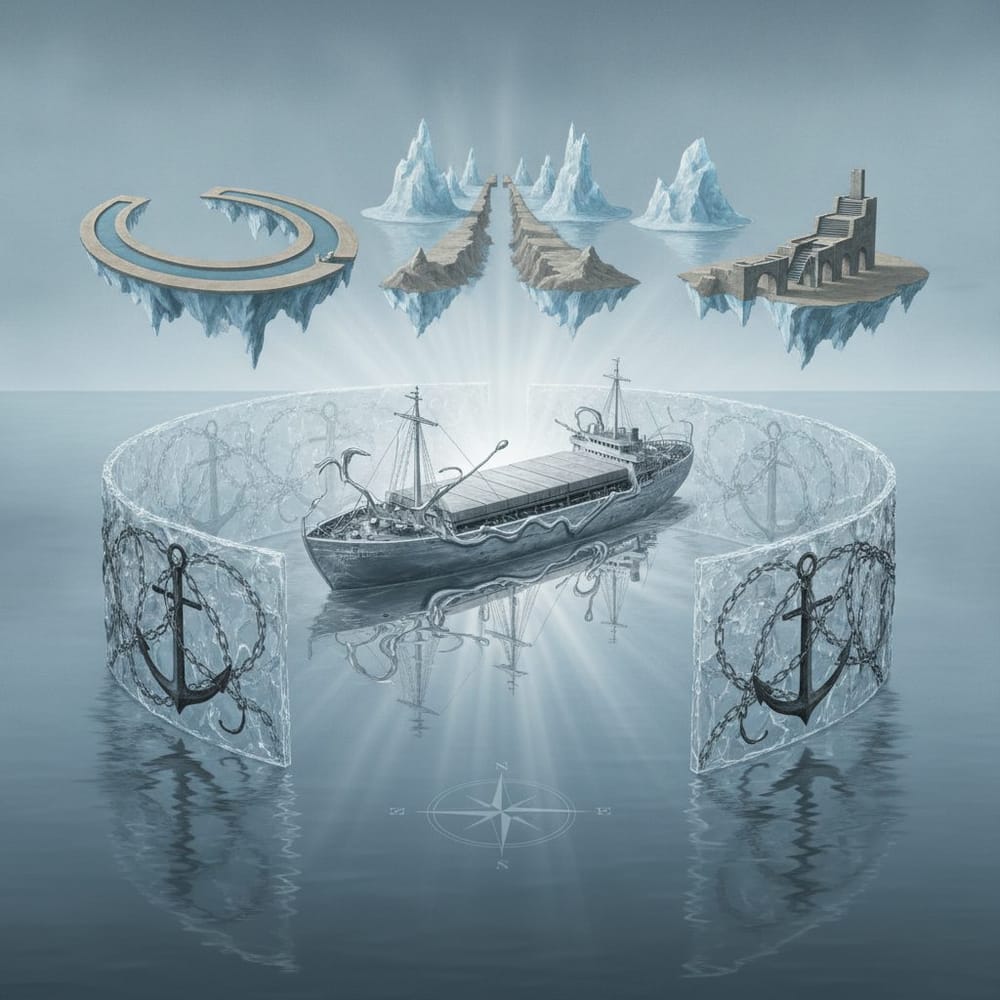
In March 2026, insurance premiums in the Persian Gulf rose sharply over several weeks. No formal blockade in the legal sense was established according to the sources consulted, but a de facto closure and blocking of the strait by Iranian forces were officially documented. Some fixed-rate coverages were canceled or renegotiated, but war coverage remained available in the London market according to risk assessment.
The Essentials
- Maritime insurance premiums in the Gulf increased by 1,000% in March 2026, rendering certain routes economically impractical without any state actor formally blocking passage.
- The Shanghai containerized freight index advanced 34.55% month-over-month, a sign that the disruption spread to entire global logistics chains (Ship Universe, Kisun Shipping, March 2026).
- Rerouting via the Cape of Good Hope adds two weeks of transit time and absorbs the margins of operators with low capitalization, accelerating sector concentration in favor of major shipping companies.
- Insurance and reinsurance can constitute geopolitical chokepoints.
- Small economies and emerging market producers see their access to long-distance supply chains compromised when insurance premiums exceed their margins.
The Strait Didn’t Move, But the Route Closed
The Strait of Hormuz is 54 kilometers at its narrowest point. Approximately 20% of global oil trade passes through it each day. Its geography did not change in March 2026. What changed was the figure written on insurance contracts for shipping companies wanting to transit it.
The rise in premiums can increase the cost of transit, but London market sources primarily attributed the decline in traffic to physical risks for crews and vessels. It can render certain transits unprofitable, especially for operators with the lowest capitalization; access to coverage remains, however, evaluated case by case. Major shipping companies can, depending on their financial resources and coverage conditions, continue to operate at increased cost. Certain operators may have more limited access to these mechanisms. Some may be forced to reduce or suspend operations without judicial decision or international treaty.
McKinsey identifies maritime insurance among non-physical chokepoints that can limit access to commercial networks. A militarily controlled strait remains a visible threat, negotiable diplomatically. The absence of coverage can reduce transits, but its effects are not necessarily identical to those of military control of the strait.
The Transmission of the Shock Throughout the Freight Chain
The Shanghai Containerized Freight Index is one of the most closely watched barometers of global commerce. A rise in the SCFI can be compatible with the spread of maritime tensions without alone demonstrating propagation from the Gulf to all global flows.
The mechanism is mechanical. When short routes close or become more expensive, operators that can switch to the Cape of Good Hope. This detour circumnavigates Africa from the south instead of crossing the Red Sea and Suez Canal. Depending on the route, it can add approximately ten days to two weeks of transit time; in the Shenzhen-Rotterdam example, it adds approximately 3,000 nautical miles, or 5,556 kilometers. These two weeks are not neutral: they immobilize capital, lengthen delivery times, and mechanically increase fuel consumption.
For a container of low value-added goods, the margin can disappear. For a just-in-time supply chain, automotive, electronics, pharmaceuticals, the extension forces the constitution of buffer stocks, which costs more.
Concentration then comes into full play. Major maritime transport companies can have reserves and fleets enabling them to better absorb rerouting. Their vessels are newer, more fuel-efficient, better covered. They can negotiate long-term agreements with shippers that guarantee them stable volumes even at increased prices. Secondary operators experience the same increase in premiums and fuel costs, without the same cushions.
Crises can favor consolidation or pooling of capacity, but this effect is neither automatic nor demonstrated for each crisis.
This phenomenon articulates directly with geopolitical fragmentation weighing on growth: logistical disruptions are not accidents; they are the physical expression of structural tensions whose costs are redistributed unequally.
Lloyd’s of London at the Center of an Invisible Geography
There is a map of maritime power not found in atlases. It does not represent naval bases or exclusive economic zones. It maps the reinsurance syndicates that intervene in global maritime commerce. London, particularly Lloyd’s, remains a major global center for reinsurance and specialized maritime risks, without alone covering all global maritime commerce. Lloyd’s syndicates constitute a major source of capacity and expertise for war risks, without solely determining worldwide maritime insurance conditions.
This system operates on a principle of risk mutualization and pricing. When geopolitical events raise perceived risk in a zone, the syndicates adjust their premiums, sometimes brutally. Geopolitical tensions can trigger significant tariff revisions. Underwriters are not making policy: they manage portfolios of risks. But their collective decision produces geopolitical effects that any foreign ministry would envy.
The concentration of reinsurance power can influence access to coverage. It is a form of power requiring neither aircraft carriers nor blockade decrees.
China has been aware of this for a long time. The expansion of China Re, its efforts to develop a reinsurance market in Shanghai, and its bilateral coverage agreements with certain countries in the maritime belt of the Belt and Road Initiative directly address this structural vulnerability. The Shanghai market is developing in the reinsurance domain, while Lloyd’s has recognized expertise for complex war risks. This competition is a signal to monitor.
Small Operators Caught Between Premium and Margin
Intermediate operators in South-South trade and exports from developing countries can suffer significant losses during these episodes. Major shipping companies can have financial reserves and volumes enabling them to better absorb premium increases and rerouting surcharges. Medium-sized actors can, in certain cases, reduce their activity.
A cocoa producer in Côte d’Ivoire shipping to Southeast Asia depends on a regional freight forwarder. This forwarder does not have a risk management department in London. It purchases its coverage through a broker accessing the Lloyd’s market in several steps. When premiums surge, the information reaches it with a delay, and the tariff shock is amplified by each intermediary. Its margin, already narrow on low value-added merchandise per kilogram, may not absorb a significant increase in insurance costs.
Freight forwarders can modify their routes when insurance coverage becomes difficult to access. These suspensions do not make headlines: they have no code name, no press release. They translate into delivery delays, broken contracts, and lost markets for exporters who do not always regain their position once the crisis passes.
Exclusion by price is particularly difficult to combat because it leaves no institutional trace. A state can contest a blockade before the International Maritime Organization. It cannot contest the tariff schedules of a Lloyd’s syndicate.
Regionalization of Chains or Financial Adaptation, the Emerging Trajectories
The question of access to long-distance chains for small economies is not new, but the events of March 2026 give it unprecedented urgency. Two major trajectories are emerging for the 2028-2035 decade, without either being inevitable.
The first is accelerated regionalization. If long-distance insurance premiums remain structurally high or subject to unpredictable spikes, economic actors have a strong incentive to shorten their supply chains. Industries that can are relocating their suppliers to geographically closer zones, reducing their exposure to sensitive routes. This logic is already at work in nearshoring strategies that followed pandemic disruptions. It could accelerate under insurance pressure.
But it especially favors economies neighboring major consumption markets: Mexico for the United States, Eastern Europe and North Africa for Europe, Southeast Asia for China. More distant economies, such as African producers or certain South American countries, risk structural marginalization from these shortened chains.
The second trajectory passes through innovation in financial instruments for access. Initiatives exist to create mutualized insurance facilities at the regional scale, allowing groups of operators to share risk without going through the London market. The African Union has discussed mechanisms of this type within the framework of the African Continental Free Trade Area. The World Bank and MIGA use partial guarantees and reinsurance to support certain investments and non-commercial risks; precise application to the maritime operators described is not established. These initiatives remain embryonic and their scaling up will suppose significant institutional and financial commitments, but they indicate that structured responses are possible.
A third, more speculative path would be the rise of alternative reinsurance markets, Shanghai, Singapore, Dubai, capable of offering credible coverage for routes that Western markets overprice for geopolitical reasons. China is deliberately investing in this. Singapore has positioned itself as a regional maritime insurance hub for Southeast Asia. These alternatives are developing in maritime insurance, but their capacity to cover complex war risks varies by market.
The signals to monitor for distinguishing these trajectories are precise: the evolution of Asian insurers’ market share on Indo-Pacific routes, the volume of guarantees granted by development banks to small operators on Africa-Asia routes, and whether elevated premiums persist or not after geopolitical stabilization. If premiums remain high even after a lull, the exclusionary effect can persist. A return of premiums to pre-crisis levels would indicate that the insurance shock was temporary, without permitting conclusions alone that all economic, commercial, and human consequences of the episode are reversible.
Shipowners’ Decisions During Diplomatic Negotiations
Facing insurance uncertainty, actors with the means to adapt do not remain passive. Several dynamics merit monitoring because they could structurally modify the geography of maritime transport.
Major shipping companies are investing in diversifying their operational routes. Having a fleet capable of profitably transiting the Cape of Good Hope as well as Suez or Hormuz provides tactical flexibility that geopolitical disruptions cannot durably neutralize. This is a lesson that successive episodes since 2021—the blockade of the Suez Canal by the Ever Given, Houthi attacks in the Red Sea, tensions in the Gulf—have made evident.
Industrial shippers, meanwhile, are reinforcing their logistics resilience through strategic stockpiling and diversification of their supply bases. This movement, visible in automotive and electronics since semiconductor shortages, is extending to broader sectors. It has a cost—immobilized inventory does not produce—but it reduces vulnerability to freight rate spikes.
Finally, technology actors are developing dynamic pricing tools and real-time maritime risk monitoring, allowing operators to anticipate premium movements and cover their exposure before spikes. These tools remain the preserve of major actors, but their diffusion toward secondary operators is a concrete avenue for reducing the information asymmetry that aggravates crisis impacts on the smallest players.
The exclusionary power of the insurance market is not inevitable. It is the product of a financial architecture historically constructed around a few centers, and which can evolve if public institutions and private actors from emerging economies deliberately invest in alternatives. The stake for the years ahead is whether these investments will be sufficiently coordinated to truly modify power dynamics, or whether shocks like that of March 2026 will continue to accelerate concentration in favor of already dominant actors.
Sources
- McKinsey & Company, Chokepoints: How to respond when the global economy gets squeezed, 2026, mckinsey.com
- Baker Institute, analyses on maritime insurance and geopolitical chokepoints, March 2026
- Ship Universe, data on the Shanghai containerized freight index, March 2026
- Kisun Shipping, report on suspension of routes in the Gulf, June 2026