By 2033, Medicare’s hospital trust fund will run out of money, according to the program’s trustees—a figure cited by the Peter G. Peterson Foundation and the Pew Charitable Trusts. Each year of delay makes rebalancing more costly and more severe for the insured with no other safety net. One in five American retirees has no retirement savings, according to AARP.
The Essential Points
- Medicare’s hospital fund will be exhausted in 2033 according to the Medicare Trustees Report 2026; beyond that threshold, benefits would be automatically cut by approximately 11 percent.
- According to Medicare’s trustees, total Medicare spending is projected at 6.83 percent of GDP by 2060.
- Among the illustrated options are increased contributions or reduced benefits; other legislative choices, including general budget funding, are possible and shift the burden between generations differently.
- Postponing the choice until the fund runs dry effectively selects a limitation of payments to available revenues—the harshest option for retirees without savings.
- Comparable democracies have stabilized their public health systems without fragmenting universal coverage; the mechanisms they used are documented and adaptable.
2033: A Mechanical Date, Not a Metaphor
Medicare’s hospital trust fund operates as a separate account. Contributions deducted from wages flow in; hospital reimbursements flow out. Outflows exceeded inflows from 2008 to 2015, then again in 2018-2020, but not every year since 2008. The HI (Hospital Insurance) reserve declined during certain deficit periods, but it also grew during surplus years, particularly from 2021 to 2025. The program’s trustees calculate that it will be zero in 2033.
This mechanism is straightforward. The American population is aging faster than the base of contributors is growing. In 1965, when Medicare was created, four workers financed each retiree. Today, that ratio is 2.8 to one. By 2035, according to Census Bureau projections, one in five Americans will be over 65.
Pressure on hospital spending increases mechanically.
What makes 2033 different from other warnings: beyond that date, American law provides that HI payments be limited to available revenues. The trustees estimate this cut at approximately 11 percent of current hospital reimbursements. For a retiree depending on Medicare as the sole health coverage, this translates directly into unpaid medical bills or delayed care.
Three Paths, Three Distributions of the Burden
Closing the deficit requires an arithmetic decision. The options have been known for a long time, and economists agree on their structure, even if they diverge on their mix.
The first path is raising contributions. Today, employees and employers each pay 1.45 percent of gross wages to fund Medicare Hospital Insurance. Raising this rate by a few tenths of a percentage point would be enough to postpone the fund’s depletion by several decades, according to the trustees’ simulations. This solution places the burden on today’s workers and their employers. It is politically unpopular with a middle class whose real wages have barely advanced in twenty years, but it preserves the program’s structure.
The second path is reducing benefits. It can take several forms: raising the eligibility age, increasing deductibles, reducing the list of covered procedures. This option transfers the cost to the most vulnerable retirees. A retiree without savings has no cushion to absorb a higher deductible. The issue connects to an already-documented dynamic: the years preceding retirement are often when incomes drop most sharply, leaving households unprepared for unexpected health expenses.
The third path is general taxation. It consists of financing Medicare through general taxation rather than dedicated payroll contributions. Medicaid, the program for low-income households, already operates on this model. This option broadens the tax base beyond salaried workers alone, but undermines the program’s contributory logic and puts Medicare in direct competition with all other federal spending during budget negotiations.
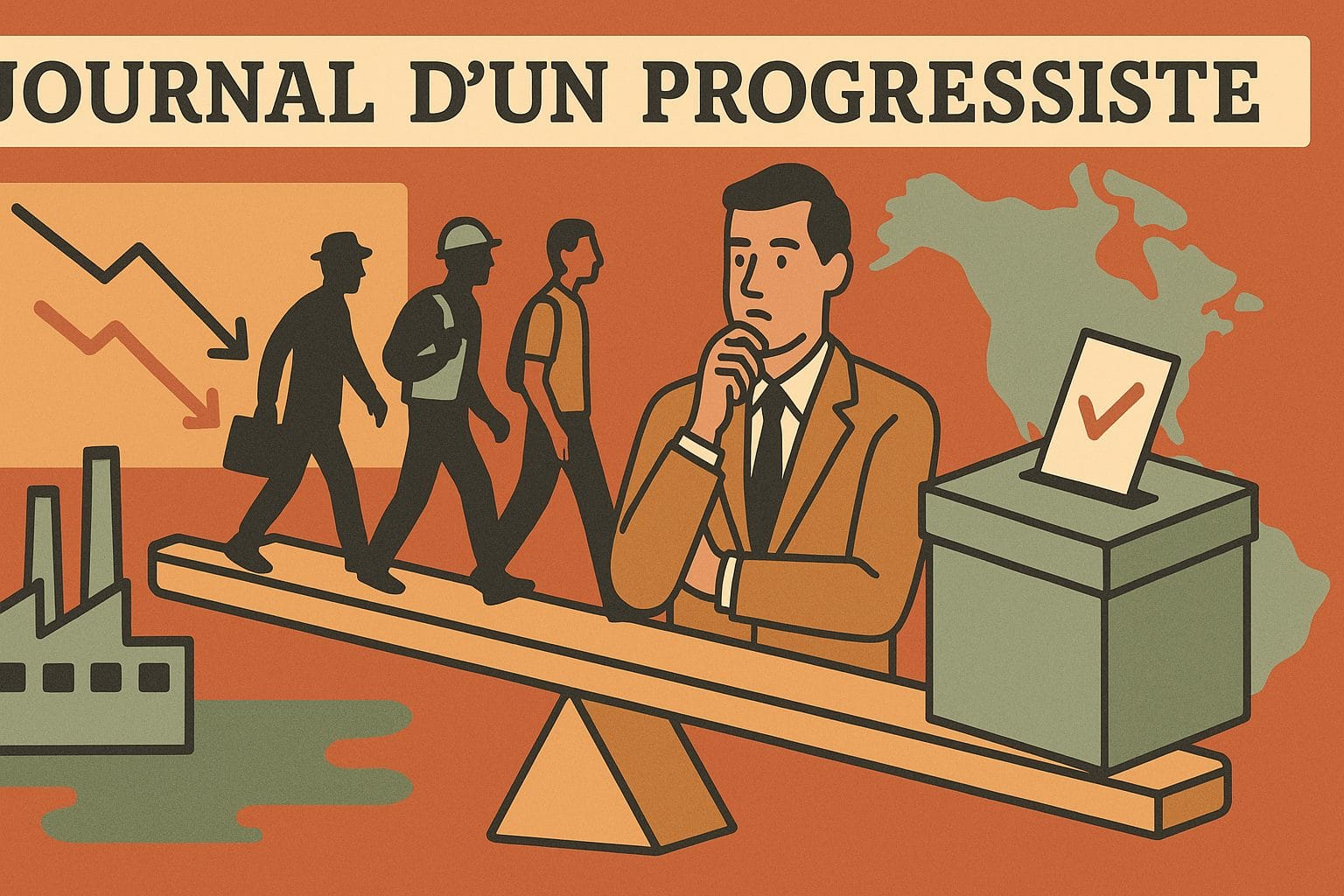
None of these three paths is neutral. Each responds to an implicit question about who should bear the cost of aging: workers through contributions, retirees through reduced benefits, or all taxpayers through general taxation. This choice is fundamentally political.
Inaction Is Itself a Choice
The U.S. Congress has delayed this debate since 2000. At each session, depletion projections are updated, the date draws closer, and no decisive vote occurs. This delay has electoral logic: any contribution increase angers workers, any benefit reduction angers retirees, and any taxation widens debate over budget priorities.
But inaction is not a neutral position. It automatically selects one of the available options. If the fund runs dry in 2033 without legislation changing the mechanism, benefits will be reduced de facto in proportion to incoming revenues. Retirees without savings have no adjustment mechanism. Those with investments or supplemental insurance absorb the shock more easily.
The Pew Charitable Trusts emphasizes in its 2026 analysis that population aging is already structurally changing revenues and spending for American states, independent of Medicare. The oldest states see their tax base contract while their health spending and senior services spending rise. Medicare is the most visible part of a broader budget rebalancing that all American states must absorb simultaneously.
This creates cross-pressures. States cannot borrow freely to cover current deficits. If Medicare cuts reimbursements, states must either supplement care through Medicaid or let costs fall on households. This question of the tax base and who bears it runs through all American budget trade-offs in the medium term.
Solutions Built in Other Democracies
The United States is not alone in facing this challenge. Most democracies with aging populations have had to stabilize their public health systems over the past thirty years, and the mechanisms they have used vary enough to illuminate American choices.
Germany chose gradual contribution increases coupled with hospital supply reform. The health contribution rate increased progressively, and hospitals were pushed to merge and specialize to reduce fixed costs. Universal coverage was not questioned.
Canada, meanwhile, finances its hospital coverage primarily through general taxation, without a dedicated fund. This means the debate over health financing is integrated directly into federal and provincial budgets. This structure is politically more transparent: trade-offs between health, education, and infrastructure are explicit. In return, health depends on fiscal cycles and annual political will.
Sweden introduced automatic adjustment mechanisms in its pension systems: when the ratio between workers and retirees deteriorates, benefits are adjusted automatically according to a pre-established formula rather than through political votes. This automatic brake has the advantage of being predictable and spreading adjustments gradually rather than through abrupt shocks. The OECD documents this model in its international comparisons of pension systems as one of the most robust against demographic shocks.
These experiences do not transpose unchanged. The American system is more fragmented, more tied to the private insurance market, and politically more polarized on fiscal questions. The mechanisms are documented and can inspire reforms, but their transposition requires institutional, budgetary, and political adaptation. They show that multiple architectures exist for financing aging without sharply reducing universal coverage.
Reforms to Implement Between 2033 and 2050
The 2033 horizon is near. The 2050 horizon is the real playing field for decisions to be made in the coming years. The trustees project Medicare spending at 6.83 percent of GDP by 2060. Aging is one factor in these projections, along with beneficiary demographics, utilization and intensity of care, and prices in a structurally expensive health system.
Three structural scenarios emerge for the next two decades, without any being inevitable.
The first is gradual adjustment negotiated before 2033. It would combine a moderate contribution increase, reform of incentives in the hospital system to reduce overconsumption, and partial broadening of the tax base on capital income. This scenario is defended by economists at the Peter G. Peterson Foundation and the Brookings Institution: politically painful, but technically feasible without undermining the program’s structure.
The second scenario is adjustment forced by fund depletion in 2033. HI payments are limited to available revenues. An emergency repair bill is passed with the compromises that parliamentary majorities of the moment allow. This scenario is most likely if Congress maintains its habit of inaction. It places greater burden on retirees without resources and increases pressure on the states.
The third scenario is deeper structural reform that would integrate Medicare into a broader, potentially universal coverage system financed by general taxation. This scenario is politically most difficult in the United States. It would require a consensus that the current American political system does not easily produce. But it is the only one that would simultaneously address the financing problem and inequality of access to care.
Signals exist that would indicate which of these scenarios the country is heading toward. The first is the evolution of the worker-to-retiree ratio in the oldest states: Florida, Pennsylvania, Maine. If these states begin creating mechanisms to supplement Medicare reimbursements, it signals that federal adjustment is lagging and the sub-federal level is anticipating. The second signal is the behavior of private insurers in the Medicare Advantage supplemental market: if they begin reducing coverage or raising premiums significantly before 2033, it means markets are building fund depletion into their models. The third signal is legislative: a bipartisan proposal for funding reform, even partial, would break the pattern of structural inaction.
Medicare in 2026 raises a question that goes beyond the accounting of a public fund: all democracies with aging populations must decide who bears the difference when current workers’ contributions are insufficient to cover retirees’ benefits. The working generation, the one that has already worked, the one to come, or the community as a whole can each contribute in varying proportions. Each institutional architecture resolves this differently, and the absence of deliberate choice constitutes itself a response.
The Politics of Aging Cannot Be Reduced to a Single Fund
Medicare dominates the debate because its depletion date is precise and near. But it is part of a broader demographic rebalancing that the Pew Charitable Trusts document state by state for the United States. Public spending related to age, grouped under the term National Transfer Accounts in comparative economic literature, represents the flow of resources that workers transfer to retirees through taxes, contributions, and public services. This flow increases mechanically when the worker-to-retiree ratio falls.
This mechanism is universal. Japan reached it before the United States and responded with a combination of migration policy, keeping seniors in the workforce, and gradual benefit reduction. South Korea is preparing for it two decades in advance. Southern Europe is already experiencing it.
The United States has an advantage these countries do not or no longer have: sustained immigration that feeds the contributor base. The Census Bureau projects net immigration affecting population size and age structure, even as this flow slows under current migration policies. A slowdown in immigration can increase the elderly dependency ratio, but its effects on Medicare revenues and spending depend on migrants’ age, employment, and eligibility.
This is one of the rare subjects where migration policy and public health policy have a direct and quantifiable arithmetic link. It is rarely at the center of Medicare debate, but the fund’s trustees model it in their long-term projections.
The open question for the coming years is whether agreement is possible before fund depletion, or whether the system will wait for crisis to reform itself. Democracies that acted before depletion almost all began by making the mechanism visible: publishing projections, naming the date, and creating a bipartisan commission with a precise mandate. These conditions exist in the United States. The political will to activate them remains the undetermined variable.
Sources
- Pew Charitable Trusts, “The Aging Population Is Changing States’ Revenue, Spending, and Service Demand Outlook”, July 2026
- Medicare Trustees Report 2026, Social Security & Medicare Board of Trustees
- Peter G. Peterson Foundation, analyses of Medicare deficit and reform options
- AARP, 2026 survey on retirement savings for American seniors
- Census Bureau, demographic projections 2024-2060
- OECD, “Pensions at a Glance 2023”, international comparisons of pension and public health systems