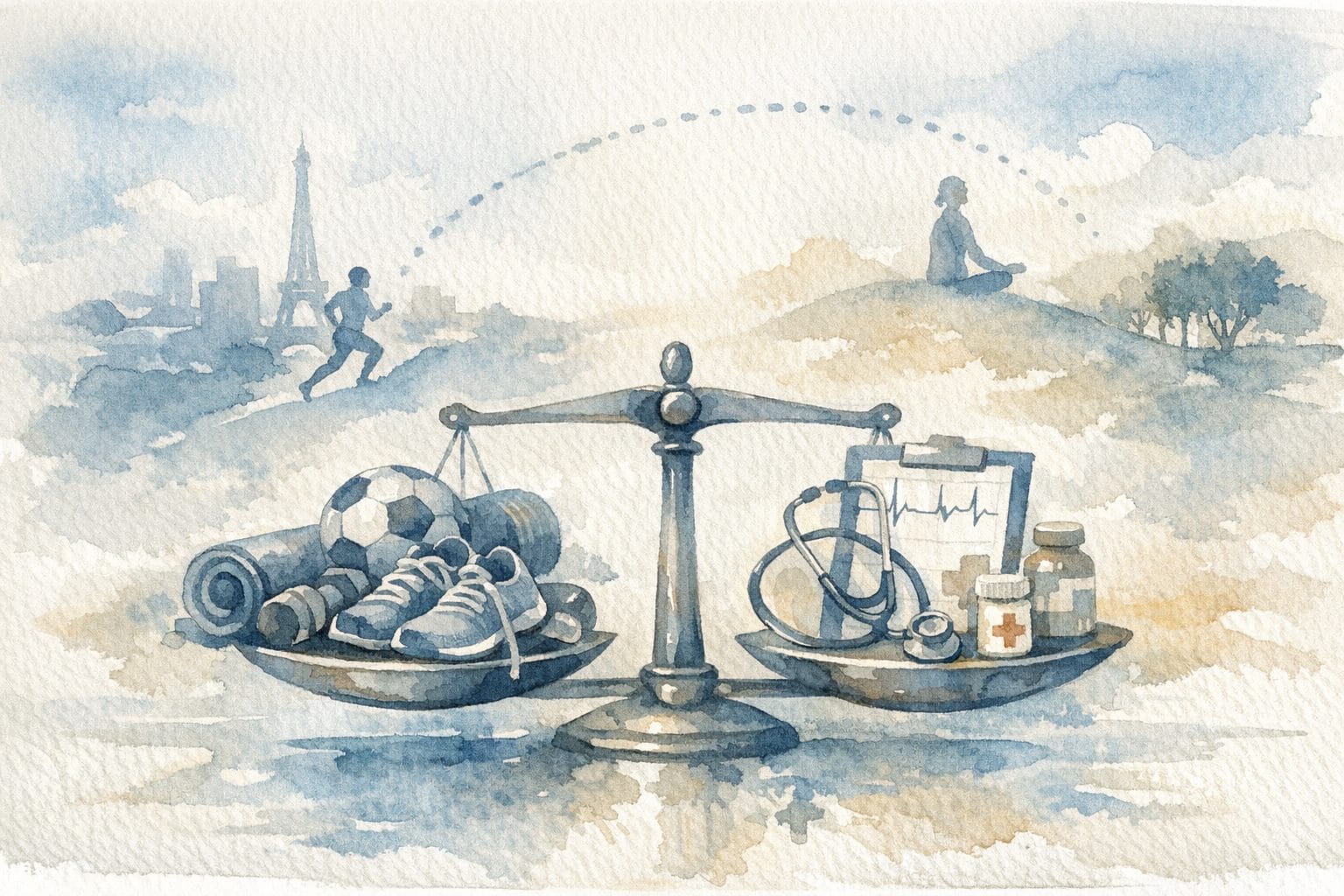
In 2025, 61% of people aged 15 and over practice a sport at least once a week, and 72% have practiced at least once during the year, according to the National Barometer of Sports Practices from the Ministry of Sports. Yet behind this real progress, a silent fracture is widening: fewer and fewer practitioners are going through an associative club. Between 2018 and 2025, the share of athletes affiliated with an association fell from 24% to 20%. This decline raises questions about the French sports system’s capacity to turn more widespread practice into shared benefit.
The essentials
- In 2025, 61% of French people aged 15 and over practice a sport at least once a week, compared to 54% in 2018, according to the National Barometer of Sports Practices from the Ministry of Sports.
- Over the same period, the share of practitioners registered with an associative club fell from 24% to 20%, reflecting a decline across the entire 2018-2025 period, with intermediate fluctuations.
- Associative clubs serve as an access lever for children, seniors, and people with disabilities, notably because of coaching and affordability.
- The overall increase in practice coexists with growth in unstructured practices, which are distributed unevenly across the population.
- The question for the coming decade: how to anchor the momentum of free-form practices to structures that guarantee universal access.
61% of French people active in sport each week: what the Games accelerated
The progress is clear and sustained. In 2018, just over half of French people practiced a sport each week. By 2023, this proportion had reached 59%. By 2025, it exceeded 61%. The Ministry of Sports attributes part of this acceleration to the effect of the Paris 2024 Olympic and Paralympic Games, which brought sport back to the center of public debate for several months.
This “major events” effect is documented in other countries. London 2012 had produced a measurable increase in sports practice in Britain in the two years following the Games, before the curves stabilized. Paris 2024 appears to have played a comparable role, amplifying a trend that already existed.
The increase touches diverse audiences. Women, historically less sporty than men in French surveys, have narrowed the gap. Seniors practice more. The barometer data do not allow for precise isolation of sectoral effects, but the overall movement is clear and consistent over seven years.
French people report practicing more, but weekly frequency excludes occasional practices from the measured scope. The indicator is therefore relatively robust.
Free-form practice grows, associative clubs decline
The overall increase masks a structural transformation in how French people relate to sport. What is growing fastest are autonomous practices: going for a run, cycling in the city, training at home or in a commercial gym. What is declining, proportionally, is affiliation with an associative club.
In 2018, 24 practitioners per 100 were members of a sports association. In 2025, this ratio is 20. In absolute volume, the number of affiliated members may have slightly increased since the overall base of practitioners has widened. But the associative share is shrinking, and it is this relative movement that deserves attention.
The reasons are multiple. Practices without time constraints or annual commitments appeal to working people with packed schedules. Activity-tracking apps have made autonomous training more attractive. Commercial fitness gyms have multiplied their entry-level offerings. And for certain disciplines, digital platforms offer training programs that partially substitute for collective coaching.
This transformation is not uniquely French. All Western European countries observe a similar trend: the share of athletes affiliated with national federations stagnates or declines, while unstructured practice grows. What France is experiencing today resembles what Germany or the Netherlands went through in the 2010s.
What associative clubs offer that solitary running does not
Understanding why this relative decline poses a problem requires describing precisely what an associative club does.
A club first means trained supervision. Whether it is a credentialed sports educator or a certified volunteer, the presence of a competent adult makes practice accessible to those who do not know where to start: a ten-year-old child, a senior returning to activity after a break, a person with a disability. The commercial or autonomous offering presupposes a capacity for self-direction that not everyone has.
A club also means pooled pricing. Associative memberships generally offer affordability distinct from commercial gym subscriptions. Some clubs offer social rates, grants, and partnerships with family benefit agencies. Low-cost gyms have diversified the commercial offering, but for team sports, martial arts, swimming, and gymnastics, the associative club remains an important entry point.
A club also constitutes a territorial anchor. In certain priority neighborhoods and rural municipalities, the associative club represents a structured offering with no commercial equivalent. Its disappearance or weakening leaves a gap with no alternative.
These three functions—coaching, affordability, territorial presence—characterize the associative model and have no equivalent in autonomous or commercial practices. And it is these functions that make sport a public health tool, not merely an individual habit.
The audiences benefiting least from the overall increase
The rise from 54% to 61% of weekly practitioners is real. It deserves to be measured against who benefits from it.
The data confirm social inequalities in practice by education and income, and a predominance of free-form practices, but do not allow precise attribution of the increase to a determined urban socio-professional group. This profile corresponds to the core of the commercial fitness and running market. These people often already practiced sport; they do more of it now, and in ways more visible in overall statistics.
The data show inequalities in practice by age, education, and income, and a low share of sports licenses in priority neighborhoods. For these populations, the associative offering has structural importance that no other model can reproduce. Yet it is precisely this offering that is losing ground, relatively.
This trend extends beyond the sports domain alone. Large national statistics regularly mask divergent trajectories by social group, as shown by data on households’ net savings, where national averages conceal very different realities by income category.
The overall increase in sports practice is therefore real progress. But it is not distributed evenly, and the mechanisms that could correct this distributional inequality—associative clubs—are precisely those that are weakening.
The actors working to reverse the trend
Several categories of actors are actively working to maintain or strengthen the associative sports network.
The State launched the “Generation 2024” plan to develop sports practice in schools and priority neighborhoods. The “30 minutes of daily physical activity” program in primary school, gradually rolled out since 2023, is aimed precisely at children who do not attend clubs. The National Sports Agency, created in 2019, channels public funding to federations and local clubs with reinforced territorial targeting.
Some sports federations have undertaken transformations of their model. The French Football Federation has developed short-format practice offerings, futsal, five-a-side football, adapted to the time constraints of urban adults and less dependent on costly infrastructure. The French Judo Federation is experimenting with per-session memberships in several territories to reduce the barrier of annual commitment. These adjustments attempt to bring associative offerings closer to contemporary lifestyles without abandoning coaching.
Local authorities also play an active role. Several major cities have implemented local “sport pass” schemes, complementary to the national pass launched by the State, to finance membership for children from modest-income families. Lyon, Bordeaux, and Strasbourg have developed specific programs in priority neighborhoods in partnership with local associative clubs.
The open question is one of scale. These initiatives exist; they work locally. But they remain scattered and underfunded relative to the magnitude of the movement they seek to counterbalance. For associative momentum to rebound, these efforts would need to scale up, which is not assured in the current budget context of French municipalities.
Sports rights and universal access
The question of associative decline connects to a broader debate on the nature of the right to sport. In international forums, sports practice is increasingly treated as a fundamental right, not merely as leisure. This evolution in the normative framework, analyzed in detail in the book review of Sarah Joseph’s work on human rights and sport, has concrete implications for public policy: if sport is a right, the State has responsibility for accessibility, not just overall practice.
This perspective leads to evaluating the 2025 outcome differently. A seven-point increase in weekly practitioners is a success if sport is measured as an aggregate. It is a partial result if sport is measured as a right distributed equitably across territory and all social categories.
Both readings are legitimate. They do not lead to the same policies.
Transforming momentum into system
France in 2025 is more active in sport than in 2018. This increase is supported by multiple survey waves between 2018 and 2025. The Ministry associated the Games with the 2025 increase, but their specific causal effect and the trajectory without the Games are not measured precisely.
The challenge in the coming years is of a different nature: how to ensure this momentum reaches those it has not yet reached? Isolated elderly people whose health benefits from regular practice are best documented. Children in priority neighborhoods for whom sport is also a vehicle for socialization. Adults in precarious situations for whom the cost of an associative membership remains a real obstacle.
The associative network plays a structuring role in sports access for populations facing barriers. Free-form practices, commercial gyms, and digital platforms offer differentiated access; associative structures retain a specific function for populations facing barriers. Strengthening clubs, adapting their formats, and funding their presence in under-resourced territories represents the most difficult part of French sports policy.
Sources
- Ministry of Sports, Youth and Civic Life, National Barometer of Sports Practices 2025
- Santé publique France, Physical Activity and Sedentary Behavior in the French Population (no guaranteed URL)
- National Institute for Youth and Popular Education (INJEP), data on sports licenses and associations