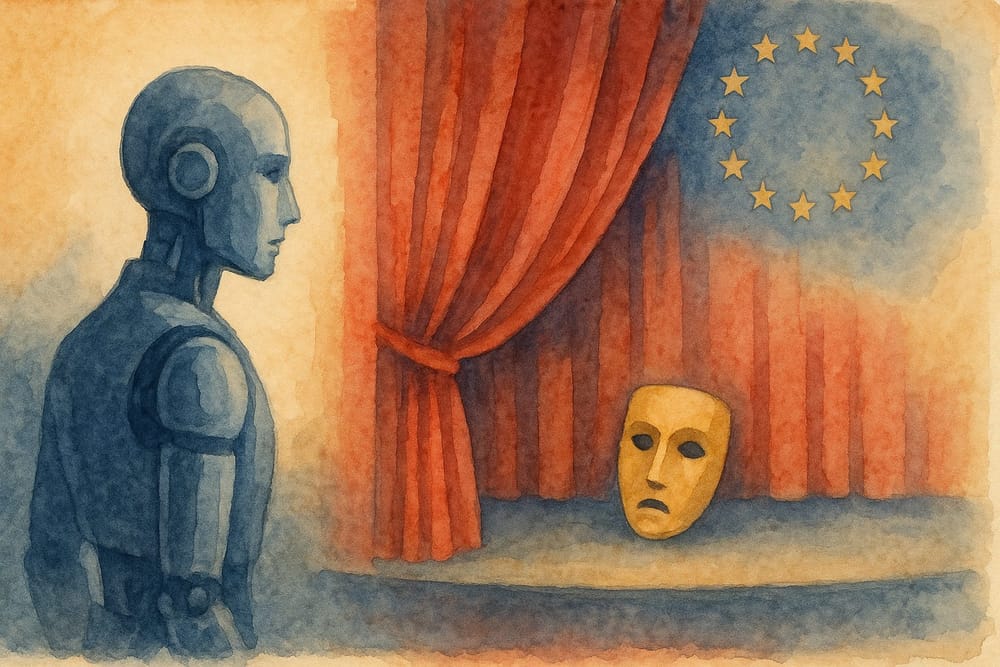
In 1967, a parliamentary committee recommended the abolition of theatrical censorship; this was implemented by the Theatres Act 1968, an institution two centuries old that had entrusted a single official with the right to decide what Londoners could see on stage. The European AI Act today covers 450 million citizens spread across 27 countries, but it provides for a complaint mechanism with the supervisory authority without establishing a specialized appeal for every moderation decision. Economist Deirdre McCloskey sees in this parallel an alarm signal: danger often stems from the absence of checks and balances. The question of who decides what AI can say, and through what channels one can contest it, is not trivial.
The Essentials
- The European AI Act (2024) establishes rules for high-risk AI systems but does not provide a dedicated appeals procedure for moderation decisions, although it allows direct complaint to the supervisory authority in case of violation.
- McCloskey cites London theatrical censorship (abolished in 1968) to show that concentrating the right to decide what can be said blocks creative contestation, whether artistic or intellectual.
- The AI Act requires independence, impartiality, and absence of bias from competent national authorities, but does not establish accessible adversarial procedures for citizens to contest moderation decisions.
- A competing reading, that of institutional economists, holds that an imperfect regulatory framework is better than the absence of rules, provided it is subject to amendment.
- The issue at the 2030 horizon: either liberal democracies invent mechanisms for digital contestation, or they leave the field to state or corporatist actors who have no need for them.
The Lord Chamberlain and the Algorithm
Until September 26, 1968, the date the Theatres Act 1968 came into force, every play performed on an English stage had to obtain approval from the Lord Chamberlain. This royal official could strike out a line of dialogue, forbid a character, demand the rewriting of an entire act. He did so for works by Samuel Beckett, Edward Bond, and Harold Pinter. Prior censorship organized English theatrical space by defining what would never have a place there.
Plays were being discussed. The question of who could contest the censor’s decision, and according to what procedure, remained unanswered for two centuries.
McCloskey mobilizes this parallel in an interview granted to the Institute of Economic Affairs in 2026 to point out something specific: London theatrical censorship produced an architecture of power in which a single actor held final authority, with no obligation to justify refusals nor any procedure allowing the author to defend himself. What McCloskey calls “creative contestation,” the right to challenge what has been decided, to experiment, to fail and try again, was structurally impossible. Applying this reading to generative AI yields uncomfortable results for supporters of regulation without adversarial procedures.
The AI Act: Scope and Limitations
The AI Act, adopted in 2024 and progressively implemented since 2025, is the first comprehensive legal framework on artificial intelligence in the world. It distinguishes four levels of risk, prohibits certain uses (Chinese-style social scoring, subliminal manipulation), and imposes transparency obligations on high-risk systems. It is a serious text, the fruit of four years of negotiations among 27 member states.
It organizes oversight by competent national authorities that each country designates. These authorities receive reports and conduct oversight or evaluation of systems, while member states determine the rules and authorities applicable to sanctions. High-risk system providers must notably document and have conformity evaluated before market placement; deployers must notably keep logs under their control and inform affected workers when they are employers. Users, for their part, have the right to be informed that they are interacting with an automated system in certain situations. They can report a breach to the national authority.
But the AI Act does not create a dedicated appeals procedure for specific moderation decisions, refusals to respond, or content removal, although the DSA already requires online platforms to have an internal complaints system against such decisions.
The contrast with the GDPR is stark. The data protection regulation creates subjective rights: right of access, right to rectification, right to erasure. Every citizen can invoke these before the competent national authority and, if unsatisfied, before a court of law. The AI Act does not create an equivalent for digital speech. This gap reflects a political choice about who is authorized to contest.
The McCloskey Thesis: Freedom and Contestation as Drivers
McCloskey has defended for several decades a thesis on the origins of the Great Enrichment, the unprecedented economic growth that has multiplied average living standards by thirty or forty since 1800. Her answer diverges from usual explanations based on capital accumulation or narrow institutional analysis: what changed is the legitimacy accorded to innovation and questioning. Societies that prospered are those that allowed “bourgeois dignity,” the right to attempt, to fail publicly, to start over, and to be taken seriously in doing so.
Applied to AI regulation, this thesis takes a precise direction. What matters, according to McCloskey, is the existence of mechanisms allowing one to contest or challenge rules in societies where innovation has flourished. A rule without a contestation procedure is a sentence without appeal. In the digital world, this means that an algorithmic moderation decision should be contestable by those it affects.
McCloskey emphasizes in this interview that London theatrical censorship was, in its way, perfectly regulated. There was a form to fill out, a response deadline, fixed fees. What was missing was not regulation but contradiction: the possibility for the author to respond and make his point through accessible and independent channels. The AI Act does not establish this system for all AI, but European citizens already have, for platforms covered by the DSA, channels to contest moderation decisions.
The Institutionalist Reading: Imperfect Rules Beat Anarchy
A different strand of intellectual compass from liberal progressive thinking resists this reading, and it deserves to be taken seriously. Institutional economists, of whom Daron Acemoglu represents a major voice, emphasize that the absence of a regulatory framework is not a neutral zone of freedom: it is a space where the most powerful actors set the de facto rules. In the case of AI, these actors are a handful of American and Chinese companies.
The argument is empirically solid. Before the AI Act, internal policies already coexisted with European obligations, notably those of the DSA for concerned platforms, imposing transparency and recourse for certain moderation decisions. An imperfect framework, according to this reading, is better than a market without rules dominated by oligopolies. Rejecting the AI Act in the name of absent checks and balances risks leaving the field to actors who never needed them.
This tension is real. But McCloskey is not arguing for the absence of rules, and it is precisely here where the theatrical parallel becomes illuminating. What the British Parliament did in 1968, in abolishing the Lord Chamberlain’s censorship, was not to eliminate all theatre regulation: laws on defamation, obscenity, and incitement to hatred continued to apply. The transformation concerned the architecture of control: from a system of unilateral prior censorship toward a system based primarily on offences and judicial procedures after or around the performance, while retaining preventive administrative and police mechanisms. The AI Act does not establish an individual appeals mechanism specific to all moderation decisions, but it does provide for complaint channels and preserves administrative and judicial recourse.
The true alternative opposes rules accompanied by adversarial procedures accessible to citizens against rules stripped of them. The institutionalist reading reminds us that such procedures result from political power dynamics and do not impose themselves. Defending them requires actors—states, civil society organizations, and lawyers—capable of asserting them against companies with the least interest in them.
The data localization laws indeed show that digital regulation regularly produces unforeseen effects that reinforce oligopolies instead of constraining them: compliance costs weigh more heavily on newcomers than on giants already in place.
The Contestation Mechanisms Liberal Democracy Must Build Before 2030
The prospective question is this: do liberal democracies have a window of time to decide whether digital speech will fall under a legal regime close to press law, contradiction, recourse, decision-maker independence, or a technical compliance regime where the essential happens in audits between companies and regulators, beyond citizens’ reach?
Two trajectories are emerging, without current data allowing one to definitively privilege either.
In the first, European democracies complete the AI Act with mechanisms inspired by the GDPR: individual rights opposable to algorithmic decisions, access to an independent body, obligation to justify refusals of service. The Court of Justice of the European Union plays a growing role in interpreting these rights. Organizations like AlgorithmWatch or the EDRI provide the citizen expertise that allows litigation to function. This scenario assumes a political will that the regulatory revisions underway in 2025-2026, notably on the Digital Services Act revision, have not yet clearly demonstrated.
In the second trajectory, the compliance architecture prevails. Providers of general-purpose AI models have obligations for documentation, transparency, and, for systematically risky models, risk assessment and management. A general certification regime by accredited private audit does not exist. Complaints between companies provided specifically for general-purpose AI models are addressed to the AI Office; national authorities receive general complaints provided for in Article 85; individual users have limited channels to contest.
This model organizes multi-institutional governance with independent national authorities and complaint mechanisms, rather than censorship by a single decision-maker. Countries exporting AI models with their own moderation standards, notably the United States and China, find in this architecture a convenient void to deploy their explicit ambitions in this area.
McCloskey’s analysis suggests that AI regulation could function without adversarial procedures accessible to citizens if no deliberate political effort establishes them. The other trajectory requires deliberate political effort, comparable to what represented the abolition of the Lord Chamberlain: changing who can contest rules and through what channels. The 2027 French presidential election will be one of the battlegrounds where these architectural choices, often presented as technical, become explicitly political choices.
The Signal to Watch: Who Drafts Contestation Standards
Harmonized standards CEN-CENELEC published in the EU Official Journal can provide a presumption of conformity; ISO and NIST also develop technical references, but they do not automatically become AI Act audit references. These standards describe what a high-risk AI system must do to be compliant. They rarely describe what a user affected by such a system can do to contest it.
The issue is there, more than in the legislative texts themselves. London theatrical censorship did not survive the arrival of authors like John Osborne and Harold Pinter, who made its decisions publicly untenable. Creative pressure preceded legislative reform. In the case of AI, equivalent actors exist—lawyers, citizen organizations, journalists specialized in algorithmic systems. Their capacity to document moderation decisions, to reveal their criteria, and to show their concrete effects on identifiable people is the most direct signal to distinguish the two trajectories.
An architecture of contestation is built through accumulation of precedents, case law, and scandals made visible. This is how press law was built in Europe during the nineteenth century: not through a single decision, but through accumulation of cases where the impossibility of response became politically untenable. The automation of cognitive work raises an analogous question on other grounds: who benefits from the gains, and who can be held accountable. Digital speech and digital work share the same fundamental institutional gap.
The next AI Act review cycle is scheduled for 2028. That is the window in which the question of users’ contestation rights can, or cannot, enter the text. The actors working to open it, or to keep it closed, are identifiable now in the working groups of standardization agencies, in the European Commission’s public consultations, in disputes brought before national courts. The outcome is not written.
Sources
- Deirdre McCloskey, Freedom or Welfare State? Deirdre McCloskey on the Liberal Choice, Institute of Economic Affairs, 2026, https://insider.iea.org.uk/p/freedom-or-welfare-state-deirdre
- Deirdre McCloskey, The Legacy and Future of Liberalism, American Enterprise Institute, https://www.aei.org/articles/the-legacy-and-future-of-liberalism-a-quick-qa-with-economist-deirdre-mccloskey/
- Regulation (EU) 2024/1689 of the European Parliament and of the Council of 13 June 2024 laying down harmonised rules on artificial intelligence (AI Act), Official Journal of the European Union
- Theatres Act 1968, Parliament of the United Kingdom
- Daron Acemoglu & Simon Johnson, Power and Progress: Our Thousand-Year Struggle Over Technology and Prosperity, PublicAffairs, 2023