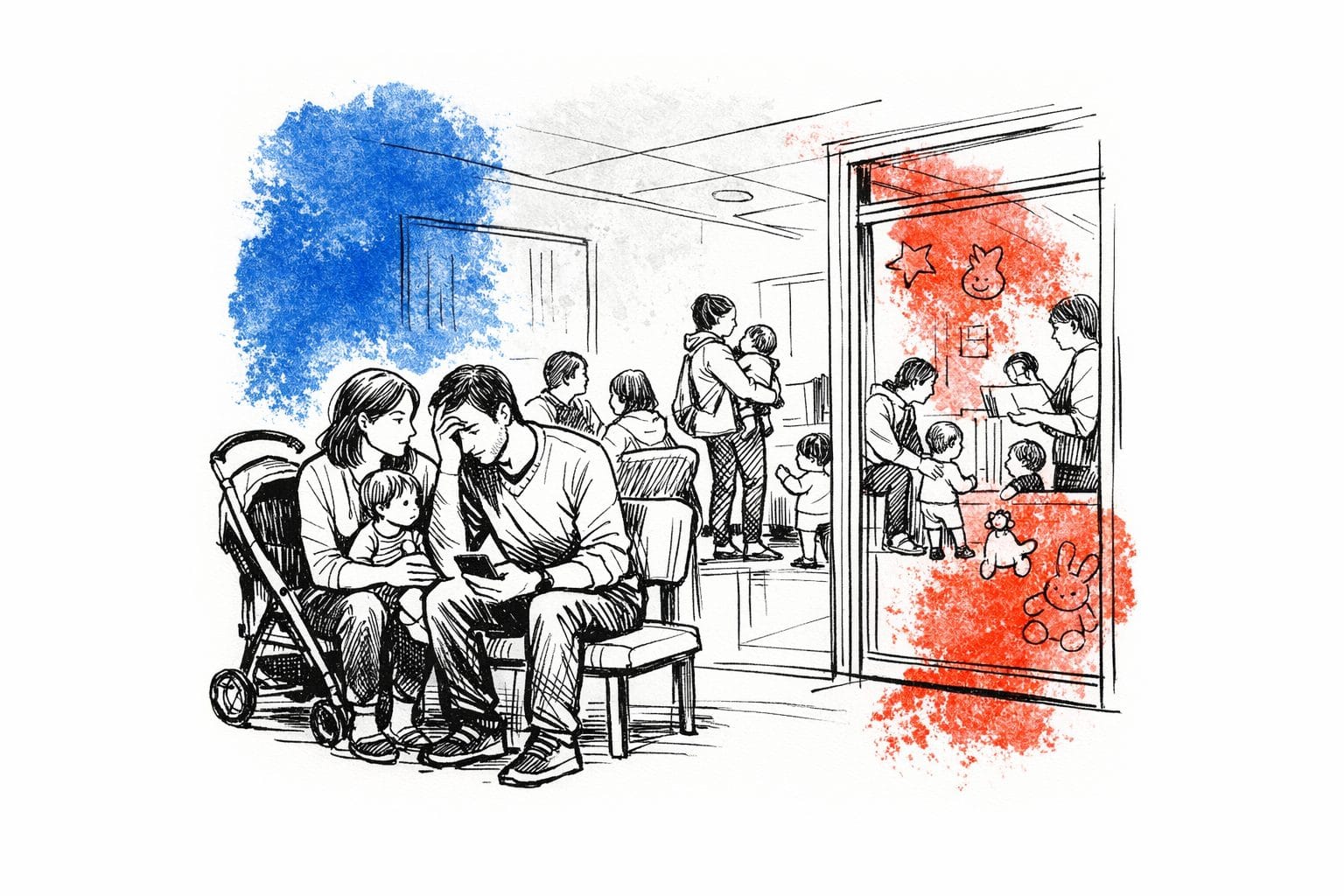
Sixteen percent of salaried jobs have precarious status in 2024, twice as many as forty years ago [1]. This doubling of the precarity baseline is the structural fact weighing on unemployment insurance. Successive reforms since 2017 have tightened compensation conditions for those who needed it most, while the State drew from the joint-management fund to finance other things. The 2027 arbitration consists of deciding who should bear the cost of flexibility: the precarious workers themselves, or the employers who resort to it.
Three million recipients, one thousand seventy-five euros per month
At the end of 2024, 4.3 million people registered with France Travail are eligible for benefits, or two-thirds of registrants [2]. Among them, 3.1 million actually receive benefits. Those who do perceive an average of 1,075 euros gross per month [2]. A system that still covers the majority, but with modest amounts and shrinking coverage.
France ensures 57% of the reference daily wage, compared to 90% in Denmark, 80% in Luxembourg and 75% in the Netherlands and Italy [3]. These comparisons are based on 2024 Unédic data.
The 2021 reform reduced the rights of nearly one million people
The 2019-2021 reform widened the gap for the most precarious. It introduced a new calculation method for the reference daily wage that includes non-working periods. For those alternating short contracts and unemployment, this reference wage drops by an average of 25% [4]. The daily allowance falls by 18% as a consequence [4]. The compensation period lengthens in return, but the monthly payment decreases.
In total, this recalculation affects nearly one million people with fragmented work histories [4]. The measured result is faster return to work, but to non-sustainable jobs, obtained by accepting degraded conditions [4].
The circle is there. Precarious jobs generate reduced rights. Reduced rights push people back into precarious jobs. These jobs generate new reduced rights. Unédic itself observes that precarious workers and young people were most affected by the 2021 and 2023 reforms, and that the number of rights openings fell by 14% between 2019 and 2023 [5].
In February 2023, a second layer was added. The compensation period is now modulated according to the labor market situation [6]. When unemployment is low, rights are reduced. But precarious workers remain exposed even when the market is doing well.
Twelve billion drawn from the joint-management fund in four years
The second structural fact is budgetary. Unemployment insurance spending reaches 44.4 billion euros in 2024 [6]. It also finances approximately 80% of France Travail’s budget, the public job placement operator. Employee and employer contributions thus finance both allowances and a public placement service.
Since 2023, the State has drawn directly from these revenues. A decree from December 2023 set the amounts: 2 billion in 2023, 2.6 billion in 2024, 3.35 billion in 2025, 4.1 billion in 2026 [6]. That is 12.05 billion in four years.
The consequence is direct. After a slightly positive balance in 2025, the deficit reaches 2.3 billion euros in 2026 [6]. Unemployment insurance debt should reach 61.5 billion euros that year [6]. The debt reduction underway after the Covid crisis has stalled.
The debt results largely from exogenous decisions, imposed without consultation with the labor unions and employer organizations that manage the system. Unédic is a joint-management fund, governed by unions and employers. Since 2017, the State sets the rules, then captures surpluses to finance other things.
Nicolas Dufourcq places this mechanism in a broader picture: each month, three days of pensions, income support or unemployment benefits out of thirty are financed by borrowing [12]. In the early 1980s, debt financed only 1% of social spending. It now finances 10% [12].
The incentive to hire precarious workers remains subsidized by the public
The causal chain runs higher. Precarity has doubled in forty years partly because the system makes the public pay for the cost of employer flexibility, without making them bear their fair share.
The bonus-malus introduced in 2021 sketched out an answer. But this mechanism remains limited to a small number of sectors. It rests on an imperfect criterion, the separation rate, which does not reflect the real cost to the system.
Laying off a senior costs the system on average more than laying off a young person. The current bonus-malus does not distinguish between them. The Economic Analysis Council indicated in 2026 that the project of employer incentives remains crucial, both for short contracts and for severance agreements and retention of seniors [11].
Bertrand Martinot points to an unemployment insurance system that encourages early departures, reducing the effective duration of work compared to the European average [13]. The penalization of continuous work and the implicit subsidy of short-contract use are two sides of the same malfunction.
Transfer the cost to employers, return the fund to social partners
The 2027 arbitration is not another tightening of benefits. It concerns two linked decisions, on the side of contributors and governance.
First point: employer contribution base. The partial bonus-malus must become a genuine generalized experience-rating mechanism. Each employer contributes in proportion to the real cost they generate for the system: frequency of separations, profile of employees concerned, duration of contracts.
An employer who regularly lays off seniors pays more than an employer who retains them. The CAE formulated it in 2026: a more refined mechanism adjusts contributions based on real cost [11]. This reform transfers to the employer the decision to factor into their hiring and separation choices the real cost to the public, instead of externalizing it to the common fund.
Second point: governance. State takeover has become the rule since the Professional Future Law of 2018. This law introduced a budget framework letter by which the government pre-sets the objectives and financial trajectory of negotiations between social partners. As long as the State can dictate rules, then tap surpluses, social partners can neither properly protect the insured nor finance support that accelerates return to sustainable employment.
The break consists of eliminating the budget framework letter and returning dedicated revenues to the system. Social partners regain real control over the fund they manage. In return, they assume a performance obligation on return to sustainable employment and debt reduction. France Travail’s financing shifts to the State budget, consistent with what Bertrand Martinot documented: in other European countries, the placement operator’s financing is assured by taxes, not unemployment contributions [13].
What this choice closes is clear. The State can no longer use joint-management fund surpluses to finance training or placement policies unrelated to unemployment insurance. This choice opens a configuration in which employers who generate the most unemployment finance its real cost, and social partners run a system for which they are genuinely responsible.
Sources
[1] Center for Social Observation, “Job precarity has doubled in forty years,” from INSEE data, April 2026, https://www.observationsociete.fr/travail/statuts/evolution-precarite/ (accessed 26/10/2026).
[2] DARES, “Compensation for those registered with France Travail in 2024,” France Travail, 2025, https://dares.travail-emploi.gouv.fr/publication/indemnisation-des-inscrits-france-travail-en-2024 (accessed 26/10/2026).
[3] Unédic, “Europ’Info 2024: Unemployment Insurance in Europe,” Unédic, September 2024, https://www.unedic.org/publications/europ-info-2024-l-assurance-chomage-en-europe (accessed 26/10/2026).
[4] DARES / Evaluation Committee, “Report of the Committee Evaluating the Unemployment Insurance Reform 2019-2021,” DARES, March 2025, https://dares.travail-emploi.gouv.fr/comite-devaluation-de-la-reforme-de-lassurance-chomage-initiee-en-2019 (accessed 26/10/2026).
[5] Unédic, “Monitoring and Effects of Unemployment Insurance Regulations in 2023,” Unédic, 2024, https://www.unedic.org/publications/suivi-et-effets-de-la-reglementation-d-assurance-chomage-en-2023 (accessed 26/10/2026).
[6] Unédic, “Unédic Financial Forecasts: June 2026,” Unédic, June 2026, https://www.unedic.org/publications/previsions-financieres-de-lunedic-juin-2026 (accessed 26/10/2026).
[11] Economic Analysis Council (CAE), “Measuring the Effectiveness of Unemployment Insurance,” CAE Notes, no. 4, May 2026, https://shs.cairn.info/revue-notes-du-conseil-d-analyse-economique-2026-4-page-1?lang=fr (accessed 26/10/2026).
[12] Nicolas Dufourcq, The Social Debt of France. 1974-2024, Odile Jacob, 2025.
[13] Bertrand Martinot and Franck Morel, Work Is the Solution, Hermann, June 2025.