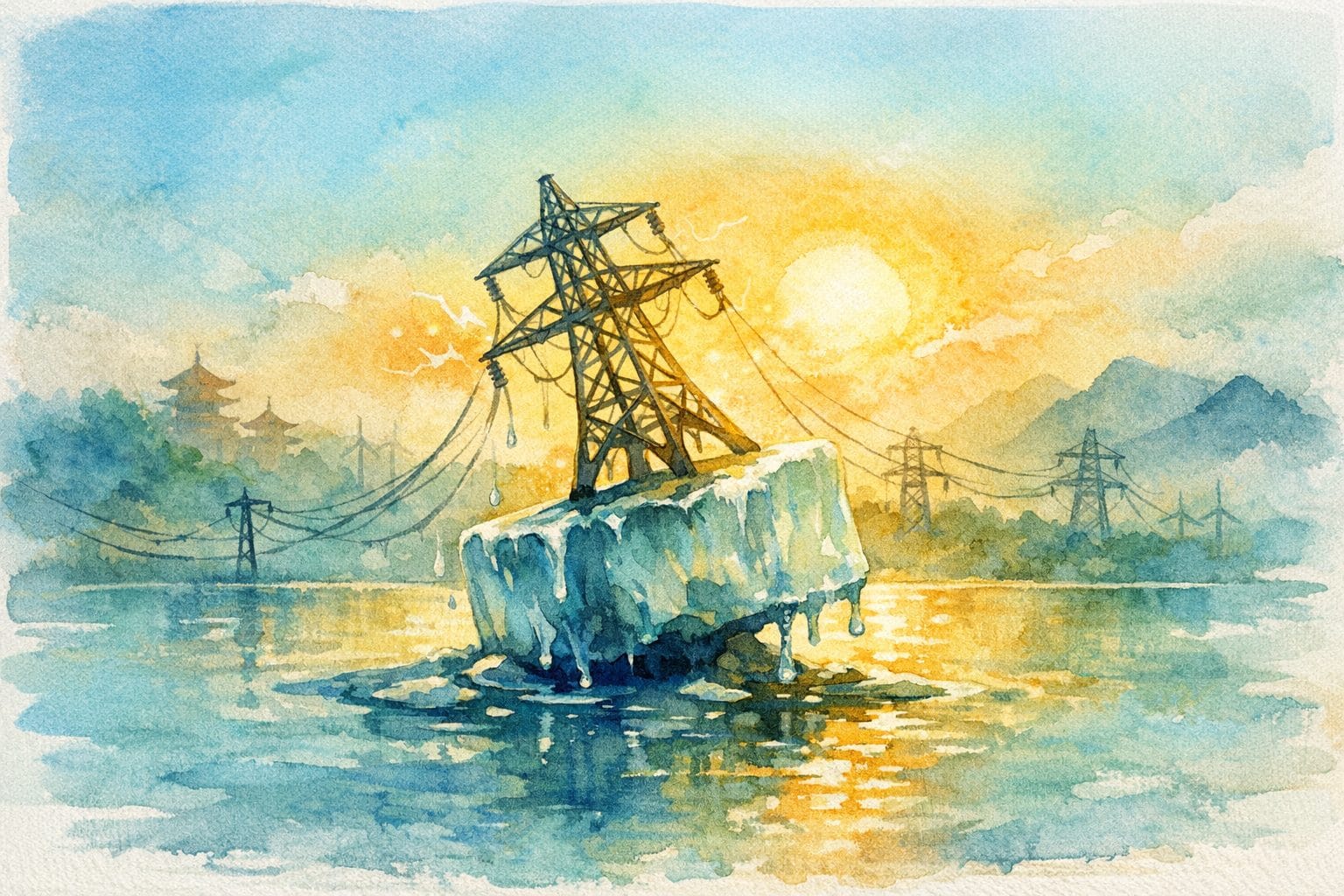
Reaching carbon neutrality is not enough to stop global warming if emissions cease too late. Simulations published in Nature Climate Change in November 2026 show that the world would inherit an additional 0.4 to 0.6 °C of warming for 150 years if emissions stop between 3 and 5 °C of warming. This finding transforms the debate on net zero: the ambition of the peak matters as much as the date of reaching neutrality.
The essentials
- Reaching net zero between 1.5 and 2 °C tends to stabilize temperature; beyond that, an additional warming of 0.4 to 0.6 °C persists for 150 years after emissions stop (Gibbs et al., Nature Climate Change, 2026).
- This additional heat depends on the peak level reached before stopping, something that carbon neutrality pledges rarely express.
- At a higher peak, terrestrial absorption tends to saturate and the decline in CO₂ produces proportionally less radiative cooling, which limits the reversibility of warming after emissions stop.
- A high warming peak can commit to additional warming for centuries in these simulations, but the study does not assign a withdrawal obligation to any given nations.
- The Global Tipping Points Report 2023 indicates that several systems could tip from around 2 °C, which makes limiting the thermal peak distinct from the neutrality objective.
Net zero measures the path, not the destination
The concept of carbon neutrality, “net zero,” has become the common language of climate policy. National plans display it, companies claim it, treaties refer to it. The idea is straightforward: if emissions fall to zero, temperature can stabilize, but this stabilization depends on the level of temperature reached before stopping. But this intuition rests on a condition that climate models now specify with care: it only holds fully if emissions cease before crossing certain warming thresholds.
Laura Gibbs and her coauthors subjected the UKESM1.2 climate model to a series of simulations in which emissions stop abruptly at different temperature levels, from 1.5 °C to 5 °C above preindustrial. The result published in Nature Climate Change is clear: when stopping occurs between 1.5 and 2 °C, temperature stabilizes or declines slightly. When it occurs between 3 and 5 °C, additional warming after neutrality reaches 0.4 to 0.6 °C and persists for 150 years.
These fractions of a degree become significant on a human scale. One hundred fifty years represents six generations. A child born in 2026 will have great-great-grandchildren who will still live under the additional heat committed by today’s emissions. Delayed action translates into additional temperature imposed on generations who did not emit.
Carbon sinks absorb less well after a high peak
This additional warming results from radiative imbalance and the evolution of terrestrial and oceanic carbon sinks.
Forests and oceans currently absorb about half of human CO₂ emissions. This free service rests on fragile physical and biological balances. With warming, the terrestrial sink degrades and the cooling effect of sinks is nonmonotonic and weakens at the highest warming levels, while absolute ocean absorption can increase. Warmer oceans have reduced capacity to absorb CO₂, but their absolute absorption can nonetheless increase when atmospheric CO₂ is higher. Forests subjected to repeated droughts and fires release carbon instead of storing it.
Permafrost thaws and releases methane and CO₂ accumulated over millennia.
At 1.5–2 °C in these simulations with zero CO₂ emissions, sinks and energy balance lead to zero emissions commitment (ZEC) close to zero. At 3 °C and beyond, additional warming comes from radiative imbalance and the relative limitation of cooling by sinks. Gibbs et al.’s simulations capture the mechanism of radiative imbalance and carbon sink response, without establishing a “derangement of planetary regulators.”
The Global Tipping Points Report 2023 has documented these thresholds with increasing precision. Some climate systems and ecosystems may exhibit thresholds and abrupt or barely reversible changes, but Arctic sea ice is considered reversible over timescales of a few years to decades. These irreversibilities do not disappear at the moment of net zero. They constitute the thermal foundation on which future generations must act. Widespread air conditioning already threatens the stability of electrical grids in many regions of the world, and this phenomenon amplifies as the thermal floor rises.
Persistent gaps in national carbon budgets
The political reach of Gibbs’s study lies in what it reveals about current pledges. Many new national contributions are linked to long-term neutrality objectives communicated in NDCs or in low-emission development strategies, 2050 for most developed economies, 2060 for China, 2070 for India. These dates matter. But they say nothing about the peak level reached before stopping.
Current policies project toward approximately 2.8 °C of warming this century. In the simulations, additional warming persists for at least 150 years when emissions stop at 3 K or higher; 2.8 K is not a simulated level. This distinction between neutrality level and peak level is often absent from national climate plans. Tracking indicators measure emissions and objective dates, but standard frameworks do not prescribe the thermal peak as an independent indicator.
The TIPMIP program, a cross-model effort to compare simulations on tipping points, should refine these estimates in coming years. Its results will indicate whether the additional heat observed in UKESM1.2 simulations is robust across models, or whether orders of magnitude vary depending on the representation of sinks and feedbacks. These cross-model results are the signal to watch for calibrating future ambitions. In the meantime, Gibbs et al.’s study constitutes one of the first precise quantifications of this additional amount according to peak level, and its orders of magnitude deserve to enter current policy debates.
What a society that has exceeded 2 °C will need to finance for decades
The scenario of a thermal peak exceeding 2 °C before emissions stop is the one toward which current policies are converging if their pace does not accelerate.
In this scenario, climate stabilization requires active and sustained removal of CO₂ from the atmosphere. Available or developing technologies range from large-scale reforestation to direct air capture (DAC), passing through bioenergy coupled with capture and storage. CO₂ removal methods differ greatly: DACCS remains expensive, energy-intensive, and sparsely deployed, while reforestation is more mature and already widely practiced, with other permanence and land-use constraints. Current DAC projects are estimated by the IEA at approximately 500–1,900 dollars per ton of CO₂. To remove billions of tons per year for decades, costs must fall and financing capacity must be organized.
The question of who finances this removal is as political as it is technical. Nations that have historically emitted the most are both those with the means to invest in these technologies and those bearing moral responsibility for this committed warming. The most exposed nations—small island states, South Asian coastal zones, Sahel regions—must simultaneously adapt their territories to additional heat they did not produce. This asymmetry between historical emitters and exposed territories is the central political fault line of any scenario exceeding 2 °C.
The most degraded scenario, a high peak with weakened sinks, combines both difficulties. Removal needs increase with a higher warming peak, while the cooling effectiveness of carbon sinks decreases. Global public resources, already mobilized for adaptation, must simultaneously finance CO₂ removal over an extended period. This configuration does not make removal impossible, but it requires a financial and institutional architecture that remains to be developed.
Conversely, in UKESM1.2 simulations, stopping at 1.5–2 °C produces ZEC close to zero, which corresponds to scenarios in these simulations where net zero produces ZEC close to zero. Carbon removals remain there complementary and scaled over short decades. Natural sinks continue to function. Adaptation remains costly but manageable. This is the scenario that every half-degree preserved before the peak helps keep accessible.
Three political moves that the study calls for without naming them
The Gibbs et al. study is a scientific publication, not a manifesto. Its authors publish simulations, not prescriptions. But its implications for climate policy are readable.
First move: make the thermal peak a distinct indicator in national plans. Today, national contributions display reduction targets and neutrality dates. They often imprecisely quantify the warming level at which neutrality would be reached according to their trajectory. Integrating this figure would force a direct comparison between stated ambition and actual path, and would make visible the gap between neutrality and stabilization.
Second move: finance research on the permanence of carbon sinks with harmonized measurement rules. Voluntary and regulated carbon markets pay for CO₂ removals whose permanence is still uncertain. A planted forest can burn in 2050. Geological storage can leak. Accounting rules vary by registry.
Without reliable and harmonized measures, removal plans remain fragile to a double uncertainty: their cost and their actual duration.
Third move: treat carbon removal as an intergenerational obligation distinct from neutrality, not as an optional advantage for companies with residual emissions. If additional warming depends on the peak reached before neutrality, future generations will inherit a removal burden proportional to the excesses of previous generations. This burden deserves a sustainable financing framework, public, private, multilateral, that is not subject to the volatility of short-term carbon markets.
These three moves are within reach of climate negotiators and governments revising their national plans by 2025-2026. They do not require new technologies. They require a more precise reading of the simulations that science already produces. Gibbs et al.’s study is one of them.
It deserves to move beyond the pages of Nature Climate Change to enter the negotiation rooms.
The concrete question is as follows: at what peak level can the most ambitious economies still guarantee that net zero actually stabilizes the climate for the six generations to come. If this level is already exceeded in current trajectories, it remains to be determined who finances removal and under what rules. These trade-offs fall to collective organization as much as to climate physics. They are being built now, before new simulations refine their terms.
Sources
- Laura Gibbs et al., “Zero emissions commitment depends on warming level,” Nature Climate Change, November 2026, https://www.nature.com/articles/s41558-026-02776-w
- Global Tipping Points Report 2024, University of Exeter, available on the Global Tipping Points project website (URL not guaranteed)
- TIPMIP program (Tipping Point Model Intercomparison Project), results currently being published, to follow via associated research group