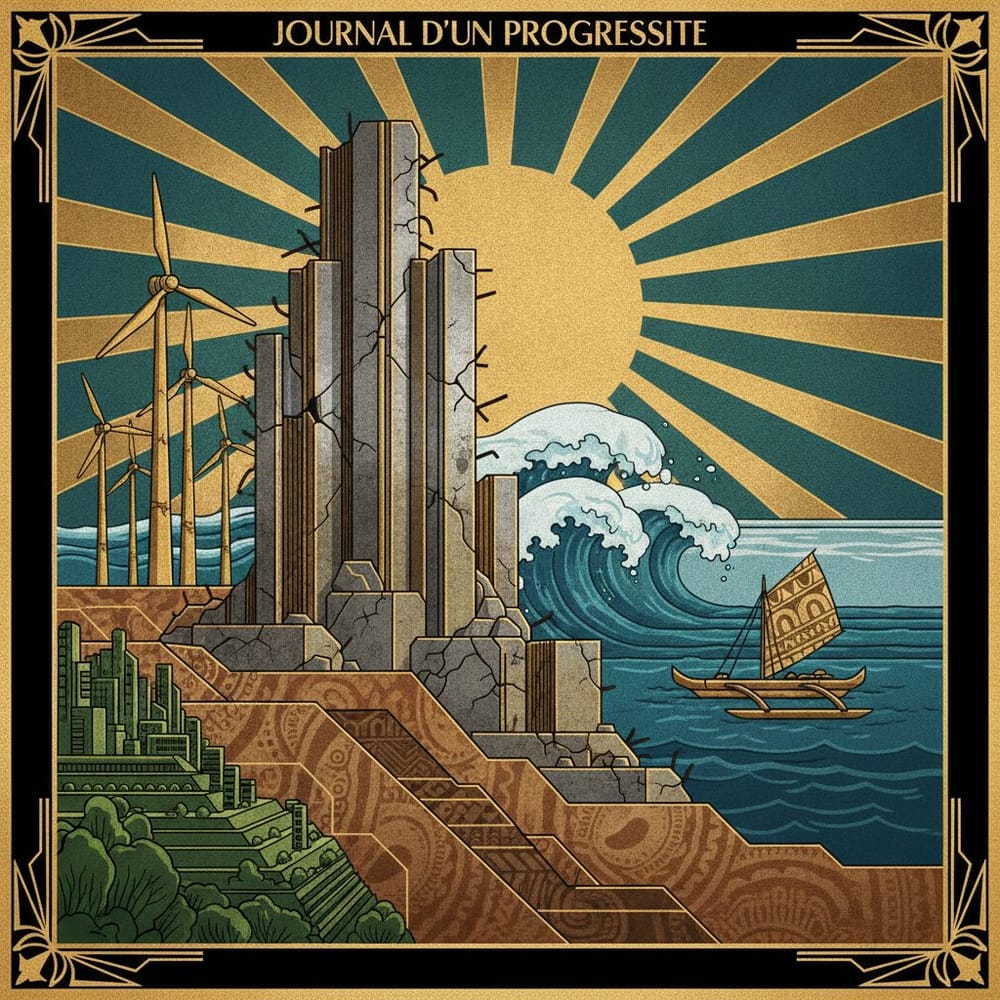
A port designed today will operate in a climate with significant uncertainties, especially locally and for extremes. Global projections to 2050 are relatively well constrained: according to IPCC AR6, the average global rise in sea level by 2050 is on the order of 0.15 to 0.30 m compared to 1995-2014 depending on the scenario. Australia and New Zealand have taken this problem seriously and are experimenting with a response that does not belong to the usual vocabulary of civil engineering: decision-making architectures designed to be revised, not to last.
The Essentials
- Climatic uncertainty to 2050 is irreducible: ±50 cm on sea level rise renders obsolete any coastal infrastructure dimensioned once and for all.
- Costs of coastal adaptation for developing countries will range from 26 to 89 billion USD per year by 2040, according to the IPCC.
- The Dutch Delta Programme, a global reference for coastal planning, is documented as insufficient beyond 2050 in its current design.
- Australia and New Zealand are experimenting with approaches called “adaptive pathways” that readjust infrastructure choices every five to ten years based on actual observations.
- The real tension is not technical but institutional: budgets, political mandates, and public procurement are structured to decide once, not to revise continuously.
Fifty Years of Concrete, Ten Years of Certainty
Coastal infrastructures can have lifespans comparable to or exceeding certain planning horizons; climate projections remain exploitable, with growing uncertainty at distant horizons. A quay, a dike, a coastal drainage system: they are designed for 2070 or 2080. The differences between scenarios become progressively more important over the course of the century; for average global sea level rise, dependence on scenarios remains weak until around 2050.
The gap between the permanence of concrete and the fluidity of climate projections constitutes a structural governance problem. When an engineer dimensions a pier, he must choose a reference height. If projections give between 30 and 80 cm of sea level rise over the structure’s lifespan, choosing 30 cm exposes it to catastrophic flooding; choosing 80 cm mobilizes resources that will be lacking elsewhere. Both options are defensible; neither is certain.
Adaptive pathways have developed mainly since the 2010s; Völz and his coauthors published in 2024 in Earth’s Future, not in Scientific Reports. The guiding idea: instead of freezing a single reference scenario at the moment of initial decision, one designs a sequence of modular interventions where each step is conditioned on thresholds of actual observation. One does not predict the future; one programs revision points.
Dutch Lessons in Dike Construction
The Dutch Delta Programme is often cited as the global standard for coastal protection. After the catastrophic floods of 1953, the Netherlands built the Delta Works, whose Eastern Scheldt barrier is among the most complex and recognized flood protection structures in the world. The Delta Programme integrates perspectives to 2050 and 2100; 2050 is a major milestone, with planning and preparation explicitly extended beyond it.
The Delta Programme judges its current strategies adequate at least until 2050, but acknowledges that an acceleration of sea level rise could necessitate major decisions after this deadline. End-of-century projections may exceed the margins of certain existing or planned structures, but this must be evaluated case by case. The Netherlands does not face an engineering failure. It faces a limit inherent to any rigid planning over a time horizon that science cannot yet constrain.
This finding led Dutch researchers and planners to document what one might call the “trap of optimized infrastructure”: the more precisely a system is dimensioned for a given scenario, the more vulnerable it is if that scenario proves inaccurate. A dike built exactly at the height required for a median scenario has no margin if actual observations follow the high scenario. This fragility is the hidden cost of optimization.
The subject furthermore articulates with a broader financial dynamic: coastal real estate and infrastructure assets are valued on bases that ignore this risk of programmed obsolescence, a capital distortion that weighs on growth and innovation far beyond the coastal sector alone.
Australia and New Zealand Reinvent the Decision Cycle
Australia and New Zealand constitute two national contexts where adaptive coastal planning frameworks and projects are being implemented. Australia and New Zealand share an exposed coastal geography, developed economies capable of absorbing the costs of experimentation, and governments that have taken the risk of departing from the single-plan model.
Several Australian coastal states have adopted planning frameworks that explicitly integrate “trigger points”: predefined thresholds or signals that trigger a reassessment and, if necessary, a decision to change course or measure; they do not always produce automatic action. This mechanism removes the decision from the short political cycle by conditioning it on scientific observation. When sea level crosses a defined threshold, the municipality applies a decision made upstream, in a state of relative calm, without reopening political debate to raise a dike or relocate a coastal road. The trigger is factual.
In New Zealand, planning under the Resource Management Act and coastal guidelines encourage flexible and adaptive plans; they do not impose the textual categories “now,” “in ten years,” and “if projections are confirmed.” This graduated temporal framing allows local communities to avoid over-immobilizing resources in immediate maximum protections, while ensuring that future options remain open. A zone designated “to be revisited in ten years” cannot receive heavy investments that would make readjustment prohibitive.
These two approaches share a common philosophy: the objective is not to predict correctly, but never to find oneself without options. Decision-makers are no longer seeking the most probable scenario; they are seeking the sequence of decisions that remains robust across the greatest number of possible scenarios.
The 89 Billion Range Reveals Something Beyond the Scale of Costs
IPCC AR6 does not confirm an estimate of 26 to 89 billion USD per year by 2040 for coastal adaptation alone in developing countries. But the range itself is more instructive than its central value.
A spread of one to three between a lower bound and an upper bound does not reflect a lack of rigor by modelers. It reflects real uncertainty about emissions trajectories, about the pace of sea level rise, about densification of coastal zones, and about the capacity of states to finance protections. This range is essential information: it shows that it is difficult to prepare a reliable long-term coastal adaptation budget.
For developing countries, the tension is even more acute. Their budgetary resources are constrained, their coastal infrastructures often undersized even today, and their exposure to extreme events already strong. Deciding to invest heavily in protection dimensioned for the high scenario means mobilizing resources that will be lacking for education or health. Deciding to wait means exposing oneself to destruction whose cost will far exceed that of prevention.
The maritime rights and coastal resources of these countries are subject to international regulatory pressures that still largely ignore the physical dynamics of sea level rise, adding a layer of legal complexity to an already difficult governance problem.
Governing When the Horizon Shifts
The difficulties of adaptive pathways are often institutional and financial, but they also include technical, informational, and physical constraints. Engineers know how to design modular structures. Hydrologists know how to define observation thresholds. The difficulty is institutional, and it is profound.
Public budgets operate on annual or five-year cycles. Public procurement requires fixed specifications. Elected officials answer to mandates of four to six years. Insurance systems calculate their premiums on historical data. These structures are not all designed to manage a decision whose logic is explicitly “we decide today, but we reserve the right to change our minds later if the data indicates we should.”
The work of Völz and his coauthors analyzes the interest of adaptive decisions accounting for future learning; it does not constitute precise and general documentation of an institutional blockage. The decision-making tools exist; their integration into existing institutional processes remains the bottleneck. A local community that adopts a coastal adaptation plan providing for periodic revisions must convince its insurers, lenders, supervising administrations, and voters that an explicitly provisional decision is more solid than one that claims to hold for fifty years.
This work of institutional persuasion is the frontier where Australian and New Zealand experiments are being played out. Their results concern not only coastal engineering: they test the capacity of liberal democracies to formalize uncertainty in their public decision-making processes, instead of hiding it behind facades of certainty.
Real Observations Exceed Planning Scenarios
Experiments must anticipate the case where real observations would exceed the IPCC high scenario before the next scheduled revision.
Models of Antarctic and Greenlandic ice sheet melting contain non-linearities that climatologists themselves believe are poorly constrained. Instabilities of ice sheets with low probability and high impact could lead to global and local sea level rise exceeding probable ranges; the IPCC examines them explicitly, but their quantification remains low confidence. This scenario is not central, but adaptive decision-making architectures must be able to absorb it.
Australian and New Zealand approaches integrate this possibility in two complementary ways. First, by defining conservative trigger points, that is, positioned below critical limits to preserve a margin for action. Second, by planning organized retreat as a planning option based on risks, resources, exposure, and societal choices, without limiting it in principle to extreme scenarios or sparsely populated zones.
Conversely, if real observations remain within the low range of projections, adaptive mechanisms allow one not to over-immobilize resources in maximum protections. This is the scenario where rigid planning would most have wasted: oversized dikes, zones classified as non-buildable through excessive precaution, investments mobilized for a threat that did not materialize. Adaptive pathways can improve sequencing of investments under uncertainty, by combining early action, monitoring, and future options rather than systematically opposing observation and precaution.
Between these two poles, the median scenario is one where institutions gradually learn to manage uncertainty as operational data rather than as a problem to be solved definitively. The most important signal to watch is not in the altimetric measurements of tide gauges, essential as they are. It is in the capacity of budgetary, regulatory, and democratic processes to integrate planned revisions without experiencing them as admissions of failure.
The stakes for the coming decade are whether Oceanian experiments will produce exportable institutional models. The Netherlands is watching closely. Pacific island states, some of which measure their survival in centimeters, do not have the luxury of waiting for the question to be settled.
Sources
- Dutch Delta Programme analysis, PMC/NIH, Völz et al. (2024)
- IPCC AR6 Sea Level Rise Fact Sheet, Intergovernmental Panel on Climate Change (IPCC), Sixth Assessment Report, 2021-2022
- Dutch Delta Programme, Ministry of Infrastructure and Water Management, revisions 2021-2026 (deltaprogramma.nl)
- IPCC, Climate Change 2022: Impacts, Adaptation and Vulnerability (Working Group II, AR6), coastal adaptation costs for developing countries