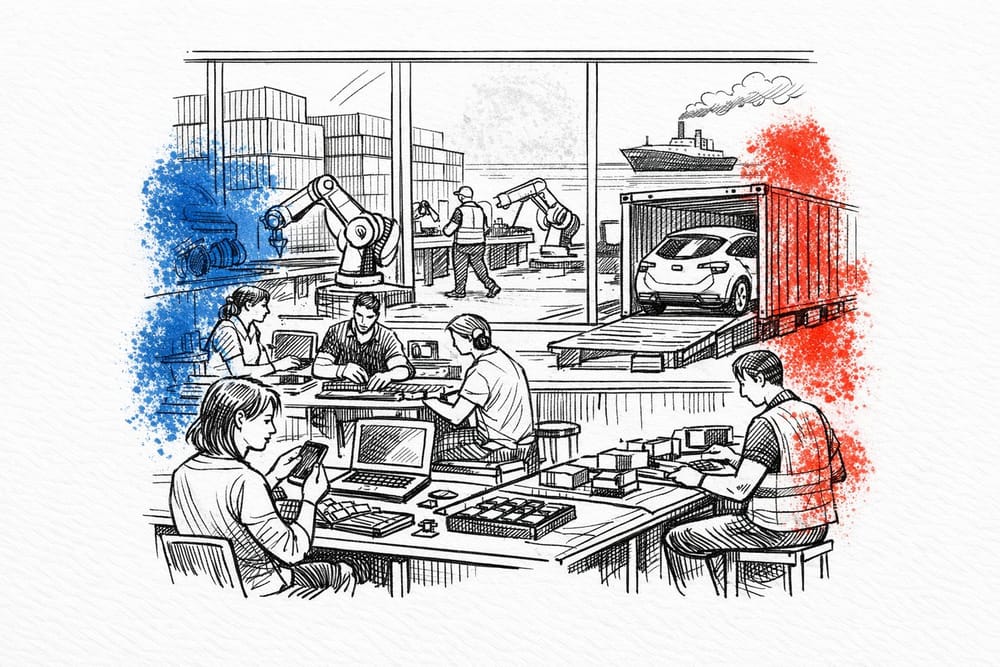
France displays a decline in its emissions on its soil. But it imports carbon in its t-shirts, its phones and its steel, and this carbon figures in no official target. The choice that 2027 poses is whether to make it a criterion for allocating industrial aid, or to continue counting half the problem.
Thirty years of progress, but on half the bill
In 2024, emissions produced on French territory amount to 404 million tonnes of CO2 equivalent, or 5.9 tonnes per person [1]. France’s real footprint, which includes everything emitted elsewhere to manufacture what the French consume, reaches 563 million tonnes, or 8.2 tonnes per inhabitant [1]. The difference, nearly 160 million tonnes, comes out of the smokestacks of Asian factories, not French ones.
Since 1990, territorial emissions have fallen by 33 % [1]. Carbon footprint, by contrast, has declined only 20 % over the same period [1]. Net imported emissions have increased by 40 % since 1990 [4]. France has progressed twice as slowly as its official figures suggest.
The reason is straightforward. Part of French industry has relocated to where energy is cheaper and less regulated, taking carbon with it. Real progress on the territory has coexisted with growing outsourcing of production.
What a phone, a sweater, a tonne of steel weighs
A smartphone manufactured outside France emits 80.2 kg of CO2 equivalent, of which 99 % occurs during the manufacturing phase alone [6]. Metal extraction and assembly in factories powered by coal account for nearly all the weight. Using the device for several years represents only 1 % of the total [6].
Textiles follow the same pattern. One kilogram of fabric consumed in France generates 54 kg of CO2 equivalent [7]. Nearly all of it, 95.7 %, is imported [7]. If that same kilogram were produced in France, it would emit only 27.7 kg [7]. The difference comes down to the coal powering Asian production facilities.
Steel illustrates the gap in numerical terms. The recycling sector produces one tonne of steel while emitting 0.4 tonnes of CO2. Production by blast furnace emits 2 tonnes [4]. Steel imported from China or India passes overwhelmingly through the conventional sector.
More broadly, national production of manufactured goods emits on average 56 % less per euro of value than French imports [4]. This climate advantage exists. It is mobilized by no major public lever.
A climate roadmap that launches with a hole in the hull
The national low-carbon strategy, in its third version adopted in 2026, integrates for the first time an objective on carbon footprint [1]. It targets a decline of 71 % to 79 % by 2050 compared with 2010. That would bring the average footprint of a French person to between 2.3 and 3.1 tonnes [1]. It is currently 8.2 tonnes [1].
Without a shift in imports, this target is unattainable. Imported emissions will be in 2050, on the current trajectory, nearly twice the total footprint target [4].
The breakdown by consumption category specifies where the essential stakes lie [8]. Transportation accounts for 36 % of total footprint. Housing represents 30 %.
Food, 12 %. Equipment, 5 %. This last category concentrates the most difficult-to-trace imported carbon content, because part of the emissions is buried in intermediate components that traverse the entire chain before arriving in a finished product.
France thus cancels out part of its annual reduction in territorial emissions by importing electrical equipment and batteries produced in countries with high carbon intensity: the same equipment supposedly meant to accelerate the decarbonization of the economy [4].
The Office of Strategy and Planning published in September 2026 a note drawing out the implications of this finding [9]. It recommends a dual neutrality objective: territorial emissions and carbon footprint. The note recommends making the decarbonization of imports an explicit strategic objective, not an externality that official indicators overlook.
Make footprint binding, or remain at the edge of accounting
The carbon border adjustment mechanism, which entered into force on 1 January 2026, levies a tax on imports into the EU of cement, steel, aluminium, fertiliser, hydrogen and electricity [11]. It is a new architecture, but it covers neither textiles, nor electronics, nor chemical products: the three sectors where the carbon content of imports per euro spent by households is highest [4].
The European Parliament adopted on 15 September 2026 a position extending it to 457 downstream manufactured products [10]. The stakes are precise: the carbon price applies when raw steel crosses the European border, but not when that same metal arrives integrated in a washing machine or an automotive component [10]. The extension targets this loophole.
Rexecode estimated, for each product-geographic zone pair, the gap between imported emissions and what France would emit to satisfy the same demand [5]. Chemical imports from non-German EU countries alone represent 21 billion euros of imports and a potential global climate gain of 4.4 million tonnes of CO2 equivalent [5].
Changing the basis of industrial aid
The real choice for 2027 is architectural. France can continue to steer its climate policy on territorial emissions alone, which allows it to display measurable progress without touching its import flows. It can also enshrine carbon footprint as a binding criterion for allocating industrial aid, public procurement and European commercial preferences.
The second option changes who has the right to count what, at what scale, and on what basis subsidies for reindustrialization are distributed. It would make France the first EU state to condition its aid on the total footprint of a product, not only its smokestack emissions. It opens the path to a consumption-based climate policy, complementing the existing production-based policy.
What it closes: the possibility of declaring a footprint ambition in the national strategy without making it a decision criterion. Footprint is currently absent from the allocation criteria of France 2030. The national low-carbon strategy does not make it binding for investment decisions [1]. Making this criterion binding requires rebuilding the rules of aid eligibility on a basis that neither Brussels nor Paris has yet formalized.
Sources
[1] SDES-INSEE, “Greenhouse Gas Emissions and Carbon Footprint of France in 2024”, INSEE Première no. 2077, October 2025. https://www.insee.fr/fr/statistiques/8654458 (accessed 04/11/2026).
[2] SDES, “France’s Carbon Footprint from 1990 to 2024”, statistical service of the Ministry of Ecological Transition, October 2025. https://www.statistiques.developpement-durable.gouv.fr/lempreinte-carbone-de-la-france-de-1990-2024 (accessed 04/11/2026).
[3] SDES-INSEE, “Estimation of France’s Carbon Footprint Between 1990 and 2024: Methodological Note”, October 2025. https://www.insee.fr/fr/statistiques/fichier/8071406/Note_methodo_empreinte_2025_FR.pdf (accessed 04/11/2026).
[4] Rexecode, Matteo Michel and Raphaël Trotignon, “Imported Emissions, Blind Spot in French Decarbonization”, Landmarks no. 21, 2 July 2026. https://www.rexecode.fr/competitivite-croissance/reperes-de-politique-economique/les-emissions-importees-angle-mort-de-la-decarbonation-francaise (accessed 04/11/2026).
[5] Rexecode, “Climate: A New Economic Ambition for France: Producing in France to Decarbonize the World”, Working Paper no. 102, April 2026. https://www.rexecode.fr/media/documents/document-de-travail/2026/climat-une-nouvelle-ambition-economique-pour-la-france-document-de-travail-n.102-avril-2026 (accessed 04/11/2026).
[6] ADEME-ARCEP, “Carbon Footprint of a Smartphone”, updated 2025, via Impact CO2. https://impactco2.fr/outils/numerique/smartphone (accessed 04/11/2026).
[7] Union of Textile Industries (UIT), Cycleco, “Carbon Footprint of Textiles in France”, January 2021. https://www.franceindustrie.org/app/uploads/2021/02/Synthese-Etude-UIT-Empreinte-carbone-280121.pdf (accessed 04/11/2026).
[8] SDES, “Decomposition of France’s Carbon Footprint of Final Demand by Consumption Categories”, 2020. https://www.statistiques.developpement-durable.gouv.fr/la-decomposition-de-lempreinte-carbone-de-la-demande-finale-de-la-france-par-postes-de-consommation (accessed 04/11/2026).
[9] Office of Strategy and Planning, Nicolas Riedinger, “Carbon Footprint: Reconciling Climate and Sovereignty”, 14 September 2026. https://www.citepa.org/changement-climatique-le-haut-commissariat-a-la-strategie-et-au-plan-preconise-de-faire-de-la-decarbonation-des-importations-un-objectif-strategique/ (accessed 04/11/2026).
[10] European Parliament, vote on extending the carbon border adjustment mechanism to 457 downstream products, 15 September 2026. https://www.carbmee.com/knowledge-insights/blog-article/cbam-scope-expansion-downstream-products (accessed 04/11/2026).
[11] Regulation (EU) 2023/956, carbon border adjustment mechanism, definitive phase entering into force on 1 January 2026. https://www.seco.admin.ch/fr/mecanisme-ajustement-carbone-ue-cbam (accessed 04/11/2026).