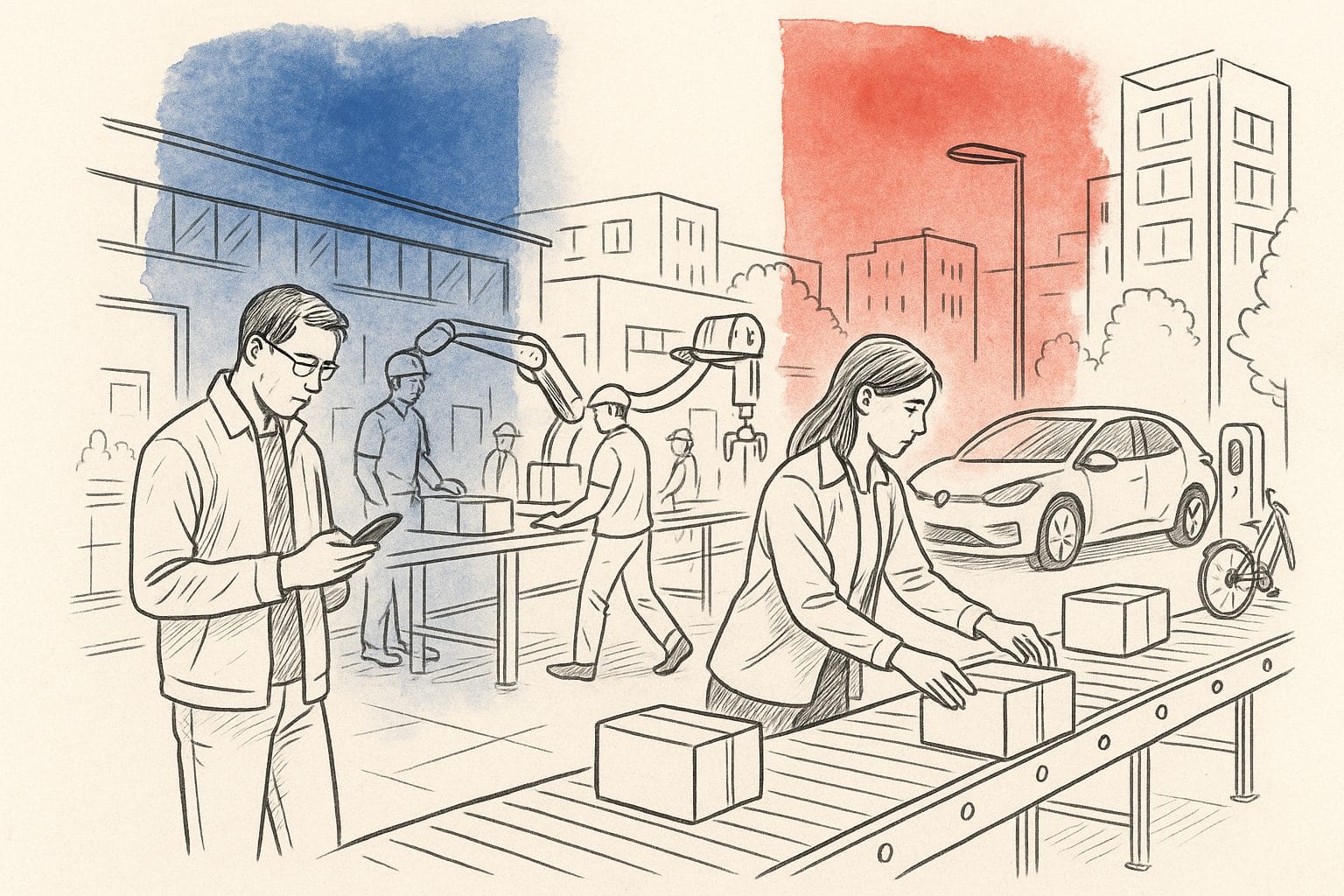
By end of 2025, French labor productivity had almost returned to its 2019 level. But this recovery masks a deeper gap: according to INSEE, it remains 4.1 points below the trend of the 2010s, meaning that France structurally produces less per hour worked than it should have if the pre-crisis trajectory had held. Recovering a level is good. Recovering a slope is something else.
The essentials
- French labor productivity has nearly recovered to 2019 levels, but remains 4.1 points below the 2010s trend according to INSEE.
- This slope deficit imposes an economic policy choice: continue financing low-productivity sectors or concentrate investments on companies capable of diffusing technological gains.
- The French social model rests on sufficient productivity growth to feed tax revenues; if the slope does not improve, financing social benefits becomes arithmetically constrained.
- The diffusion of AI in French companies represents the main identifiable acceleration lever, but its impact depends on deep process reorganization, not merely tool adoption.
The 4.1-point gap with the trend
A 4.1-point gap may seem abstract. To grasp it, one must understand what a productivity trend means. Between 2010 and 2019, France was progressing at a regular pace, stable enough that one could project where it should have been in 2025 if nothing had deviated. The Covid crisis first caused this level to drop, then recovery years brought it back up. But the slope itself did not recover its original incline.
Recovering the 2019 level erases the visible scar. Remaining 4.1 points below the projected trend means that part of the potential productive capacity was lost or deferred without being recovered. The French economy produces more than in 2020, that is indisputable. It produces less than it could have if pre-crisis dynamics had continued.
This distinction matters for public financing. Tax and social revenues depend on the level of activity, but also on its dynamics. An economy that stagnates slightly below its potential accumulates each year a shortfall in revenues. Over five years, this composition effect can represent dozens of billions in unavailable financing for pensions, health, or education. The question is therefore not only one of competitiveness policy: it directly touches the sustainability of the social model.
The persistent financing of the least productive sectors
Part of the explanation for the trend deficit lies in the structure of the French economy and the way public resources circulate through it. France maintains a high level of public spending, around 57% of GDP according to OECD data, which allows it to absorb shocks and keep low-productivity sectors afloat, but at the price of an implicit trade-off against investment in companies with strong growth potential.
Patrick Artus, economist at Natixis and figure of regulated liberalism pro-investment, has regularly documented this phenomenon. His thesis is clear: capital allocation in France structurally favors preservation of the existing over financing productive innovation. Large public enterprises, protected sectors, business aid schemes without sufficient productivity conditionality absorb a share of financing that could irrigate SMEs and mid-sized companies capable of diffusing technological gains. The result is a dual economy: a core of highly competitive companies that export and innovate, and a broader network of protected structures whose productivity stagnates.
This diagnosis is not without counterpoint. Daron Acemoglu, economist at MIT and Nobel laureate, nuances the strictly liberal reading by recalling that institutions and conditions for technological adoption matter as much as market signals. In other words, directing capital toward productive companies also supposes creating the conditions—training, digital infrastructure, adapted regulation—in which these companies can actually leverage received investments. Finance alone does not shift the productivity slope if companies lack the skills to absorb new technologies. These two readings complement each other: capital must be better allocated, and absorption conditions must be simultaneously built.
Technological diffusion, real lever or deferred promise
Generative AI is often presented as the factor likely to restart productivity in advanced economies. For France, actual diffusion throughout the productive fabric matters more than the existence of the technology. Large French companies have begun deploying AI tools in their internal processes. SMEs and mid-sized companies together represent approximately 66% of employment and thus constitute the bulk of the economic fabric, even though productivity dynamics there are mixed: according to France Stratégie, it is mid-sized companies that show the most sustained progress, while large companies and mid-sized companies dominate notably in industry.
Yet AI diffusion in these companies remains uneven. The conditions for productive adoption do not reduce to tool availability: they suppose process reorganization, upskilling of employees, and management capable of identifying where real gains are possible. An SME that adopts a text generation tool without reorganizing its workflow gains little. An SME that restructures its customer service or accounting around an AI assistant can gain the equivalent of one or two positions in efficiency.
The central issue is organizational capacity to integrate these tools, more than access to the tools themselves. Public intervention can be legitimate and effective by financing support for process transformation, management training, and diffusion of use cases in sectors, rather than subsidizing software license purchases. Bpifrance, which already accompanies thousands of mid-sized companies in their digital transformation, plays this role partially. The question concerns the scale reached and the rigor of conditionalities so that public financing translates into measurable productivity gains.
Public services, the blind spot in the productivity debate
French debate on productivity almost always concentrates on private companies. It forgets that public services represent a considerable share of national economic activity, and that their own productivity, difficult to measure but real, weighs on aggregate productivity.
Education, health, and administrative services together employ several million people. If these sectors gained in efficiency without service quality reduction, the effect on national productivity would be substantial. This does not mean privatizing or reducing staff: it means reorganizing processes, digitizing low value-added tasks, reallocating human skills toward missions that cannot be automated. A doctor who spends less time on administration and more on diagnosis is more productive without being paid less. An administrative agent who processes routine files via an automated system can focus on complex cases.
This avenue is politically delicate because it touches sectors where unions are powerful and reorganizations are perceived as threats to employment. Yet the potential gains are documented. The housing crisis, analyzed in these columns, is partly linked to the slowness of administrative procedures that slow construction and investment. Alleviating these frictions without sacrificing environmental and social guarantees would already be measurable progress.
The absorption capacity of the social model if the slope does not improve
France has built a social model whose cost is high and whose legitimacy is strong. This model rests on an implicit postulate: productivity grows sufficiently so that tax and social revenues follow spending. If the productivity slope remains durably below what it was before 2020, this postulate becomes fragile.
Two trajectories are conceivable toward 2030-2040, though neither can be presented as certain.
In the first scenario, investments in technological diffusion and public service reorganization produce their effects from the second half of the 2020s onward. The productivity slope gradually improves, the 4.1-point gap narrows, and the dynamic of tax revenues allows financing the social model without increased tax pressure or reduction in benefits. This scenario supposes specific policy choices: reallocation of public capital toward companies with strong potential, aid conditionality, massive investment in training, public service reorganization. It is possible, but it requires trade-offs that the French political class has regularly deferred.
In the second scenario, the trend gap slowly widens. The years 2026 to 2030 confirm that France has structurally lost part of its productivity slope. Financing the social model becomes an increasingly constrained equation: either increase charges on a base growing more slowly, or reduce benefits, or accept drifting public debt. None of these options is politically painless. This scenario is not inevitable, but it is the probable outcome of inaction.
The signals to monitor to distinguish the two trajectories are identifiable: the annual evolution of per capita productivity, and the cumulative gap to trend over three consecutive years. If by 2028 France reduced its trend deficit by half, that would be a strong signal of recovery. If the gap remained stable or widened, the budget constraint would become the central adjustment variable of the next decade.
Investing in diffusion, not only in the technological frontier
France has companies that innovate at the technological frontier, in defense, aeronautics, digital, biotechnologies. This network of excellence is real and deserves to be preserved. But aggregate productivity does not depend only on champions. It depends on the capacity of the rest of the economy to absorb and diffuse the innovations that these champions produce.
This diffusion has historically fed the major waves of productivity gains. After electricity, after computing, productivity advanced when the majority of companies adopted the technology and reorganized their processes accordingly, not from the first adoptions. Asia, which has understood this logic, invests massively in technological absorption capacities of its economies, not merely in their frontier.
For France, the issue is to build a coherent diffusion policy: conditional financing tied to productivity gains, support for organizational transformation, professional training reoriented toward technological adoption skills, and public service reform so they cease to be protected zones from productive innovation. The State can orient these processes without entirely directing them. The open question is whether French institutions have the capacity to maintain these trade-offs over time, or whether political preference for preservation of the existing will continue to defer the slope recovery.
Sources
- INSEE, French productivity gains partly recovered (2026)
- OECD, Public expenditure statistics as percentage of GDP (annual data)
- Journal d’un Progressiste, Housing crisis and productivity stagnation
- Journal d’un Progressiste, Infrastructure first, algorithms second
- Journal d’un Progressiste, Asia secures its scientific capabilities without closing its networks
- FIPECO, Public expenditure France (2025)
- Circle of Economists – Patrick Artus
- Wikiberal – Daron Acemoglu Nobel Prize
- France Stratégie, Mid-sized companies, driving force of the French economy (2025)
- INSEE, Employment in the public service (2024)
- AEA, Nobel Lecture Acemoglu (June 2025)