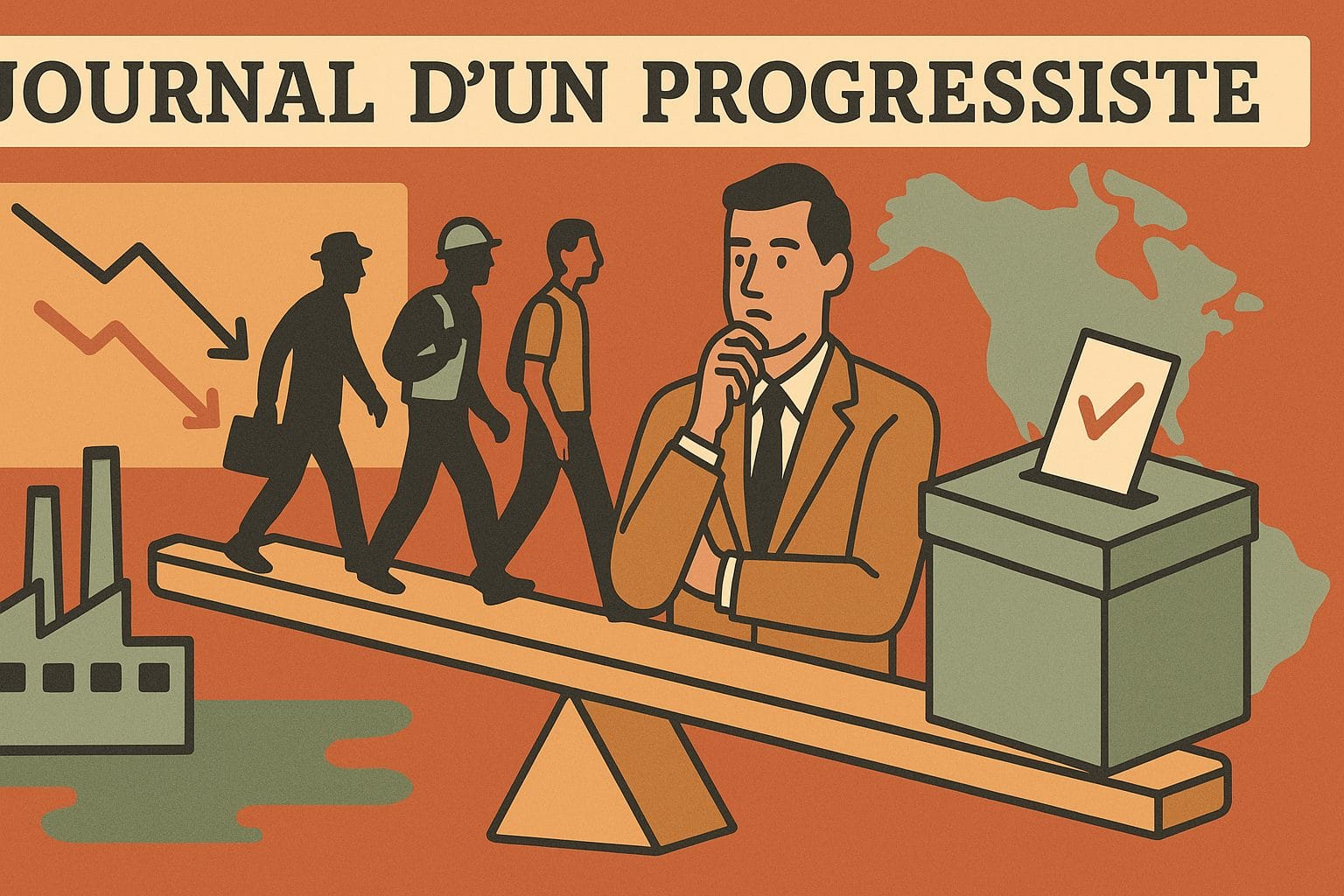
French companies are pushing out their oldest employees well before the state authorizes it. At age 60, the employment rate remains significant, but from 61-62 years old onward, half of French workers are no longer employed. At 62, this rate collapses to a minority of the active population. The 2023 pension reform, intended to delay departure from the labor market, runs up against an obstacle that legislators have not addressed: human resources management practices that organize, often discreetly, the elimination of employees starting in their fifties.
This paradox has traversed French debate for decades without public policies managing to reverse it durably. And it arrives at a critical moment: as of 2023, one-third of employed persons are already over 50, according to INSEE. This demographic turning point constitutes today’s reality, not a distant projection.
The Essential Facts
France exhibits one of Europe’s lowest employment rates for 60-64 year-olds, at 42.4% in 2024 according to DARES, compared to significantly higher levels in Sweden, the Netherlands, or Germany. This decline results from business practices that organize seniors’ departure before the legal retirement age, not from legal rule. With already one in three active workers over 50 according to INSEE, France can no longer afford to waste this reservoir of skills. European countries with comparable social budgets have demonstrated that an active policy of maintaining older workers in employment can reverse the trend.
Senior Employment Rates Collapse Where Other Countries Hold Steady
Let us begin with what the figures actually say. In France, the employment rate of 55-64 year-olds stands at 60.4% in 2024 according to DARES, a record since 1975, a level that seems reasonable until one breaks it down by age group. For 60-64 year-olds, it stands at 42.4% in 2024. Northern Europe displays rates approximately 1.5 to 1.7 times higher for the same age group: Sweden exceeds 69-70% for 60-64 year-olds and reaches 78.1% for the entire 55-64 age group according to Eurostat 2024; the Netherlands and Germany approach 60 to 65%, according to Eurostat data. For comparison, the European average for 60-64 year-olds is 53.1%.
This gap is structural, not marginal. It says something profound about how French companies manage the end of careers. And it cannot be explained by differences in wealth or social model: Sweden, the Netherlands, and Germany have generous social protection systems, sometimes more costly than the French one. What distinguishes them is their approach to senior workers, built over several decades of deliberate policy.
The real question is therefore as follows: why has France built a system that pushes its most experienced workers toward the exit, when other comparable countries have made the opposite choice?
Business Practices Do What the Law Does Not Prescribe
Behind the statistics lie concrete mechanisms. French companies use several levers to organize seniors’ departure before the legal retirement age: workforce adjustment plans that prioritize employees nearing retirement, company early retirement schemes disguised as transition programs, and more simply, recruitment practices that effectively exclude candidates over 50. Negotiated terminations are also mobilized, although according to Unédic a slight overrepresentation exists at 58-61 years old but those over 50 are globally underrepresented in this mechanism relative to their weight in total employment.
These practices are not illegal as a whole. They fit within a managerial culture that valorizes youth as synonymous with adaptability and treats seniority as a constraint rather than an asset. The cost of senior workers, often higher due to their seniority and position on wage scales, accentuates this bias.
And when they lose their jobs, their return to the labor market is much more difficult: the average unemployment duration of seniors is significantly longer than that of other age groups, according to Unédic.
It is a vicious circle. The employer hesitating to hire a 55-year-old reasons partly on the risk that this employee will himself be pushed toward the exit before the end of his contract. And this collective anticipation creates the reality it sought to avoid.
The 2023 Reform Pushed Back the Legal Age Without Changing Practices
French debate on pensions has a troubling characteristic: it focuses almost exclusively on the legal retirement age, as if moving this threshold mechanically resolved the funding problem. The 2023 reform, which raised the legal retirement age from 62 to 64, illustrates this limitation. It asks French workers to work longer without addressing the conditions that would enable them to do so.
The result is predictable: for some workers, the reform extends the period during which they find themselves without employment and without a pension, forced to exhaust their unemployment benefits or rely on solidarity provisions before receiving their pension. This outcome differs completely from actual employment maintenance.
The reform could have been accompanied by a binding mechanism for companies, on the model of what exists in Sweden or Finland: obligations for negotiation on maintaining senior workers in employment, mechanisms for adjusting working conditions for demanding positions, tax incentives conditional on measurable results on employment rates. These dimensions were debated, partially integrated into a draft senior index, then weakened under pressure from employer organizations.
The senior index, planned in the 2023 pension reform bill for companies with more than 300 employees, was however censored by the Constitutional Council in April 2023, which ruled that it had no place in a supplementary social security financing bill. It therefore was not officially created in this framework. Without this tool, even if imperfect, transparency regarding company practices toward their oldest employees remains insufficient.
What Germany, Sweden, and the Netherlands Did Differently
European comparisons do not serve to condemn France. They serve to demonstrate that other choices are possible in comparable contexts. Three examples merit detailed examination.
In Sweden, the culture of maintaining seniors in employment rests on several pillars built since the 1990s: a right to part-time work for older workers, conversion programs financed by joint funds, and a business culture that explicitly values the experience of older workers. The Swedish pension system, profoundly reformed in 1999, is designed so that each additional year worked increases the pension in visible and significant fashion. The incentive to remain is thus integrated into the system’s mechanics themselves, not added on top as a bonus.
In the Netherlands, the turning point occurred in the early 2000s, after the country became aware that its senior employment rates among Europe’s lowest threatened the sustainability of its social model. Sectoral agreements were negotiated to adapt working conditions to the needs of an aging workforce: reduction of job strain, schedule flexibility, right to continuing education. The employment rate of Dutch 60-64 year-olds progressed by more than 20 points over two decades, according to Eurostat.
In Germany, the combination of demographics even more constrained than in France and a Mittelstand culture favorable to knowledge transfer has produced a different relationship with experienced workers. German companies, particularly SMEs, see in their senior employees a capital difficult to replace. This relationship is a rational response to a tightening labor market, not an ideological posture.
In all three cases, public policy played an accompanying and incentive role. But the result depends mainly on a change in perspective on what a 58-year-old worker represents: a resource, not a liability.
The 2040 Horizon and the Arithmetic That Does Not Lie
Behind the immediate question of employment rates lies an arithmetic constraint that demographics makes inescapable. In 2000, the contributors-to-retirees ratio was approximately 2.1 to 2.5 depending on sources (COR, Cercle de l’Épargne). In 2023, this ratio stands at 1.79, that is 30.4 million contributors for 17.1 million retirees, according to INSEE and COR. INSEE projections, under assumptions of unchanged fertility and migration, project it declining toward 1.4 to 1.5 at the 2040-2050 horizon.
This projection follows mechanically from the French age pyramid, combined with increased life expectancy. It is not catastrophist. Each generation entering retirement is on average more numerous than the previous one entering retirement today, and remains in retirement longer.
The financing of French pensions rests principally on contributions from active workers. A ratio of 1.4 active workers per retiree means that each worker bears an increasing burden to finance pensions. As analyses published in this journal concerning intergenerational transfers in France show, pressure on intermediate-age workers is already intensifying.
In this context, wasting the productive potential of 55-64 year-olds is a costly collective decision. If France reached Germany’s 60-64 year-old employment rate, it would add several hundred thousand additional contributing workers in less than a decade. This contribution to the funding challenge is substantial, without increasing either contributions or taxes, even if it alone does not suffice to resolve it.
The generational dimension of this challenge deserves to be named. Today’s young active workers, who finance the pensions of their elders, will themselves be the seniors of 2040. If business practices do not evolve, they will suffer the same elimination mechanisms they are currently financing. It is a form of collective inconsistency that demographic arithmetic makes increasingly unsustainable.
Solutions That Exist, Actors Who Are Acting
The picture is not entirely dark. French companies, often large ones exposed to international competition, have undertaken serious policies for maintaining seniors in employment. Michelin, Renault, and certain banks have experimented with progressive retirement arrangements, mentoring of new recruits by experienced employees, or adaptation of positions to job strain. These initiatives remain minority, but they demonstrate that change is practicable.
On the public side, France Travail has developed specific support programs for job seekers over 55, with gradual but real results on employment return rates in certain regions. The investment plan in skills has integrated senior components. These active labor market policies are precisely the type of investment that Nordic countries massively expanded from the 1990s onward. France practices them homeopathically.
Continuing education for senior employees is a particularly underutilized lever. A 55-year-old worker who has not had access to training for ten years is indeed less adaptable than a younger colleague. But this situation results partly from company underinvestment, not from intrinsic incapacity. The relationship to work of today’s fifty-something generations is also evolving: many wish to continue working, provided conditions are adapted. The demand exists. Supply is lacking.
It must be mentioned here an issue that French labor taxation makes more acute: a senior employee costs more in social contributions assessed on his salary, often higher due to his seniority. Mechanisms for reducing the cost of senior workers exist but remain poorly understood and poorly mobilized by companies. Simplifying and expanding these tools falls within a macroeconomic decision with real scope, not a niche policy.
The question posed to French companies in coming years is therefore this: are they ready to change their perspective on a 58-year-old worker at the precise moment they will no longer have enough 32-year-old candidates to fill their positions? Demographics may do what the law has failed to impose.
Sources
- France Stratégie / DARES, Employment Perspectives and Demographic Projections: https://www.francestrategie.gouv.fr
- Eurostat, Employment Rates by Age Group and European Countries: https://ec.europa.eu/eurostat
- INSEE, Population and Active Population Projections to 2070 Horizon: https://www.insee.fr
- DARES, Analyses on Senior Employment and Negotiated Terminations: https://dares.travail-emploi.gouv.fr
- Unédic, Data on Unemployment Duration by Age Group: https://www.unedic.org
- INSEE/DARES, Situation of Seniors on the Labor Market in 2023: https://www.insee.fr/fr/statistiques/7767123?sommaire=7767424
- DARES, Seniors on the Labor Market in 2024: https://www.helloworkplace.fr/chiffres-cles-emploi-seniors-france-2025/
- Info-Retraite.fr, 2023 Reform / Legal Age: https://www.info-retraite.fr/portail-info/sites/PortailInformationnel/home/reforme-des-retraites—age-lega.html
- Toute l’Europe / Eurostat 2024, Senior Employment Rates in Europe: https://www.touteleurope.eu/economie-et-social/carte-le-taux-d-emploi-des-seniors-en-europe/
- Unédic, Real Figures on Seniors and Unemployment Insurance: https://www.unedic.org/lassurance-chomage-en-france/decryptage/quels-sont-les-vrais-chiffres-sur-les-seniors-et-l-assurance-chomage
- Social Security, Improving the 55-64 Employment Rate (PLFSS): https://evaluation.securite-sociale.fr/home/retraite/29-ameliorer-le-taux-demploi-des.html
- Cercle de l’Épargne / COR, Contributors-to-Retirees Ratio: https://cercledelepargne.com/regimes-de-retraite-une-soutenabilite-sous-contraintes
- Constitutional Council 2023, Censure of Senior Index: https://www.touteleurope.eu/economie-et-social/carte-le-taux-d-emploi-des-seniors-en-europe/
- DARES - Seniors on the Labor Market in 2024 (July 2025): https://www.aefinfo.fr/depeche/735352-la-hausse-du-taux-d-emploi-des-seniors-en-particulier-des-60-64-ans-se-poursuit-en-2024-selon-la-dares
- INSEE - Employment, Unemployment, Labor Income 2024 (Seniors in 2023): https://www.insee.fr/fr/statistiques/7767123?sommaire=7767424
- Constitutional Council - Decision No. 2023-849 DC of April 14, 2023: https://www.conseil-constitutionnel.fr/actualites/communique/decision-n-2023-849-dc-du-14-avril-2023-communique-de-presse
- Social Security Evaluation - 60-64 Employment Rate France and EU 2024: https://evaluation.securite-sociale.fr/home/retraite/29-ameliorer-le-taux-demploi-des.html
- INSEE / Eurostat - Employment and Unemployment in Europe 2024: https://www.insee.fr/fr/statistiques/8376888?sommaire=8376908
- COR - Annual Report June 2023 (Contributors-to-Retirees Ratio): https://www.cor-retraites.fr/sites/default/files/2023-06/Pr%C3%A9sentation_grand_public.pdf
- UNSA - Analysis of COR 2025 Report (Contributors-to-Retirees Ratio 2023): https://retraites.unsa.org/IMG/pdf/analyse_du_rapport_du_cor_2025.pdf