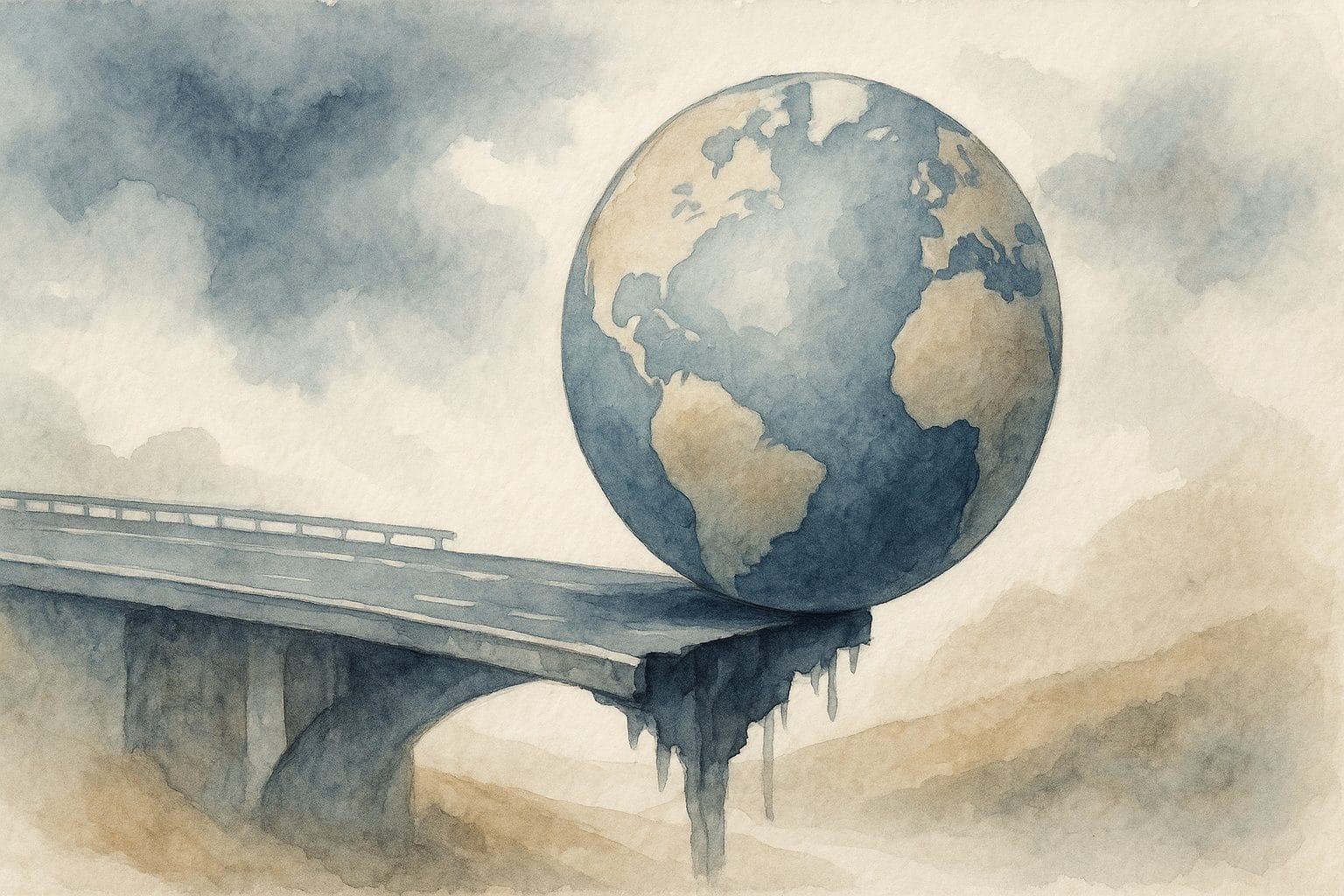
Maritime transport burns 300 million tons of heavy fuel oil per year and produces roughly 3% of global greenhouse gas emissions. Industry experts project a median reduction of 50% by 2050 compared to 2008 levels, according to a study published in Earth’s Future. The subgroup of experts with more than thirty years of experience projects 48%. For Pacific island states, this timeline arrives fifteen years too late: atolls are highly vulnerable to warming and rising seas, degraded by flooding, salinization, and waves, even though the IPCC has not established a universal physical threshold of uninhabitability at 1.5°C.
The Essentials
- Maritime experts anticipate a median 50% drop in sector emissions by 2050 compared to 2008, far short of carbon neutrality that Pacific island states are demanding by 2035 (Laskar et al., Earth’s Future, 2025).
- The gap between the two timelines reflects a distribution of costs: the cost of technical transition can be borne or passed on among shipowners, shippers, consumers, and other actors depending on markets and measures.
- Methanol is already in use and supplied on a demonstrated basis, while ammonia and maritime hydrogen remain at earlier stages of deployment and regulation, all marginal at the scale of the global fleet for lack of fueling infrastructure and competitive pricing.
- The International Maritime Organization brings together states with diametrically opposed interests: shipping powers that protect their industries, island states whose very existence is at stake.
- A global maritime emissions pricing system coupled with an IMO fund is the most advanced international measure at the IMO, but its adoption remains pending and its revenues are not explicitly allocated to island adaptation funds.
48% by 2050: What This Number Really Means
The study by Laskar and collaborators, published in 2025 in Earth’s Future, aggregates projections from experts in global maritime transport. The median comes out to 50% emissions reduction by 2050, measured against 2008 levels. This is an ambitious figure for a sector that has begun regulatory decarbonization, but whose medium-term global measures have not yet entered into force. It is insufficient to keep warming below 1.5°C.
The distinction matters. A median decline of roughly half is not aligned with IEA trajectories of 1.5–1.8°C. Higher emissions trajectories worsen the habitability risks for small islands, though this maritime study alone does not allow quantifying an existential risk by state, or one of survival.
The International Maritime Organization adopted a revised strategy in 2023 aiming for net-zero emissions around 2050. This flexible phrasing—“around”—reflects exactly the uncertainty that experts quantify: the range of projections is wide, between a 30% reduction and near-complete decarbonization depending on the technological and regulatory assumptions retained. The median of 48% thus sits in the lower half of what the most optimistic scenarios consider achievable.
The gap between stated ambition and realistic projection lies in the very structure of international maritime transport: a large fleet whose useful life exceeds twenty-five years, operated by shipowners whose capital is scattered across flags of convenience, fueled by heavy fuel oil whose price incorporates no carbon cost on the vast majority of commercial routes.
The Physics of Atolls Does Not Negotiate
Representatives of these states are calling for rapid decarbonization of maritime transport. They are doing arithmetic.
According to IPCC projections, under a very low emissions scenario (SSP1-1.9), likely sea level rise reaches between 0.28 and 0.55 meters by 2100 compared to 1995-2014. Low-lying atolls, characteristic of several Pacific states, sit a few meters or less above sea level, making these rises an existential threat.
The habitability of an atoll depends not only on permanent submersion. It depends on aquifer salinization, coastal erosion accelerated by more intense storms, and the frequency of extreme events that render infrastructure inoperable. These mechanisms set in long before water permanently covers the land.
Representatives of these states have been saying this for two decades in every international climate forum. Their demand for carbon neutrality by 2035 for maritime reflects the existential risks of delay. The gap with the experts’ median trajectory constitutes a distribution of costs among states according to their vulnerability to climate change.
This point deserves to be stated plainly. Shipowners and certain states cite real constraints to justify the 2050 horizon: fleet amortization periods, the cost of alternative fuels, non-existent fueling infrastructure at scale. These constraints are legitimate. But they imply a deferred cost for others, a cost measured in meters of sea level rise and in decades of degraded habitability conditions for populations that emit a negligible fraction of global greenhouse gases.
Current Capacities and Limits of Alternative Fuels
Maritime decarbonization combines operational efficiency, technologies, alternative fuels or energies, and, in some cases, other measures. The candidates are known: ammonia, green methanol, liquid hydrogen, liquefied natural gas as a transition. Each poses distinct problems.
Green methanol is today the alternative fuel progressing fastest at commercial scale. Maersk, the world’s largest shipowner, has ordered a fleet of dual-fuel methanol container ships, a first at this scale. Methanol from renewable sources substantially reduces emissions over the full lifecycle. But global green methanol production remains marginal, and its price still far exceeds that of conventional fuel oil.
Green ammonia attracts more long-term projections because it can be produced at scale from renewable hydrogen and atmospheric nitrogen, with no carbon in its chemical composition. Zero CO₂ on combustion. The problem: it is toxic, difficult to handle in port, and the engines capable of burning it cleanly are still at the demonstration stage.
Liquid hydrogen presents insufficient energy densities for long ocean routes without onboard storage volumes that would cut into ships’ cargo capacity. On the long, rarely-traveled routes of the Pacific, with few ports of call, this constraint is particularly heavy.
Liquefied natural gas, widely adopted as a transition fuel, reduces sulfur and particulate emissions but improves the CO₂ balance little over the full lifecycle when methane leakage is factored in. It prolongs dependence on fossil fuels without solving the climate problem.
The convergence of these technologies toward economic competitiveness depends on several variables: the price of renewable electricity, the deployment of fueling infrastructure in the world’s major ports, and the existence of a carbon price signal strong enough to make fuel oil less attractive. These conditions are not in place at the scale necessary for a rapid transition. This is what the gap between island states’ ambition and experts’ median trajectory indirectly measures.
The IMO as Arena, Not Arbiter
The International Maritime Organization is the forum where international maritime transport regulation is decided. One hundred seventy-five member states vote there. The formal structure is democratic. The actual distribution of power is not.
Shipping states—Greece, Japan, China, the United States, Norway, South Korea—weigh in negotiations in proportion to their registered tonnage and capacity to finance permanent technical delegations. Pacific island states, some with national economies smaller than the revenue of a single shipping company, negotiate with reduced delegations and limited technical resources.
This asymmetry structures outcomes. The revised 2023 strategy constitutes real progress over the previous one; the 2050 target is more ambitious than 2018 objectives. But it preserves shipowners’ room for maneuver on timelines and leaves open the question of financing transition for less capitalized actors: small shipping companies serving island routes, states that depend on maritime transport for basic supplies.
For Pacific nations, the IMO is both the sole forum where their demand could theoretically prevail and an arena where their political weight is structurally insufficient to impose a timeline compatible with their survival. This tension has no technical solution. It has a political one.
Three Possible Paths by 2035, and Their Respective Costs
By 2035, three decarbonization trajectories for maritime transport are taking shape. They are not equivalent depending on who you are.
The first path is one of strengthened IMO regulation with binding emissions standards. A more ambitious scenario could target 2040-2045, but the IMO’s current strategy aims for net-zero around 2050. This scenario implies high costs for shipowners: accelerated depreciation of current fleets, massive investments in new ships, forced development of fueling infrastructure. It would narrow the gap with island demands without eliminating it entirely. Its political feasibility depends on the ability of island states and their allies—the European Union, certain African and Caribbean states—to build a majority coalition at the IMO.
Signals in this direction exist: the European Union integrated maritime into its carbon market in 2024, creating a precedent that could weigh on IMO negotiations in 2026 and 2027.
The second path is the current trajectory: IMO net-zero objectives around 2050, gradual implementation, European regional carbon market, global IMO mechanism not yet adopted. This scenario minimizes disruptions for shipowners and ports. It prolongs physical costs for island states: sea level rise, degraded habitability conditions before even submersion, mounting migration pressure on populations that have nowhere else to go on their own territories.
The third path introduces a North-South financial compensation mechanism. A maritime carbon tax, which the IEA and several think tanks have proposed, and the Coalition for Ambitious Carbon Pricing actively defends, would generate substantial revenues that could be directed toward two uses: financing technological transition for small shipowners and poorly served island routes, and funding adaptation for the most vulnerable states. This scenario is the most equitable of the three. It is also the most politically complex: it requires agreement on the tax rate, on the key for distributing revenues, and on the governance of a fund every party will want to control.
Signals to watch in the coming months are precise. The price of green ammonia, which determines the competitiveness of the most promising alternative fuel long-term. The commitments member states will bring to 2027 IMO negotiations, which will be the next regulatory turning point. And observations of sea level rise in the Pacific, continuously measured by regional monitoring programs, not because they will influence negotiations, but because they measure the real cost of delay while negotiations are underway.
Island Routes as Revealing Structural Tensions
Maritime transport to Pacific islands receives little study in debates on global decarbonization. Yet it illustrates structural tensions in the sector that busier routes tend to mask.
Interisland connections in the Pacific rely on small, aging ships operated by local shipowners with thin margins, on rarely-traveled routes where economies of scale do not exist. These routes are economically unprofitable without public support. They are vitally necessary for populations for whom they often constitute the only connection to supply markets, health services, and administrations.
Decarbonizing these routes poses specific problems that solutions designed for major transoceanic lines do not solve. A Maersk container ship can amortize a methanol engine over thousands of rotations between Rotterdam and Singapore. A 2,000-ton cargo ship serving Kiribati’s atolls makes stops with 200 tons of cargo. The economies of scale that justify investment in alternative fuels on major routes disappear on small ones.
If maritime transition is built solely on major commercial routes, which economic logic and large shipowners’ investment capacity naturally favor, several small island routes risk remaining on fuel oil after the major commercial routes decarbonize. It is an irony that the data do not spontaneously articulate: the territories demanding the fastest decarbonization risk having the maritime routes that will be last to decarbonize. This points toward a conception of transition that explicitly includes unprofitable routes in its financing mechanisms, instead of leaving them lagging behind a market where, without public mechanisms, incentives, or tailored financing, investments in certain island services may be less attractive.
This question joins broader issues of resilience in global commercial flows, documented here in our analysis of global trade vulnerabilities. It also points to a limit found in other transitions: the risk that populations least connected to dominant economic flows are the last to benefit from the alternatives that transition makes accessible to others.
Maritime decarbonization is advancing. The 2023 IMO commitments are more robust than those of 2018. Orders for alternative-fuel ships are growing. Green methanol prices are falling as production scales up. These signals are real.
The climate risks for atolls and small islands are already significant at 1.5°C, while the IMO strategy aims for net-zero international maritime emissions around 2050. Closing that gap requires something other than technical acceleration: a political agreement on financing transition for less capitalized actors and regions. This is a major issue that IMO negotiations will need to address.
Sources
- Laskar et al. (2025), Expert Assessments Maritime Shipping, Earth’s Future (Wiley). https://agupubs.onlinelibrary.wiley.com/doi/full/10.1029/2024EF005255
- International Maritime Organization (IMO), Revised Strategy on Reduction of Greenhouse Gas Emissions from Ships, adopted in July 2023. Available at: www.imo.org
- IPCC, Sixth Assessment Report (AR6), Working Group I, 2021, sea level rise projections at +1.5°C and +2°C.
- International Transport Forum (ITF/OECD), Decarbonization of Maritime Transport, pathway reports available at: www.itf-oecd.org
- International Energy Agency (IEA), World Energy Outlook and maritime projections. www.iea.org