english
Freeze Without Breaking — What Sweden, Germany and Portugal Did That France Dare Not
France spent approximately 1,700 billion euros in 2025. The previous year, the government had announced 30 billion euros in savings. The result: spending increased by 40 billion. This is not a scheduling failure. It is the mechanics of a state whose commitments indexed to inflation, pensions, public

When Microsoft Buys a Reactor, Your Neighbors Pay the Bill
Data center electricity demand increased by 17% in a single year, according to the International Energy Agency. In absolute terms, this represents approximately 70 TWh in additional supply added to the global grid in twelve months — equivalent to the annual consumption of a country like Belgium or S

Midjourney Generates 200 Million Dollars with 11 Employees: The Model of the Cognitive Enterprise
Between 107 and 163 people. Revenues that have "significantly exceeded" 200 million dollars as of 2023, with 2024-2025 estimates ranging between 300 and 500 million. That's a ratio on the order of 3 to 5 million dollars per employee — roughly twice the ratio of a well-performing large technology com
What Americans Think About Merit Predicts Their Votes Better Than Their Salary
Two people with identical income, exposed to the same data on inequality, vote differently. One supports redistribution and affirmative action. The other opposes it. This is not an anomaly to be explained by misinformation or ignorance. It is the predictable result of a profound difference in how ea

Twenty Years of Bangladeshi Data Rehabilitate Microcredit, With Conditions
Microcredit has lifted 2.5 million Bangladeshis out of poverty over two decades. This figure, calculated by the World Bank using one of the longest time series ever constructed to evaluate a development tool, does not emerge from a pilot study or theoretical modeling. It comes from field data accumu
Morocco Proves That Logistics Beat Fiscal Policy for Attracting Factories
In 2025, Morocco captured $3.33 billion in foreign direct investment, a 91% increase in one year and 135% since 2020. This surge is not explained by fiscal policy: the kingdom launched no major tax reform, does not offer particularly attractive tax rates compared to regional competitors, and has not

China Does Not Control Rare Earths. It Controls What You Do With Them.
Geology is generous. Rare earths are neither rare nor concentrated in a single corner of the globe. They are found in Australia, Brazil, India, the United States, and Scandinavia. And yet, more than 80% of major European companies are fewer than three intermediaries away from a Chinese producer, acc

For the UN, the Fall in Births is Not a Choice But Material Renunciation
The majority of humanity now lives in countries where women have on average fewer than 2.1 children — the threshold below which a population no longer reproduces itself. Two-thirds of the world's population, according to the report published in July 2026 by the United Nations. This figure is less a

Book Review — "The Hour of the Predators" by Giuliano da Empoli: Power through Shock and the Dikes That Still Hold
There is a scene in contemporary politics that repeats itself in a loop, across vastly different latitudes. A leader announces a dramatic decision. Institutions creak. Experts protest. And then, often, nothing happens — or almost nothing. The decision passes, modified, slowed down, sometimes blocked

What AI Couldn't Do in January, It Mastered by September
In January 2025, the performance of the best artificial intelligence models on a test designed to resist their capabilities was still very limited: GPT-4o scored approximately 5% on ARC-AGI-1, while o3, announced in late December 2024, reached 75.7% at standard budget and 87.5% in high compute mode

Africa Bets on Banning Raw Mineral Exports to Capture the Value of the Energy Transition
For decades, Zambia extracted copper to sell it raw, leaving others to reap the added value of refining. Since 2023, at least 13 to 14 African countries have restricted exports of raw or semi-processed minerals, including the DRC, Zimbabwe, Namibia, and Ghana among the most engaged actors in this ap
France Spends More Than Germany on Vocational Training and Places Fewer Unemployed Workers
France devotes approximately 32 billion euros per year to continuous vocational training — roughly 1.4% of GDP, one of the highest ratios in Europe. Yet six months after training financed by Pôle emploi, fewer than one in two job seekers has found a stable contract. In Germany, this rate exceeds 60%

Europe Has an Advantage It Doesn't Recognize: More Competitive Markets Than the United States
In 2019, a French economist based in New York published a statistical demonstration that many initially refused to believe: American markets had become less competitive than European markets. Not in a niche sector. In telecommunications, air transport, financial services, healthcare. Entire sectors

When Helping Your Elderly Neighbor Becomes a Retirement Savings Account
Toshiko Yamasaki is 74 years old. She lives alone in Osaka. Three times a week, a 52-year-old woman comes to do her shopping, accompanies her to the doctor, helps her sort her mail. In exchange, the caregiver receives no money. She accumulates time credits on an account managed by a local associatio

AI Video Analysis Invades Stadiums Before Hospitals: The Misalignment of Technological Progress
Premier League clubs deploy on average twelve high-definition cameras coupled with artificial intelligence video analysis systems per stadium. In NHS hospitals of comparable budget size, fewer than one in five radiology departments has a fully integrated AI diagnostic aid tool, according to NHS Engl

The Factory Is No Longer the Staircase to the Middle Class
In Bangladesh, the manufacturing sector employs approximately 10% of the active population. When Taiwan and South Korea were going through their industrial takeoff, at a comparable income level, industry's share of total employment was already heading toward 25 to 30%. The staircase still exists. It
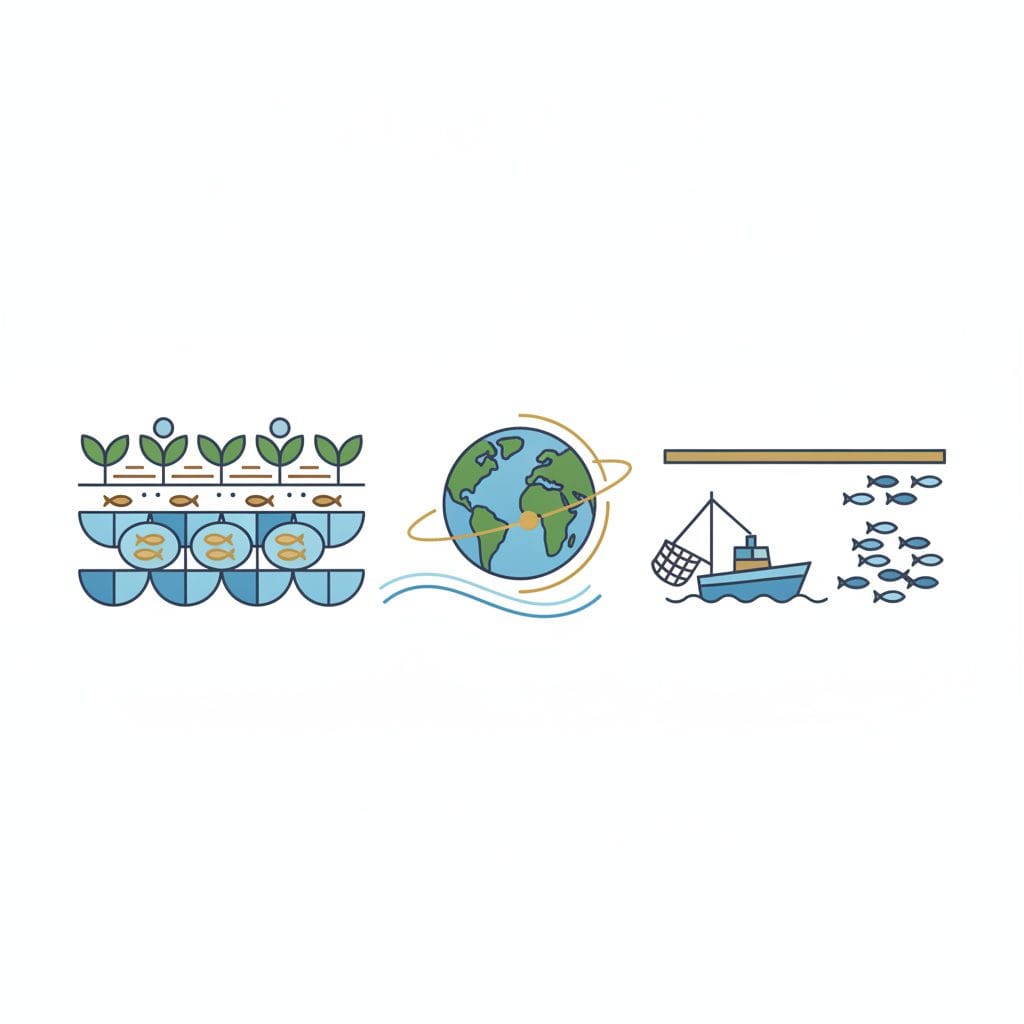
Aquaculture Feeds the World, Wild Fishing Has Plateaued for 40 Years
In 2024, humanity drew 235 million tonnes of fish, crustaceans, and seaweed from the water. It's a record. But behind this figure, two divergent stories have been unfolding over four decades, and they do not tell the same story about the future. Wild fishing reached its physical ceiling in the 1980s

"Fair Gatekeeping" According to Tirole Facing a World That Won't Wait
Last year, 22 of the 30 platforms subject to the obligations of the European Digital Markets Act were designated as "gatekeepers" by the Commission. Each one conditions access to hundreds of millions of users, sets interoperability rules at its discretion, and determines in practice who can sell wha

Technology Does Not Benefit Everyone — Except When Forced to Do So
A thousand years of history of major innovations lead Daron Acemoglu and Simon Johnson to a conclusion that should worry anyone betting on AI to improve the lot of the majority: technology spreads its gains only when countervailing powers force it to do so. Without this, it enriches those who contro

AI in Schools Deepens Inequality If the Institution Doesn't Hold
The PISA score gap between a privileged student and a disadvantaged student reaches 113 points in France. In Germany, this same gap stands at 86 points. The difference is explained neither by the average level of teachers, nor by the volume of public spending — France spends more per student than th

Twenty Minutes to Restore Sight, A Generation to Train Surgeons
In sub-Saharan Africa, cataracts blind approximately five million people. Each of them could regain their sight in less than half an hour, for a cost of less than fifty dollars in equipment. This gap between what is technically possible and what exists on the ground is one of the most documented and

When a Stranger's Intestinal Bacteria Become a Patentable Drug
A vial of standardized human stool now sells for several thousand dollars per dose. This is not a laboratory curiosity: since 2022, the FDA has approved two treatments based on human gut microbiota — Rebyota in November 2022, then Vowst in April 2023 — to prevent relapses of *Clostridioides difficil

Cities Now Know Where to Plant to Survive the Heat
Urban heat kills 489,000 people annually, according to the World Resources Institute. More than nearly all ongoing armed conflicts. And unlike those conflicts, the victims do not all die in the same place: they die in specific neighborhoods, on specific heat islands, in streets where concrete accumu
The Rampant Concentration of American Information
By 2026, a single company will be able to reach 80% of American households via local television. This figure, resulting from the Tegna-Nexstar merger that the FCC approved under controversial conditions and without a public vote among commissioners — despite serious opposition from eight state attor