english

The OECD Shakes the Promise of Reskilling in the Face of AI
In establishments that adopt artificial intelligence, the demand for cognitive, emotional, and digital skills is beginning to decline after having increased. This reversal of trend, documented by the OECD on panels of employers, calls into question several years of consensus on reskilling as a respo

Meta Erases 14,000 Positions and Tests AI Gains Sharing
On May 20, 2026, Meta wiped out 14,000 jobs with one stroke: 8,000 outright layoffs and 6,000 cancelled recruitments. But simultaneously, 7,000 employees discovered their new posts in teams dubbed "Applied AI Engineering" and "Agent Transformation Accelerator." This peculiar arithmetic — eliminating

FIFA Delegates Its Offsides to Avatars
A growing number of professional sports organizations are already using artificial intelligence. The AI market in sports represents several billion dollars and is experiencing sustained growth. But the real transformation is happening elsewhere: sports arbitration is progressively integrating advanc

Europe Pools Computing Resources to Catch Up with AI Giants
145 million hours of high-performance computing. This is the volume that the European Union has made available to its researchers and businesses over the past five years via its supercomputers. A massive effort at pooling resources that contrasts with the continent's traditional fragmentation and re

France Undermines Its Research While Europe Invests
All French public universities should end 2026 in deficit. This historic shift occurs as Germany increases university funding by 8% in 2026 and the United Kingdom launches a rescue plan for its post-Brexit laboratories. France makes the opposite choice: ADEME loses 350 million euros in two years, th
Blockchain Defies the Right to Erasure in Europe
More than a third of complaints received by the CNIL in 2024 concern the right to erasure, revealing a growing fracture between technological promises and fundamental rights. When 37% of complaints involve what was supposed to be a democratic achievement since 2018, it means the very architecture of

Singapore Turns Individual Training Account into a Shield Against AI
A growing number of Singaporeans have drawn on their personal training account in 2024, revealing a collective adaptation strategy: anticipating technological change through massive investment in individual skills rather than suffering its consequences passively. While the United States still debate
Europe Loses Its Biotech Startups to the United States and Asia
An American biotechnology startup receives on average several times more late-stage funding than its European equivalent. This disparity reveals a structural deficit that pushes young European companies toward exile or extinction. While Europe debates, America and Asia are capturing tomorrow's talen

French Civil Security Betting on Its Own Drones
French civil security has reached a turning point: a growing number of drone interventions were carried out in 2024 across several French departments. Behind this dynamic, a strategy is taking shape to build a French technological ecosystem capable of rivaling the foreign giants dominating the secto

AI Invades Law Firms and Undermines Expertise
A growing number of legal professionals now use artificial intelligence in their daily practice. This massive adoption conceals a more troubling phenomenon: the progressive erosion of verification skills, even for the simplest tasks. The paradox is becoming clear. AI promises greater efficiency and

East Africa Steals Textile Factories from Europe
European energy costs for textiles jumped 15% in 2023 — a rise that has definitively diverted orders toward East Africa. While Europe attempted to relocate its textile production to reduce its dependence on Asia, industrialists massively shifted their investments toward Ethiopia, Kenya, and Uganda w

India Proves You Can Skip the Factory and Still Win
418 billion dollars. That's what India exports in digital and intellectual services in 2025, representing 10% of its national GDP. A figure that now exceeds Germany's manufacturing exports and places India 7th globally among service exporters, with a 4.3% share of the global market. While China buil

In Europe, Robots Finally Arrive in SMEs
A family-owned metalworking SME can now install an industrial robot for 800 euros per month instead of the initial 80,000 euro investment. This pricing revolution is transforming European automation: the Robot-as-a-Service market is expected to grow from 2.48 billion dollars in 2026 to 9.83 billion
France Discovers That Its Departments Can No Longer Finance Social Solidarity
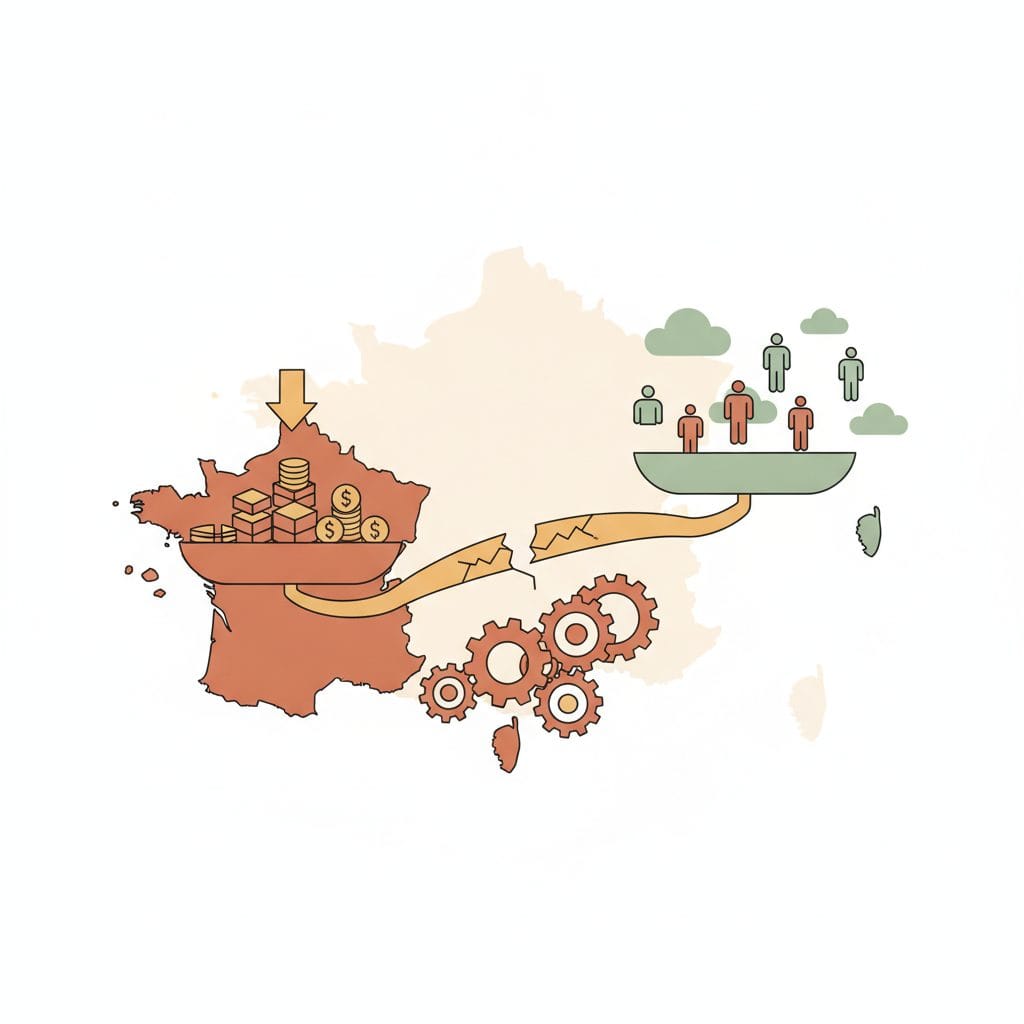
Sixty French departments out of 101 are in serious financial difficulty by the end of 2025, more than double the 29 recorded a year earlier. This spectacular deterioration reveals a fracture at the heart of the French welfare state: the local authorities tasked with the heaviest social missions — th

Technical Support Reduces Pesticides Without Eroding Farm Income
Europe is discovering that persuasion works better than coercion. While the European Commission abandoned its plan for drastic pesticide reduction in February 2024 following agricultural protests, a new generation of studies demonstrates the effectiveness of technical support approaches. In Malaysia

Global Electricity Overheating
In 2026, global electricity demand will grow faster than the economy for the first time in thirty years. This historic rupture — with growth of 3.6% annually through 2030 according to the International Energy Agency — is equivalent to adding more than two European Unions in five years. Artificial in

Generative AI Adopted Everywhere, Productive Nowhere
Four out of five companies use generative AI but see no effect on their results. This is not a technical problem. It is a method problem. A synthesis of the latest studies from Deloitte, McKinsey, and PwC reveals a spectacular gap: 78% of American and European companies deploy generative AI in at le

China Catches Up With America While the West Abandons Research
Public research and development budgets fell by 5% in real terms in 2025 across OECD countries, marking the first widespread decline since the 2008 crisis. This contraction occurs at the precise moment when China reaches parity with the United States in total R&D spending, at approximately 1,050 bil

Africa Creates a Solar Cold Chain
More than 30% of African fruits and vegetables rot between harvest and consumer. This food hemorrhage, which starves millions of people on the continent most affected by nutritional insecurity, is finally finding a technical solution equal to its scale. Sub-Saharan Africa is developing a distributed

Skills-Based Recruitment Is a Mirage. Diploma, Diploma, Diploma
85% of American companies claim to recruit based on skills rather than diplomas. In reality, only 0.14% of hiring is affected by this supposed revolution. The gap between promises and actions reveals a system struggling to overcome its class reflexes. Since 2013, IBM, Google, Apple, and hundreds of

How to Create Supremacy: China Trains Its Rare Earth Engineers, the West Zero
China trains a significant number of engineers specialized in rare earths each year at several universities dedicated to these critical minerals. The West has no equivalent program. This educational asymmetry transforms Chinese lecture halls into instruments of geopolitical domination. By massively

The G20 Standardizes Payment Pauses to Protect Overleveraged Countries
The G20's Global Sovereign Debt Roundtable initiative is transforming the management of sovereign debt crises. No more ad hoc negotiations: temporary payment suspensions are becoming an institutionalized procedure to protect the social budgets of financially distressed countries. - The G20 Common Fr

Europe Bets on Standards and Digital Innovation to Fill Its Housing Deficit
Europe produces 2.25 million fewer homes than necessary each year, a deficit that widens the investment gap to 275 billion euros annually. For the first time, the European Commission acknowledges that the main obstacle is no longer financing or good intentions, but industrial incapacity to build at

Insurers and Territory: Planning through Risk
When a homeowners insurance premium varies significantly between two zip codes a few kilometers apart, the market reveals what urban planning struggles to measure: the true cost of climate disruption on American real estate. This spectacular variation illustrates an uncomfortable reality for public