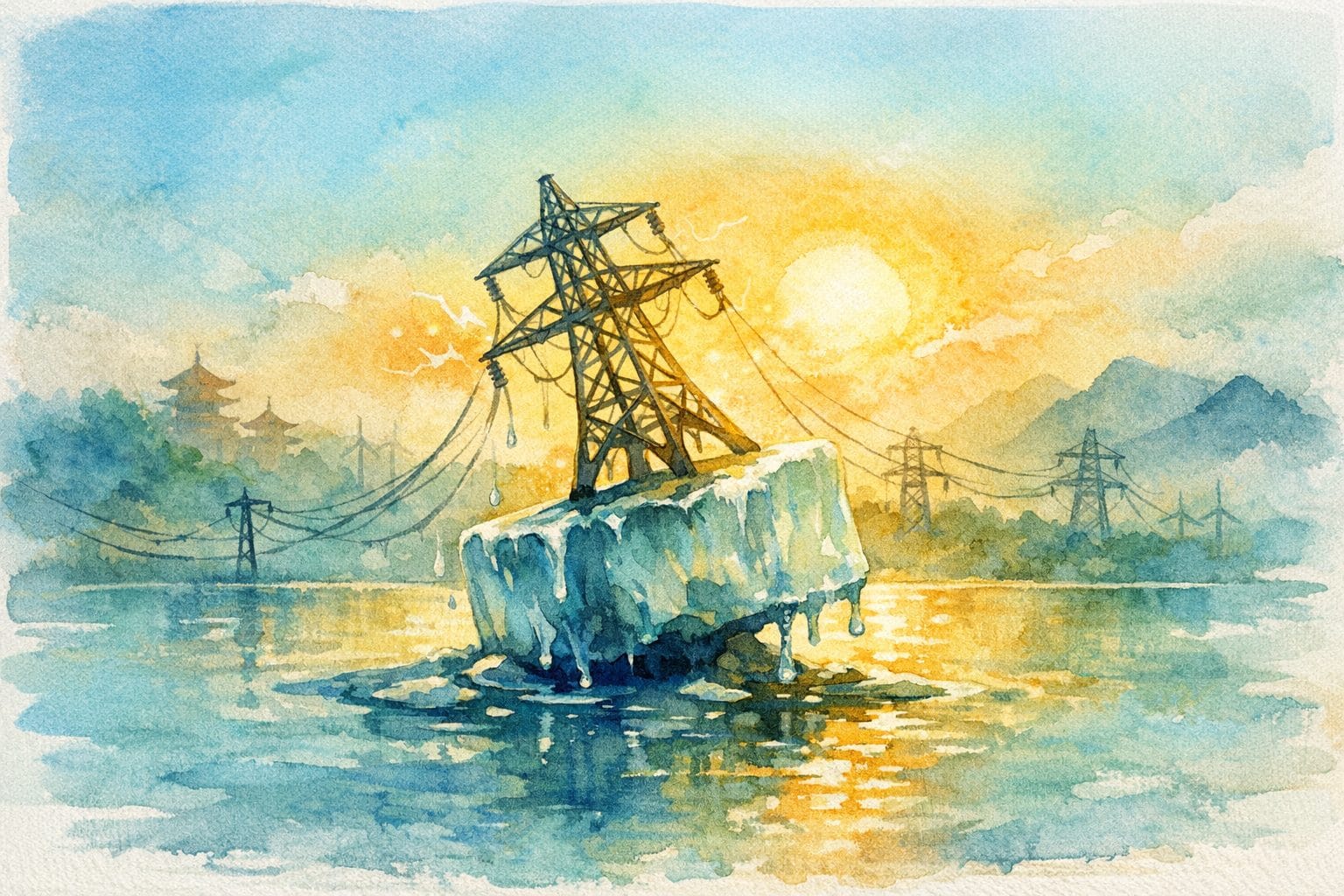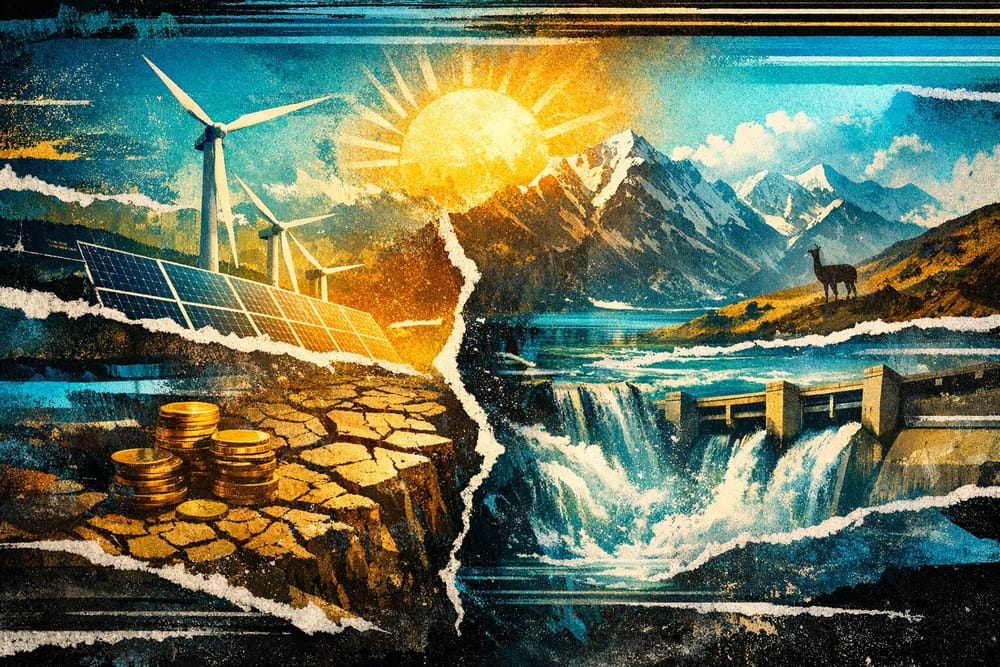
Ecuador rationed electricity for weeks in 2024, short on water in its reservoirs. The World Meteorological Organization’s 2025 report documents severe droughts and their regional socioeconomic impacts, including agriculture and food security. Latin America produces more than 45 % of its electricity from dams: an enviable low-carbon mix, but fragile whenever rainfall runs short. The fragility is also institutional: the absence of pre-planned rules to arbitrate between households, irrigated agriculture, and energy production can lead governments to decide hastily, which favors recourse to fossil fuels.
The essentials
- The WMO report establishes regional climate impacts on water, glaciers, agriculture, and food security.
- Latin America is the world’s region most dependent on hydroelectricity: when reservoir levels drop, governments face competing uses of water.
- Insufficient contingency plans and pre-defined operational criteria can lead to exceptional decisions, complicating drought management.
- Concrete avenues exist: national framework laws, accelerated deployment of solar and wind to reduce dependence on reservoir levels, and integrated water-energy-food planning before the next crisis.
Andean hydroelectricity: a climate asset turned vulnerability
Latin America has built an electrical grid the whole world might envy. Brazil, Colombia, Venezuela, Ecuador, and Paraguay depend heavily on hydroelectricity; in Paraguay, this share approaches 100 %. This historical choice, made of geography as much as politics, allowed the region to maintain a largely low-carbon electricity mix at a time when Europe and Asia were still burning coal on a large scale.
The counterpart is now appearing. These systems were designed for stable hydrological regimes, with predictable precipitation cycles. The Andes receive their water from tropical glaciers and seasonal rains. Both sources are declining. Andean glaciers have been retreating for decades.
Precipitation is becoming more erratic: longer dry periods, intense rains but concentrated, reservoirs that take months to fill and empty faster.
Ecuador illustrates what this means concretely. In 2024, the country suffered daily electricity cuts reaching fourteen hours in some areas. In 2024, hydraulic power plants represented approximately 62.5 % of effective installed capacity in Ecuador. Facing the crisis, Ecuador combined rationing, electricity imports, and emergency contracts for thermal capacity.
Falling reservoir levels pit competing uses against each other
A reservoir does not serve only to produce electricity. In the Andes, the same water supplies cities with drinking water, irrigates vegetable and fruit crops exported to North America and Europe, and maintains river flows on which ecosystems and fishing depend.
In normal periods, these uses coexist. In drought periods, they enter direct conflict. A reservoir level too low to run turbines may still suffice for drinking water supply to a mid-sized city, but not to irrigate thousands of hectares of crops. The state managing this reservoir must choose between these competing uses.
The institutional response in several Andean countries remains poorly anticipated. Institutional structures often function in silos: water agencies, electricity regulators, and agriculture ministries. Each defends its sector. During a water crisis, governments face immediate political pressures to choose between competing uses. Households in capitals carry more political weight than farmers in rural areas.
Electricity cuts in cities create immediate political crises. Small irrigating farmers lose their harvests in relative silence.
The World Meteorological Organization’s 2025 report documents this accumulated pressure. The droughts of 2023 and 2024 simultaneously affected drinking water supply, agricultural production, and electricity generation in several countries in the Andean region. It is the same resource, withdrawn by three sectors without formal coordination.
Fossil fuels as backup: a choice that costs
Facing low reservoirs, the fastest response is to start thermal power plants. Natural gas, diesel, sometimes coal: these capacities exist in almost every country in the region, maintained precisely to cover peak demand and hydraulic failures.
The problem is twofold. First, cost. Importing gas or diesel to replace water that fell from the sky for free weighs heavily on public finances. In 2024, the crisis led to additional public spending and tariff compensation to households. Colombia experienced a similar situation during the 2015–2016 drought linked to the El Niño phenomenon.
Second, the carbon balance. A country producing 80 % of its electricity from dams emits little CO₂ per kilowatthour. A country forced to shift to 40 % hydroelectricity and 40 % gas for several months sees its balance degrade rapidly. If droughts last longer and recur more often, this temporary recourse to fossil fuels can become structural. The region’s low-carbon advantage then disappears gradually, without anyone having made an explicit decision to that effect.
This is precisely the mechanism—the silent degradation of an electricity mix through the accumulation of emergency decisions—that work on energy tipping points flags as a major risk. Fragile hydraulic infrastructure pushes operators to keep fossil fuel capacity operational, to remunerate it, to integrate it into long-term contracts. These choices create new dependencies that last long after reservoirs refill.
Planning before drought: what countries preparing for it are doing
Southern Africa offers a useful point of comparison. Zambia and Zimbabwe are themselves heavily dependent on hydroelectricity from the Zambezi River, particularly the Kariba Dam, one of the world’s largest reservoirs. The droughts of 2019 and 2024 caused severe power cuts in both countries. But institutional responses diverged.
Zambia launched an accelerated solar deployment program, with public tenders aimed at diversifying its production before the next declared drought. Zimbabwe bet more on bilateral electricity import negotiations from South Africa. Both approaches have their merits and limitations, but one tackles structural dependence while the other manages it.
In the Andes, Chile stands out through energy planning more explicitly linked to water constraints. The country has reduced its dependence on hydroelectricity by massively developing solar in the Atacama Desert and wind in the South. This diversification responded to repeated droughts that affected its reservoirs in the 2010s, as much as to climate objectives. Chile has reduced its dependence on hydroelectricity by massively developing solar and wind.
Brazil followed a similar trajectory: after the 2021 drought, which nearly triggered a national rationing, Brazil mobilized primarily thermal capacity in an emergency, while ordinary auctions also included wind and solar projects. Brazilian wind is now among the most competitive in the world in terms of cost. These investments aim to reduce vulnerability to hydrological variations.
The coming decades require anticipated arbitrage
The favorable scenario for the Andes is legible: national framework laws that explicitly rank water uses in shortage situations, accelerated deployment of solar and wind capacity to reduce dependence on reservoir levels, and integrated planning that brings together water agencies, electricity regulators, and agriculture ministries before the next drought forces the hand.
This integrated planning is not an abstract concept. It means concretely that a government establishes in advance, in a legally binding text, that household drinking water is prioritized over irrigation, which is itself prioritized over electricity production below a certain reservoir threshold. Energy and agricultural operators know the rules of the game before the crisis. They can organize accordingly: storing, diversifying, insuring.
The unfavorable scenario is equally clear: arbitrage remains informal, agencies continue working in silos, governments decide hastily under political pressure, and fossil fuels serve as the default solution to each severe low-water period. This second scenario requires no decision: it suffices to do nothing. That is precisely its danger.
The signals to watch are precise. The share of non-hydroelectric renewable energy in the electricity mix of each Andean country indicates whether diversification is actually progressing. The existence and effective activation of water-energy-food arbitrage plans during declared droughts indicates whether governance is being built or remains a communications document. These two indicators are measurable, public, and do not require waiting for the next disaster to be evaluated.
The question posed to these governments is not whether droughts will return: the World Meteorological Organization’s 2025 report indicates they are intensifying. It is whether the rules for sharing water will be written by legislators or dictated by the next crisis. These two paths lead to different decisions about who, ultimately, pays the bill for fossil fuel dependence.
Facts to track to see if the region turns the page
Two facts will allow progress to be measured by 2030 without waiting for an overall assessment. The first: the share of non-hydroelectric renewable energies in the electricity mix of several Andean countries heavily dependent on hydroelectricity and with constrained public budgets. A significant increase in this share would reduce vulnerability to low waters; without additional low-carbon and flexible alternatives, a decline in hydroelectricity can increase recourse to fossil fuels.
The second: the adoption, in at least one Andean country, of a framework law ranking water uses during drought periods. This type of legislation has existed in Spain since the 1980s, and years of severe drought in the Ebro Basin have shown that a pre-established rule, even imperfect, reduces political conflicts between irrigators, cities, and energy producers.
Latin America is already negotiating its place in a transforming global economy: its energy choices in the coming years will weigh on this trajectory as much as its industrial choices. An electricity mix that is low-carbon and holds up during droughts is a durable competitive advantage. A mix that tilts toward fossil fuels at each low-water period is a handicap built silently, arbitrage by arbitrage.
Sources
- World Meteorological Organization, State of the Climate in Latin America and the Caribbean 2025
- International Energy Agency, data on electricity production by source in Latin America (iea.org)
- International Renewable Energy Agency (IRENA), data on installed capacity in Latin America