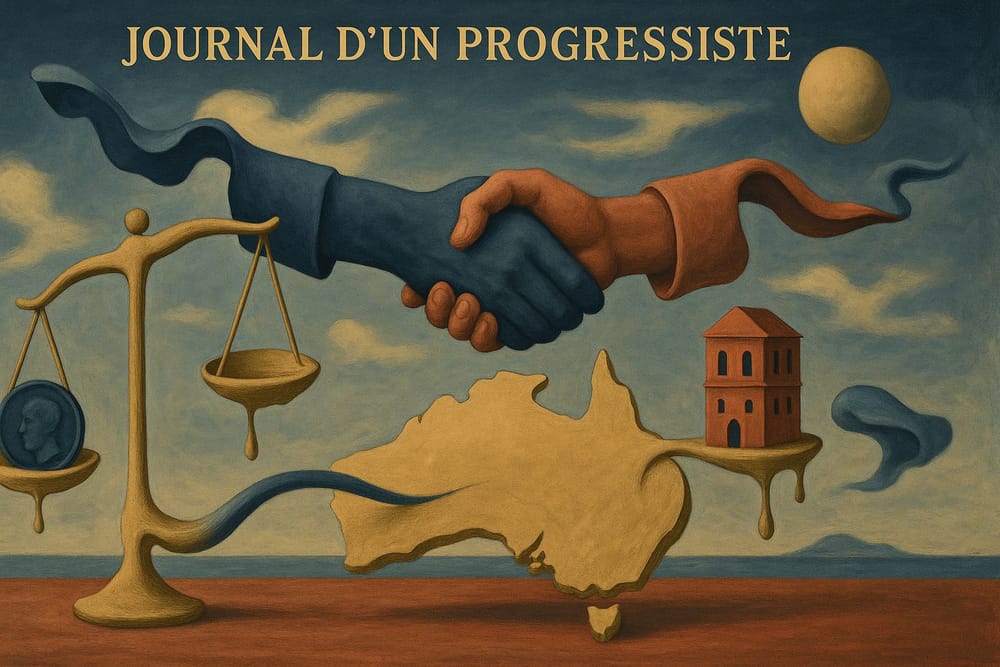
The PACER Plus negotiations were concluded on April 20, 2017 by fourteen members of the Pacific Islands Forum; the agreement was first signed by ten states in June 2017, then Vanuatu became the eleventh signatory. Customs harmonization work is underway: PACER Plus delivered in 2025 a balance sheet that deserves to be examined. PACER Plus is a multilateral regional agreement, of which Australia and New Zealand are parties and principal donors of the implementation mechanism. It has established a framework for commercial relations between its parties.
The Essentials
- PACER Plus brings together 10 signatories out of 16 invited states, with Fiji and Papua New Guinea remaining absent or lagging.
- The 19 million Australian dollars promised for capacity building represent a minuscule fraction of the structural needs of the island economies in question.
- The agreement produced in 2025 a partial customs harmonization, without effective regional synchronization among signatories.
- A trade agreement between highly asymmetric partners tends to consolidate the existing order rather than redistribute the levers of development.
- Avenues for improvement exist, notably on labor mobility and preferential access to Australian and New Zealand markets, if review mechanisms are activated.
An Agreement That the Pacific’s Largest Economies Refused to Sign
Let us start with the most troubling fact. Fiji is the second-largest economy in the Pacific islands. Papua New Guinea is by far the first. Neither of them is among the active signatories of PACER Plus. Fiji did not sign PACER Plus, judging the text then proposed insufficiently favorable to its interests and development needs; it denied having withdrawn from negotiations.
PNG did not sign PACER Plus and is therefore not awaiting ratification.
Other Forum members could express their interest or accede to the agreement subsequently; four countries that concluded negotiations had not signed at the initial ceremony in June 2017; after Vanuatu’s signature in September 2017, three remained. Several did not do so. The ten active parties are Australia, the Cook Islands, Kiribati, New Zealand, Niue, Samoa, the Solomon Islands, Tonga, Tuvalu, and Vanuatu. These economies share several characteristics: heavy dependence on imports, customs revenues representing a significant share of public budgets, and reduced administrative capacities to implement complex trade commitments.
The absence of Fiji and PNG creates a structural gap. The exclusion of Fiji and PNG severely limits the economic and political coverage of PACER Plus, without preventing it from being legally qualified as a regional agreement. Port Moresby and Suva are among the regional poles for supply chains, capital flows, and people movements. The framework aims at regional integration, but its ambition and scope are substantially limited by the absence of Fiji and PNG.
Scope and Limits of 19 Million Australian Dollars
This mechanism reveals a deeper structural limitation: the strengthening of administrative capacities and productive transformation obey incompatible temporal logics. Training customs agents or standardizing procedures produces measurable effects in the short term, which satisfies donor accountability requirements. Diversifying an import-dependent island economy requires coordinated investments in training, infrastructure, and commercial outlets. The treaty text does not establish a hierarchy among its parties’ priorities.
Australia funded 19 million Australian dollars in an implementation package for 2021-2025, supplemented by 7 million New Zealand dollars. The program notably finances customs modernization, SPS capacities, and trade support work; customs training, rules of origin, and computer systems constitute possible activities, without representing the exhaustive and itemized allocation of the package. These are real needs.
But the figure must be placed in context. Customs revenues can be significant in some island states, but their exact share is not established by available sources. When a trade agreement provides for the progressive reduction of these tariffs, the budgetary loss does not self-finance spontaneously. It requires compensatory tax reform, an increase in domestic revenues, or external transfers. The 19 million AUD relates to support for implementation and strengthening of trade capacities; it does not constitute an explicit fund to compensate for tariff losses, but its scope is not limited to administrative costs.
This imbalance is a classic problem in trade agreements between developed and developing countries. The effects of an agreement that liberalizes trade without simultaneously investing in local productive capacities depend on the conditions of its implementation. The application of PACER Plus depends on its implementation by the parties.
Partial Customs Harmonization in 2025, a Real but Insufficient Step
Work on harmonizing customs procedures is underway among several parties to the agreement. Modernizations and customs alignments have been undertaken, with documented gains in some countries; general standardization of forms and generalized reduction in port delays are not established. For a merchant from the Solomon Islands exporting to Australia, this represents a concrete and measurable simplification.
This result deserves to be recognized for what it is: real administrative progress, the product of patient technical work between administrations very different in terms of resources. Customs cooperation is one of the rare dimensions of PACER Plus where the benefits are visible and distributed relatively equitably among signatories.
The problem is that partial customs harmonization does not guarantee effective regional synchronization. Tariff reduction schedules differ by country. Exclusion lists vary. Rules of origin, which determine whether a product is truly “originating” from a signatory country to benefit from tariff preferences, include technical requirements, but PACER Plus presents them as modernized and flexible to facilitate preferential access, including with external inputs. Intra-regional trade flows may remain concentrated on primary and undiversified products.
Customs harmonization alone does not address the diversification of intra-regional trade.
Labor Mobility: The Underutilized Lever
This underutilization also results from an asymmetry of interests difficult to resolve within the current framework. Recipient economies benefit from flexible, low-cost sectoral labor without committing to guaranteed volumes or pathways for progressive qualification of workers concerned. Emitting economies bear the social costs of temporary emigration, particularly pressure on family and community structures; the Arrangement does not create an explicit mechanism for financial compensation of these costs, but it provides for consideration of social issues as well as measures for cooperation and institutional strengthening. This asymmetry in benefits and burdens may limit the scope of mobility provisions.
PACER Plus contains a chapter on the temporary movement of people, mainly linked to services and qualified categories. Mobility of low-skilled or semi-skilled workers is primarily organized by the Arrangement on Labour Mobility and national programs.
This lever is potentially more transformative than tariff reductions. Remittances from migrant workers constitute a significant source of income for economies like Tonga or Samoa, countries that have not all signed PACER Plus but participate in related programs. For small island economies, labor mobility generates financial flows that can finance education, health, construction, and indirectly support local demand.
The question is whether PACER Plus provisions on mobility are ambitious enough to make a difference. PACER Plus does not provide for general quotas; eligibility conditions and any quantitative limits fall under national labor mobility programs. The potential of PACER Plus depends notably on deepening the mobility chapter and tariff liberalization. This is a hypothesis that the agreement’s review mechanisms should seriously examine.
The Geopolitics of the Agreement: Australia Also Plays Its Part
It would be naive to read PACER Plus solely as a development instrument. PACER Plus evolves in a context of increased strategic competition in the Pacific, but the primary sources consulted do not establish that its objective was to maintain Australian influence. Chinese investments in port infrastructure, bilateral security agreements, loans to island governments: all of this has changed the regional landscape since the mid-2010s.
PACER Plus establishes cooperation mechanisms among its parties. The agreement creates regular consultation mechanisms, common institutional structures, and habits of administrative cooperation. These effects, less visible than tariffs, may be the most durable. The agreement strengthens cooperation and certain regulatory convergences among its parties, without demonstrating in itself any regulatory capture of island states.
This dual objective, development and influence, is not necessarily contradictory. But it creates tensions. Fiji refused to sign, judging that the text did not meet its interests and risked affecting its development; Australian interests in the agreement are not established by this source. This perception, whether founded or not, weakens the political legitimacy of the framework and makes it more difficult for hesitant states to commit.
The same tension between partners with very unequal resources is found in other regional contexts. As the analysis of democratic drift in Latin America shows, the appreciation of legitimacy and mutual benefits of an institutional architecture is a matter for its members.
What an Agreement Between Unequals Can Produce If Reoriented
The 2025 balance sheet is therefore mixed, but not discouraging. Partial customs harmonization exists. Review institutions exist. Labor mobility is in the text. These gains are not null.
The question is whether the agreement’s review mechanisms will be used to correct the most visible asymmetries.
Three paths are regularly discussed by researchers and practitioners of Pacific development. The first: expand provisions on labor mobility, by increasing quotas and simplifying access conditions for workers from the most vulnerable economies. The second: substantially increase the capacity-building component, with priority targeting on productive diversification rather than regulatory compliance alone. The third: open specific negotiations with states not participating in the agreement.
Reflection on what regional economic institutions can actually produce in a context of strong asymmetry is long-standing. It connects, on a different level, to questions raised by assembly without design economics: a commercial framework can generate flows that do not necessarily modify local productive structures. Pacific island nations do not need one more agreement that consolidates their position as suppliers of raw materials and tourist destinations. A commercial framework can include measures intended to support economic diversification.
PACER Plus’s capacity to support economic diversification depends on its implementation. The agreement’s review clauses allow parties to discuss its implementation. Review mechanisms can lead to discussions on implementing the agreement.
Sources
- SIBC, PACER Plus Joint Committee Charts Strategic Path Forward for Pacific Trade and Development
- DFAT Australia, PACER Plus Implementation Unit (annual reports, no stable URL guaranteed)
- UN LDC Portal, profiles of Pacific least-developed countries
- Pacific Islands Forum Secretariat, reports on intra-regional trade flows
- Lowy Institute, analyses on labor mobility in the Pacific