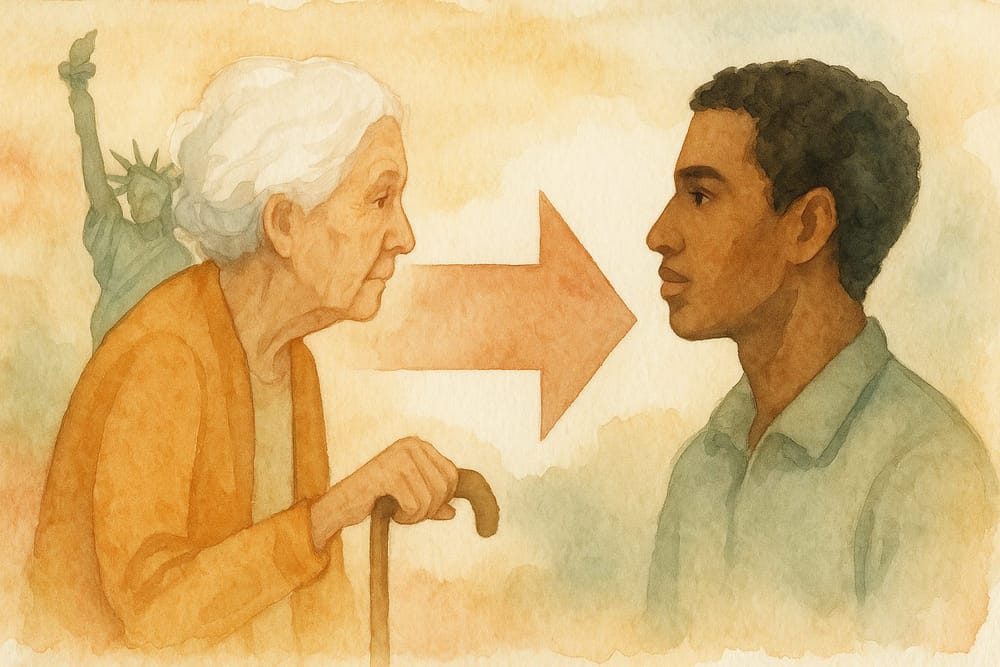
By 2032, the United States will need to fill 8.9 million positions in direct care for elderly persons. The population of Americans aged 85 and older is projected to more than double between 2020 and 2040, growing from 7 to 14 million. Existing federal initiatives are insufficient to fill all projected openings. Migration restrictions are aggravating recruitment difficulties, as the sector depends heavily on immigrant workers.
The Essentials
- The United States faces a structural labor deficit in elderly care: 8.9 million job openings between 2022 and 2032, according to projections from the Bureau of Labor Statistics, compiled and aggregated by the Bipartisan Policy Center.
- The population aged 85 and older doubles between 2025 and 2040, from 7 to 14 million. More than 60% of non-metropolitan counties have no psychiatrist.
- Immigrant workers represent a disproportionate share of the workforce in home and institutional care. Restrictions and the absence of suitable visa pathways can limit the recruitment of immigrant care workers.
- Shortfalls in formal support can increase unmet needs for families, whose caregivers are predominantly women, though substitution does not automatically occur in all cases.
- Germany and Switzerland have aligned their migration policy with their demographic needs, an explicit political choice.
Demography Does Not Lie, Politics Pretends It Does
Germany and Switzerland have adopted immigration policies favorable to this sector and maintain a functioning care system.
Seven million Americans are now aged 85 or older. In fifteen years, they will number 14 million. This progression follows simple arithmetic: baby boomers are aging, medicine is extending lifespans, and the cohorts reaching advanced age are the largest in American history.
From age 85 onward, physical dependency is intense. People in this age group are the largest consumers of direct care: assistance with bathing, meals, mobility, and management of multiple chronic conditions. This care requires human presence and resists automation. A robot can deliver a meal tray down a nursing home corridor; it cannot help an 88-year-old woman get out of bed, assess her pain, and adjust her medications.
The NEJM published this analysis in 2025 and an erratum in August 2026. The Bipartisan Policy Center estimates 8.9 million job openings between 2022 and 2032 according to Bureau of Labor Statistics projections. This figure does not include physicians or registered nurses. It concerns nursing aides, home health aides, nursing home assistants—the hands that perform daily care work. The Bipartisan Policy Center notes that more than 60% of non-metropolitan counties lack a psychiatrist.
Entire regions are already medical deserts for elderly people, even before the demographic wave arrives.
The Invisible Work That Immigration Made Visible
In the United States, the composition of the direct care workforce is documented. Foreign-born workers represent a disproportionate share of home health aides, nursing home assistants, and personal care workers. The Pew Research Center has measured this repeatedly: in personal care and home support sectors, immigrants represent approximately 28% of the total workforce, a share higher than their representation in overall employment.
This situation results from sector characteristics. These positions are physically demanding, poorly paid, offer limited advancement prospects, and are often part-time or irregular hours. The native labor market has abandoned them. Immigrant workers, often experiencing upward social mobility over a ten to fifteen-year horizon, accept these conditions as an entry point. The system has functioned this way for decades without this dependence being formulated as an explicit political choice.
Migration restrictions can aggravate recruitment difficulties. Limited visa pathways for home health aides can reduce international recruitment. When care supply contracts while demand continues growing, the result is silent rationing: waiting lists for certain community services, nursing homes limiting or refusing admissions due to staffing shortages, reduced home care hours, families called upon to compensate.
The work of economist Bruno Palier on the political economy of labor and social protection illuminates this mechanism. When a labor market segment is inelastic and the supply flow closes, the system adjusts not through wage increases or retraining, but through implicit rationing. The cost then shifts, preferentially, toward households least equipped to absorb it.
The Burden Shifts to Women, Without a Budget Line Item
This transfer has a gender dimension. Women constitute the majority of unpaid family caregivers, and service shortfalls can increase family burden. Daughters, daughters-in-law, spouses: they reduce their work hours, leave positions, refuse promotions to provide care they deliver without wages or social protection.
This phenomenon is documented in the United States by the National Alliance for Caregiving: approximately 53 million Americans provide unpaid informal care to an elderly or disabled relative. Among them, 61% are women. The individual economic impact is real: reduced income over time, diminished retirement contributions, interrupted career trajectories. At the national scale, it represents a massive transfer of costs from the formal system to households, rendered invisible because it creates no line item in the federal budget.
This intersects a broader tension over the distribution of gains and burdens in the economy: unpaid care work is human capital mobilized for free, appearing in neither GDP nor social protection accounts. When the formal market contracts, this capital absorbs the shock, and the adjustment remains invisible to policymakers.
This problem is not new. The very rapid aging projected for those 85 and older may intensify recruitment tensions, though not necessarily to historically unprecedented levels.
Germany’s and Switzerland’s Choice
Facing the same demographic constraint, Germany and Switzerland have made a different choice. Their political contexts are conservative democracies with strong traditions of migration control, and they merit examination for this reason.
Germany launched its 2023 reform of the Skilled Immigration Act, Fachkräfteeinwanderungsgesetz, aimed at facilitating immigration of skilled workers, including in unregulated professions across all sectors. Elderly care ranks at the top. The law simplifies foreign credential recognition procedures, opens pathways for experienced workers without formal German qualifications but generally requires formal qualification recognized in the country of training, and creates a job search visa. Active recruitment programs operate with the Philippines, Tunisia, and Mexico.
Switzerland operates differently, within the framework of the free movement agreement with the EU/EFTA and a contingent and selective regime for third-country nationals. The canton of Vaud, like several others, has developed specific recruitment pathways in home care that explicitly acknowledge the shortage as a public health risk.
These examples do not solve everything. Germany faces administrative processing delays and real integration difficulties. Switzerland maintains selective access conditions that exclude many potential candidates. But in both cases, the choice is deliberate: Germany relies more on skilled immigration; Switzerland combines international recruitment, training, and workplace condition reforms. The constraint is the same as in the United States; the political trade-off is different.
A liberal reading of this issue, one defended by economists like Raghuram Rajan on the role of markets and communities in providing social goods, might emphasize that wage increases in the sector would attract additional native workers, changing workforce composition. The argument deserves serious consideration. In May 2024, the median hourly wage for nursing aides was $19.01 according to the Bureau of Labor Statistics, a level uncompetitive with expanding sectors. Substantial wage increases would change incentives.
But this argument confronts two realities. First, Medicaid is a major funder of long-term services and supports, particularly for low-income persons. Its reimbursement rates to providers are set politically and move slowly. Without additional funding, wage cost increases can increase financial risk, particularly for facilities heavily dependent on Medicaid. Second, even with higher wages, multiple combined approaches will be necessary to meet projected care demand by 2040.
Immigration is an important lever among several measures for recruitment, retention, remuneration, and training.
This aligns with the finding in a previous article on home care: funding alone is insufficient when hands are lacking.
What Institutional Architecture for 2040
The figures pose the question clearly: the projected increase in Americans aged 85 and older increases care needs, requiring identification of an institutional model and evaluation of its effects on families and formal systems.
Three architectures are conceivable, each implying collective choices that American public debate has not yet formulated explicitly.
The first scenario is accelerated marketization. The private market partially fills the void with high-end services—luxury nursing homes, home aides recruited by specialized agencies, accessible to wealthy households. For others, rationing deepens. This scenario already exists in embryo: Medicaid-funded facilities show lower staffing ratios than private facilities, and the gap widens. It resolves nothing on the overall demographic plane: it segments the response according to income.
The second scenario is targeted public investment: wage increases funded by revised Medicaid rates, accelerated training programs for native workers in career transition, and sector-specific immigration pathways on the German model. This scenario requires political coherence presently absent: training investment must accompany migration policy aligned with sector needs. It presupposes explicit arbitrage between migration objectives and care needs. Several states—Minnesota, New York, Illinois—are experimenting with elements of this architecture, with partial but documented results.
The third scenario relies on prevention and extended home-based care to reduce the number of people transitioning to severe dependency. Fall prevention and home adaptation can help some people remain at home longer, with no federal estimate consulted between two to four years on average. At the scale of 14 million people, two years of prevented dependency represents a considerable mass of formal care avoided.
This scenario delays the workforce need without eliminating it. Its implementation itself requires human resources, particularly prevention nurses, social workers, and care coordinators, markets already experiencing tensions.
The likely reality is a combination of all three scenarios, in proportions depending on political arbitrages remaining to be made. The data allow establishment of the problem’s order of magnitude: multiple combined approaches will be necessary.
The signal to watch over the next five years is the vacancy rate in Medicaid-funded long-term care facilities. If this rate continues progressing at current pace, silent rationing will become a visible crisis, perceptible in empty beds and families called upon for reinforcement.
The question of aging and active-to-retiree ratios poses itself differently across systems, but the bottleneck of human care is common to all aging demographics. Care workforce cannot be printed.
Sources
- New England Journal of Medicine, analysis on labor shortages in geriatric care, July 2026
- Bipartisan Policy Center, report on elderly care needs, July 2026 (bipartisanpolicy.org)
- Bruno Palier, Social Policies and Globalization, Sciences Po LIEPP
- Pew Research Center, data on immigrant share in personal and home care workforce
- National Alliance for Caregiving, Caregiving in the US, data on informal caregivers and their profile
- Bureau of Labor Statistics, median wages for nursing aides (home health and personal care aides)
- Administration for Community Living, data on dependency prevention and home-based care
- German Skilled Immigration Act (Fachkräfteeinwanderungsgesetz), 2023 reform, Bundesministerium des Innern und für Heimat