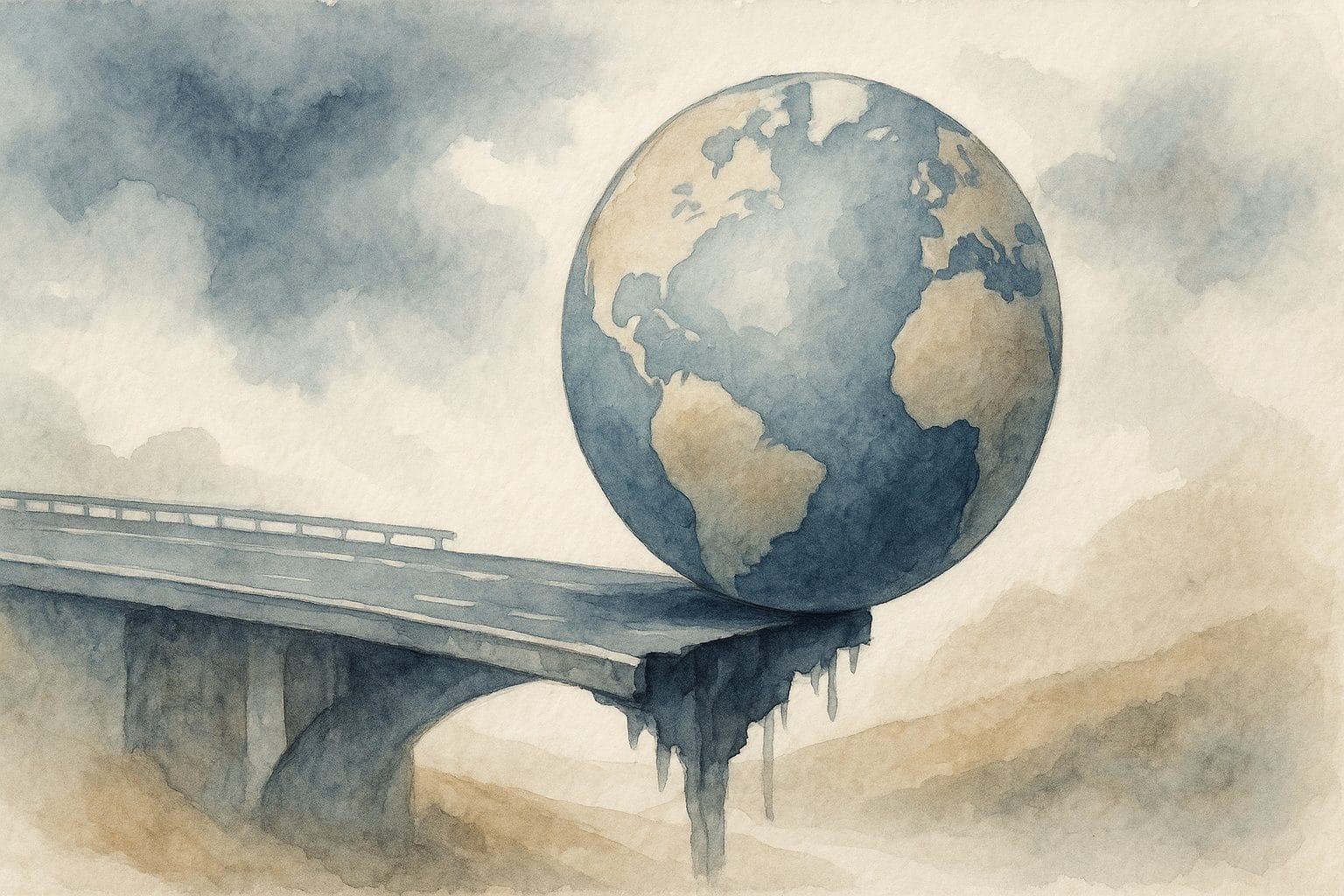
Since February 2026, a concurrent crisis has affected two of the planet’s most critical maritime chokepoints. Global commerce operated on an assumption never written anywhere: at least one passage would remain open. This assumption collided with a new reality: differentiated economic effects depending on the value of goods and available routes. The disruptions have led to restrictions, diversions, and variable surcharges depending on products and markets.
The Essential Points
- The Strait of Hormuz suffered major disruption from late February 2026, while the Red Sea experienced intermittent restrictions and diversions, not continuous closure.
- Many tankers are anchored off the Strait of Hormuz; Maersk, MSC, CMA CGM, and Hapag-Lloyd are suspending or diverting their lines (FreightWaves, S&P Global).
- Alternatives, air freight and the transcaspian rail corridor, cost significantly more than normal maritime rates.
- Global supply chains have been optimized for fluidity, not resilience against dual chokepoint blockage.
- Maintaining a global commercial architecture in the face of simultaneous disruption of two critical chokepoints is a major issue for the years ahead.
The Disappearance of the Base Assumption
Global maritime freight rests on a network of roughly a dozen mandatory transit points. Three or four of them concentrate the bulk of energy and manufacturing traffic: Hormuz for Gulf oil, the Red Sea and Suez for Asia-Europe trade, Malacca for Southeast Asia. Resilience models for major shipping lines always plan for a partial closure scenario, one chokepoint under pressure while others absorb the overflow. They were never built for the simultaneous closure of two of them.
Yet this is what has been happening since February 2026. The Strait of Hormuz, through which approximately 20 percent of global oil transits according to the International Energy Agency, has been effectively closed to commercial traffic for more than five months. The Red Sea has been disrupted since November 2023, when Houthi attacks began diverting major container lines. The two crises overlapped, with diversions, limited transit, and evacuation measures that partially mitigated certain effects.
Data from S&P Global and FreightWaves document the concrete scale: many tankers anchored off the Strait of Hormuz, unable to load or discharge. Maersk, MSC, CMA CGM, and Hapag-Lloyd, the four largest lines by capacity, have suspended or significantly diverted their services on affected routes. Shipping companies maintaining transit face significant increases in war risk insurance premiums, according to Lloyd’s maritime insurance market data.
Economic Filtering at Work
The direct documented consequence is a cost increase and route reconfiguration, not a generalized sorting by value. Alternatives exist—air freight, the transcaspian rail corridor known as the “Middle Corridor,” routes circumventing Cape of Good Hope—but they generate costs above normal maritime rates. Surcharges modify certain logistics and commercial choices without demonstrating automatic worldwide selection.
High-value-per-unit pharmaceutical products move by air and absorb the surcharge without margin collapse. High-end electronic components, advanced chips, next-generation battery modules, take the same routes. Mid-value consumer durables attempt the Cape detour, at the cost of an additional two to three-week delay and cost increases more bearable than air freight, but which erode distributor margins.
Everything else—bulk raw materials, food products, mass-manufactured goods, construction materials—remains blocked or faces localized shortages. Buyers in South Asia and East Africa, who relied precisely on these low-cost flows, are the most exposed. The Southeast Asian logistics hubs already weakened by their energy dependence see their position deteriorating further.
The transcaspian rail corridor, which connects China to Europe via Kazakhstan, Azerbaijan, and Turkey, absorbs part of the diversion. Its capacities have been increased since 2022, but remain a fraction of maritime volumes. According to Baker Institute data, this corridor handles at best a few million tons per year, against several hundred million for the routes alone being bypassed. The gap is not closing in a few months.
Weaponization of Chokepoints: The Cost of Mutually Destructive Escalation
Edward Fishman, in Chokepoints: American Power in the Age of Economic Warfare, describes the mechanism with precision: logistics and energy chokepoints have become the preferred levers of modern economic warfare, precisely because they allow maximum pressure with limited direct cost for the one who closes them. Iran’s closure of Hormuz, or Houthi harassment in the Red Sea backed by Tehran, illustrate exactly this logic: the cost is borne by third parties, global commerce, importing economies, shipping companies, not by the actor who pulls the lever.
Fishman nonetheless emphasizes a structural tension in this strategy: weaponizing chokepoints produces cascading effects the triggering actor does not control. Iran closing Hormuz disrupts its own oil exports, which partly transit through the same strait. The Houthis also affect supply route flows transiting the Red Sea toward Yemen. Escalation is mutually destructive, but asymmetrically depending on each actor’s absorption capacity.
In 2026, the remarkable characteristic is the simultaneity of two critical closures. Its analysis is constructed around the sequential or isolated use of chokepoints as weapons. The simultaneous closure of two chokepoints creates a new configuration: The disruptions in both zones have been treated by shipping companies as concomitant effects of regional escalation, with no documented indicator of planned coordination between the two. The disruptions in both zones have been treated by shipping companies as concomitant effects of escalation of the same regional conflict. The documented result is a major shock to energy markets and supply chains.
Philippe Aghion, in his work on creative destruction and innovation shocks, suggests that severe supply chain constraints sometimes produce accelerated technological and organizational responses: relocation, constructed resilience, forced diversification of suppliers. This reading complements Fishman’s diagnosis and raises the possibility that the 2026 shock accelerates industrial reconfigurations already underway. Current data does not yet allow conclusion: signals of reshoring are real but predate the crisis, and their amplification by dual closure remains to be documented.
The Actors Holding the Line
Certain actors have responded to the crisis with concrete adaptations. Major shipping lines have deployed their substitute fleets on the Cape of Good Hope detour, lengthening rotations by 10 to 14 days but maintaining degraded service. CMA CGM announced additional investments in its bulk fleet to increase capacity on these alternative routes, according to its first-half 2026 financial communications.
On the rail side, Azerbaijan and Kazakhstan coordinated frequency increases on the Middle Corridor, with political support from the European Union seeking to diversify its logistics connections with Central Asia. Volumes remain modest, but the trajectory is upward. Several major European freight forwarders, in automotive and electronics, have begun contracting multi-year capacity on this corridor, a signal that the crisis is producing structural adaptations, not merely cyclical adjustments.
Air freight is in full capacity expansion. Companies operating freighters have recorded fill rates near saturation since March 2026, according to FreightWaves. Qatar Airways Cargo and Emirates SkyCargo, geographically well-positioned to absorb redirected flows, have increased frequencies on Asia-Europe and Asia-North America routes. This response is rapid but structurally limited: global air freight represents roughly 1 percent of maritime volumes by tonnage, even if it captures a far higher share by value.
The dynamic of industrial robotization already underway in Southeast Asia could paradoxically accelerate under the logistics crisis: sustainably elevated transport costs make geographic proximity between production and consumption more attractive, reducing dependence on long maritime routes.
Global Commercial Architecture Under Stress
The 2026 shock illuminates a fragility that international trade economists had theorized but that private and public actors had systematically underestimated in their investment decisions. Global supply chains have been optimized for thirty years to minimize costs in an environment of open flows. Resilience, meaning the capacity to absorb a major shock without rupture, was sacrificed to efficiency.
This rediscovery of vulnerability occurs at high cost. Industries with high transport intensity and low value-added per kilogram—processed food, basic chemicals, construction materials—suffer cost increases that compress or erase margins. Some have suspended orders, others have begun building larger safety stocks. Both behaviors reduce overall system efficiency but increase marginal resilience.
The African Continental Free Trade Agreement takes on new meaning in this context: African economies advancing toward more integrated intra-continental trade structurally reduce their dependence on long-distance maritime routes, a form of geographic resilience that the 2026 crisis validates retrospectively.
Reshoring, Regionalization, or Contraction: What the Coming Years Will Tell
The simultaneous closure of Hormuz and the Red Sea forces economic actors to determine the conditions under which a global supply chain remains viable when two critical chokepoints close together, and to evaluate the cost of this viability.
Three trajectories emerge for 2026-2028, though none is certain.
The first is resilience through redundancy: private actors and governments invest in alternative routes—rail, arctic, trans-African—and in larger strategic stockpiles. The cost of this redundancy is real and permanent, but is distributed across all chains and becomes sustainable over the long term. This is the trajectory most compatible with maintaining global commerce at levels comparable to today, at structurally higher costs.
The second is accelerated regionalization: companies reduce supply chain length, favor geographically close suppliers, and accept higher production costs in exchange for reduced exposure to logistics shocks. This trend, already visible before 2026 due to Sino-American tensions and the 2020 pandemic, could accelerate significantly. It produces lower-volume global commerce but less concentrated on a few critical routes.
The third is differentiated sectoral contraction: certain sectors, those whose unit value is too low to absorb surcharges and whose production is too dispersed to regionalize quickly, suffer lasting contraction. Low-price mass consumer goods, produced in Asia for Western markets, are most exposed. This contraction does not affect all global commerce but structurally modifies flux composition.
The signals to watch to distinguish these trajectories are clear: the evolution of new ship orders on alternative routes, announcements of strategic stockpile investments by major distributors, and especially the actual duration of Hormuz closure. If it extends beyond twelve months, structural adaptation behaviors will become irreversible. Supply chains are not reconstructed overnight in their original configuration once actors have invested in alternatives.
Fishman’s thesis takes on full prospective force here: if chokepoints become regularly used weapons, economic logic pushes actors to reduce their exposure, meaning to progressively undo the commercial globalization that these same chokepoints made possible. The weapon destroys, ultimately, the common good it claims to defend or control. The true unknown is the speed at which this lesson will be incorporated into state and company investment decisions, and whether multilateral commercial institutions, from the WTO to regional agreements, will find the tools to secure routes before private adaptation definitively fragments the system.
Sources
- Movargo, Strait of Hormuz Shipping 2026 (FreightWaves, Baker Institute, S&P Global): https://www.movargo.com/post/strait-of-hormuz-shipping-2026
- Edward Fishman, Chokepoints: American Power in the Age of Economic Warfare, Penguin Random House: https://www.penguinrandomhouse.com/books/726149/chokepoints-by-edward-fishman/
- International Energy Agency (IEA), data on oil transit through Hormuz (annual Oil Market Report)
- Lloyd’s of London, maritime war risk insurance premium data, Persian Gulf and Red Sea zones, first half 2026
- FreightWaves, freight indices and fleet data, June 2026
- S&P Global Mobility, tanker and container line tracking, first half 2026
- Baker Institute for Public Policy, Maritime Chokepoints and Energy Security