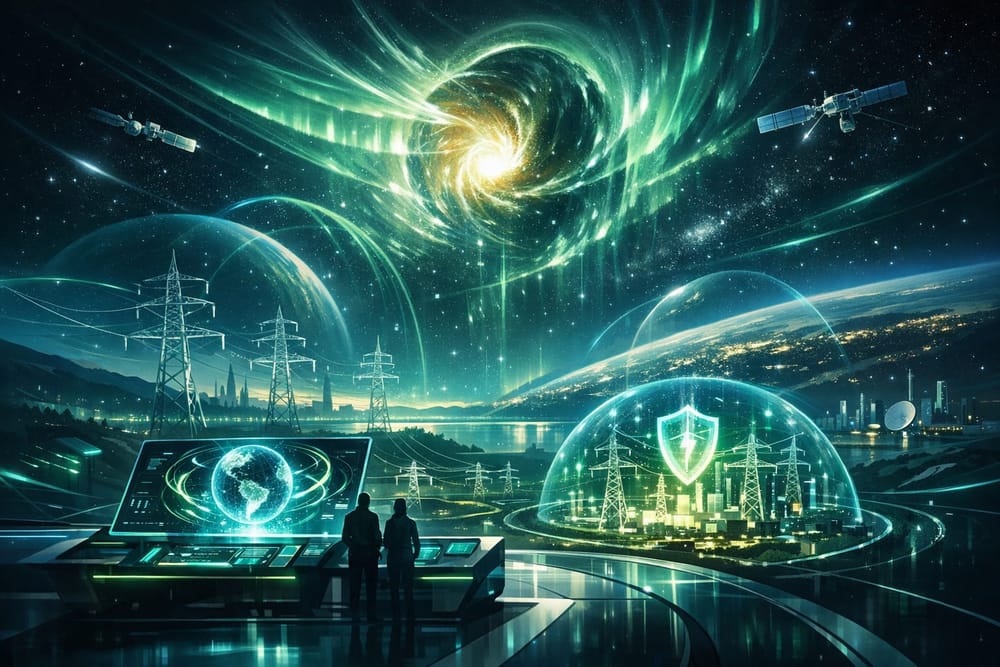
A coronal mass ejection reaching Earth in eighteen hours can disable electrical transformers whose replacement takes months. NOAA has calculated precisely what a surveillance architecture capable of alerting in time is worth: 68 billion dollars in net benefits over 2025-2050. Roughly 91% of estimated gross benefits come from electrical grid operations, which says something essential about the real nature of this investment. Monitoring space is first and foremost about protecting electricity.
The essentials
- NOAA estimates that its Space Weather Next surveillance program would generate 68 billion dollars in net benefits over 2025-2050; approximately 91% of quantified gross benefits come from electrical grid operations (NOAA, Cost Benefit Analysis 2026).
- The value of space surveillance lies in the terrestrial decision-making chain, not in the satellites themselves: an alert without operational procedure protects nothing.
- Aviation and satellite navigation also benefit from this surveillance, but their gains remain marginal compared to those in the electrical sector.
- The real risk by 2050 is that of a theoretical alert: observations are improving, but the operators involved are subject to mandatory procedures whose implementation and concrete measures can vary depending on the system.
The effects of the sun on an electrical network
Saturation of a transformer by geomagnetically induced currents does not always cause immediate and visible destruction. It can also silently degrade internal insulation, reducing the remaining lifespan of the equipment without triggering an operational alarm. This accelerated aging is difficult to detect during routine inspections, which means that a moderate-intensity storm can durably weaken a network without its operators being aware of it before the next failure. This opacity of the mechanism complicates the justification for preventive investments: the absence of visible breakdown after a geomagnetic event is regularly interpreted as an absence of impact, when it may mask cumulative degradation whose effects will only appear during subsequent stress.
The sun regularly ejects billions of tons of plasma at speeds that can exceed one thousand kilometers per second. When this flow reaches Earth, it compresses Earth’s magnetic field and induces currents in any long conductor: high-voltage lines, pipelines, underwater cables. These geomagnetically induced currents saturate transformers, overheat them, sometimes destroy them.
The problem with large transformers is that they are manufactured to order. Large grid transformers are typically custom-built, with lead times of at least one year and costs running into millions of dollars. A sufficiently intense solar storm could simultaneously destroy dozens of them on the same continent. In March 1989, a geomagnetic storm caused the collapse of Hydro-Québec’s network for nine hours and caused disruptions and voltage losses on several lines in Sweden; documented transformer damage from this episode notably affected Quebec, New Jersey, and the United Kingdom.
The 1989 event was weaker than Carrington, but remains one of the strongest geomagnetic storms of the instrumental era. The 1859 Carrington storm, the most intense ever documented, set telegraph lines aflame and produced auroras visible as far as Havana. The NOAA report models approximately 603 billion dollars in gross benefits avoided with a Carrington event, while earlier studies cited generally estimate total economic impacts on the order of 0.6 to 2.6 trillion dollars. Such a storm will recur; the unknown concerns the date.
68 billion reasons to monitor the star
NOAA has managed the Space Weather Prediction Center for decades, the federal U.S. agency responsible for monitoring solar activity and issuing alerts. Its Space Weather Next program aims to modernize the architecture of this surveillance over the coming decades: new satellites, onboard sensors, improved forecasting models.
NOAA published its cost-benefit analysis of Space Weather Next in 2026 to justify this investment. The result exceeds what intuition would suggest. Over the period 2025-2050, projected net benefits reach 68 billion dollars. The report breaks down these benefits by sector: aviation, satellite navigation, space operations, electrical networks. The distribution is striking.
The electrical grid represents 91% of quantified benefits.
Other sectors contribute, but their weight is incomparable. Airlines modify their polar routes during solar storms to avoid radio disruptions and radiation exposure, a real cost, but limited. Commercial satellite operators sometimes must switch to safe mode or postpone maneuvers. These adjustments count, but they do not change the hierarchy: protection of electrical grid operations concentrates the bulk of quantified benefits, only part of which concern transformers.
This figure of 91% deserves scrutiny. It means that investment in solar monitoring satellites is, economically, an investment in electrical grid resilience. Orbital assets are only one link. The economic value is realized when users, particularly grid operators, aviation, and satellite operators, transform alerts into mitigation actions.
The alert is only worth something if someone listens to it
The perceived rarity of severe events creates a structural difficulty in maintaining operational readiness over time. An operator who has never experienced direct consequences from a past alert has little internal experience to calibrate their response, and unexercised procedures gradually deteriorate. This erosion of organizational skills between two notable events is a documented phenomenon in other fields of low-frequency, high-impact risk management. It suggests that the value of space alerts depends as much on the regularity of simulation exercises as on the quality of the forecasts themselves.
A space weather alert today resembles an ordinary weather alert from the 1980s: the information exists, but the procedures to respond to it are not uniformly established across all operators.
Electrical grid managers have several preventive tools. They can reduce network load to diminish transformer vulnerability. They can modify network topology to isolate the most exposed sections. They can postpone scheduled maintenance to preserve reserves. Some operators, particularly in the United States and Scandinavia, have developed internal protocols.
But coverage remains uneven across operators. Between an operator who has integrated NOAA alerts into their daily procedures and another who receives them without knowing what to do with them, the resilience gap is considerable.
The NOAA report explicitly identifies this knot: the projected economic value assumes that alerts trigger corrective actions. If operators have neither procedure nor incentive to act, the value of surveillance remains theoretical. Orbital investment without organizational investment on the ground is equivalent to installing a smoke detector without training occupants to evacuate.
This adoption problem is not unique to space weather. A comparable dynamic is found in other sectors where technical information precedes organizational absorption capacity, as with AI in small and medium enterprises, where access to the tool is not enough without organizational support. The space alert poses the same challenge: converting a signal into decision requires procedures, trained personnel, and an operational culture that technology alone does not create.
European measures underway
The United States is not alone in this. The European Space Agency maintains a space weather program that monitors solar activity from several ground observatories and from the Proba-2 satellite. Its risk catalogue identifies the same vulnerabilities: electrical networks, satellite navigation systems, high-frequency communications used by aviation.
The ESA coordinates a network of institutes and national agencies, the Space Weather Alert Center in Belgium, the British Space Weather Centre at the Met Office, to produce forecasts and alerts distributed to European operators. Transatlantic cooperation also works: data from the American Geostationary Operational Environmental Satellite network feed European models.
Europe is working on a next dedicated mission, called Vigil, designed to monitor the sun from the Lagrange L5 point, a lateral observation angle that would make it possible to anticipate ejections several days before they arrive facing Earth. This geometric position provides a decisive advantage: a satellite at L5 sees solar activity before it is directed toward us. Alert times could move from a few hours to several days, which radically changes the options available to grid operators.
Space is valuable for its data on the ground, and the Vigil mission is a direct illustration: its interest lies not in the chosen orbit, but in the extra time it provides to terrestrial decision-makers.
The decade that determines real resilience
The issue of the coming years comes down to a precise gap: that between increasingly better surveillance and the actual capacity of operators to benefit from it.
Two trajectories are possible. In the first, forecasts improve and operators genuinely integrate them into their procedures. The alert comes sooner thanks to better-positioned satellites, grid managers have been trained, protocols are refined through regular exercises, and each significant geomagnetic storm produces documented avoided costs. Orbital investment generates distributed and measurable civil benefits.
In the second trajectory, observations improve but adoption stalls. Alerts circulate in bulletins that no one has transformed into operational procedure. Operators lack incentive to invest in preparation because severe events remain rare on the scale of a mandate or budget cycle. The 68 billion value calculated by NOAA remains on paper.
Two collective needs condition the improvement of this capacity. The first is standardization of response protocols between forecasters and operators: procedures to follow during a NOAA G3-level alert, decision-makers, timeframes and competent authority still vary by country and operator. The second is the creation of public indicators on delays between alert and operator decision, referred to by some as “time to action.”
Without measurement, adoption remains invisible and incentives to improve it dull.
Concrete options exist. Conditioning a portion of investments in critical networks on exercises for responding to solar alerts, following the model of cybersecurity exercises imposed on vital infrastructure operators, would force preparation without waiting for a real event. Publishing annually the avoided costs during documented geomagnetic events, even modest ones, would provide the proof of efficacy currently missing from public debate.
Two signals will make it possible to distinguish trajectories in the coming years: the share of electrical operators who declare they have integrated space alerts into their certified procedures, and the first quantified reports of avoided costs during real events. These data do not yet exist in systematic form. Their appearance would already be an indicator of progress.
The chain that must hold together
The NOAA analysis produces an image rarely as clear in public investment decisions. A scientific satellite program generates 91% of its economic value in a single sector, electricity, and this value is realized entirely in the quality of human response to an alert, not in the sophistication of the orbital sensor.
This places space weather in a particular category of infrastructure: those whose effectiveness depends on a complete chain, from satellite to the decision of the grid engineer who receives the alert at three in the morning. Strengthening one link without the others amounts to partially optimizing a system that does not tolerate weak links.
Governments investing in solar surveillance have begun to understand that the issue is organizational as much as technological. The coming years will tell whether this understanding has translated into real procedures, or whether it remained in cost-benefit reports.