UNESCO published a global survey of 500 creators across 45 countries and territories, documenting primarily their creative practices, relationships with platforms, economic models, and ethical dilemmas; it also addresses training and information. Metrics and recommendation systems influence visibility and can encourage adaptation of production, without allowing us to claim they determine it to the same extent as consumption does. Protecting creative diversity requires rights concerning distribution conditions, beyond the freedom to publish.
The essentials
- The UNESCO Behind the Screens survey covers the motivations, practices, revenues, ethical challenges, hate speech, legal frameworks, and training needs of creators, as well as their assessments of platform practices, across 45 countries and territories.
- The UNESCO Behind the Screens survey covers 45 countries and territories; the report observes distinct national profiles within its sample, without allowing these to be generalized statistically to the entire region.
- The central mechanism: visibility depends on algorithmic criteria that creators do not fully control, which can influence creators’ production choices.
- Creators have recourse options governed by the platform, but these procedures remain opaque and timelines prove lengthy.
- The forward-looking issue concerns algorithmic transparency and collective bargaining rights.
The effects of the attention market on content
The creator economy has expanded considerably in Latin America in recent years. YouTube, Instagram, TikTok, Twitch: platforms have opened a new professional space, accessible without substantial initial capital. Hundreds of thousands of people have built an activity there, sometimes a career. UNESCO wanted to know under what conditions.
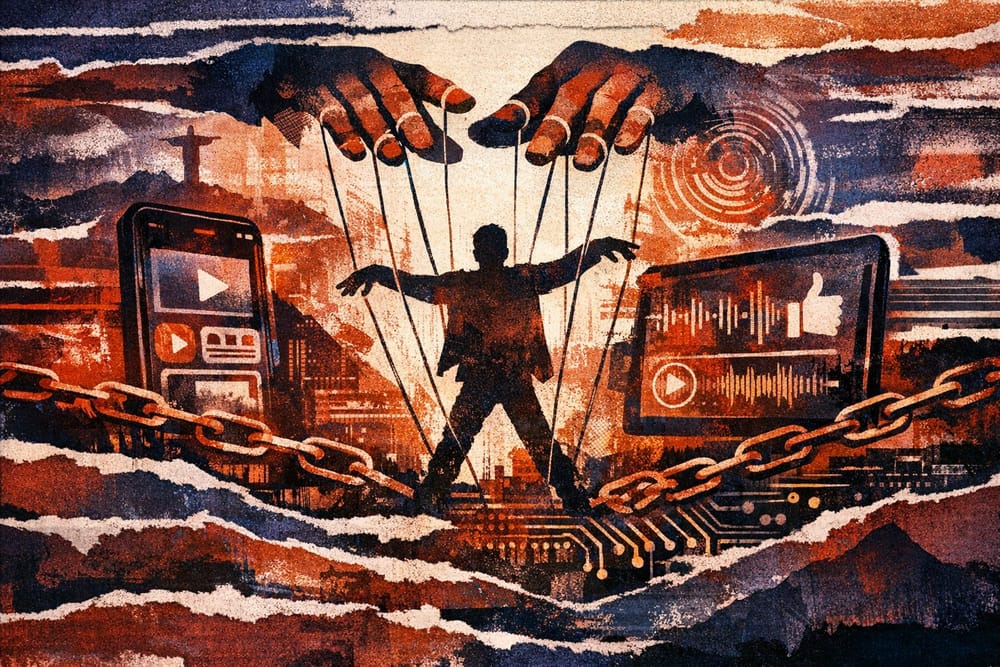
The UNESCO report identified is Behind the Screens, a global study of 500 creators across 45 countries and territories. What emerges from it goes beyond the question of income. Creators are not simply producing content that platforms would then distribute neutrally. They modify what they create based on algorithmic criteria whose logic often escapes them.
Engagement metrics and algorithmic preferences influence production choices. A creator who observes that their long-form videos are less recommended than their short-form formats is not making an aesthetic decision. They are responding to an economic constraint. The algorithm censors nothing in the legal sense of the term. It directs content according to criteria that creators do not control.
This mechanism also applies to messages. The UNESCO study documents the motivations, practices, revenues, ethical challenges, hate speech, legal frameworks, and training needs of creators, as well as their assessments of platform practices. The opacity of moderation policies can influence creators’ content choices. The freedom to publish remains formally intact; the freedom to earn a living from what you publish is much less so.
Highly unequal professionalization profiles by country
The survey does not present Latin America as a homogeneous bloc. The six countries studied display notably different professionalization trajectories, combining training or professional experience, digital skills, and national contexts in which monetization opportunities are unequal.
Brazil has a significant proportion of professionalized creators—that is, earning the bulk of their income from their activity on platforms. The ecosystem of brands, networks of specialized agencies, and the size of the Brazilian advertising market offer opportunities that smaller markets, such as Peru or Chile, struggle to replicate at the same scale. This disparity is structural: depending on their country of origin, creators operate in different economic conditions, even when they use the same global platforms.
Professionalization is also unequal by gender. Female creators access partnerships under different conditions than male creators. The female creators interviewed, particularly in political content, report gender-based violence and harassment. UNESCO documents the practices, difficulties, and working conditions of creators. This structure resembles other transforming labor markets, where sector growth masks a polarization of conditions.
The algorithm as invisible employer
The relationship between a creator and a platform is presented as a relationship between an independent worker and a market. In practice, it resembles more a relationship of employment without the protections that typically accompany it.
Platforms define the monetization rules. They can alter advertising revenue-sharing rates, change eligibility criteria for revenue programs, or restrict eligibility for certain distribution forms according to their rules, whose application can be contested through internal procedures. A creator suspended from YouTube monetization has internal recourse options, but these are not comparable to ordinary labor law protections. Appeal is possible, but procedures remain opaque and timelines lengthy.
This asymmetry is structural. Platforms have an interest in maintaining an abundant and diverse supply of content, but may also seek engagement and user satisfaction according to their formats. Engagement is an important signal among other recommendation considerations, namely satisfaction and relevance for each user.
UNESCO observes a mutual dependency between creators and platforms as well as possible effects of algorithm or policy changes on visibility. The energy devoted to deciphering and satisfying algorithms is time and creativity that goes nowhere else. It is an invisible cost, appearing in no balance sheet.
The question points to a broader issue documented by recent work on mobile popular media: the popular cultures developing on mobile platforms are not simply digitized local cultures. They bear the imprint of the technical architectures that host them.
The concrete effects of algorithmic transparency
UNESCO’s 2025 report on artificial intelligence and culture extends this diagnosis. The study aims to better understand the intentions, practices, and challenges of digital content creators.
Three levers emerge from the analysis. The first is transparency: understanding how a recommendation algorithm functions, which signals it prioritizes, and how its parameters evolve. Without this information, creators navigate blind and regulators cannot assess whether a recommendation system produces discriminatory effects or runs counter to cultural diversity.
The second lever is audience portability. Audiences are not automatically transferred between platforms, but creators can attempt to migrate them through cross-platform strategies and owned channels. This fragmentation of audiences strengthens dependence on each platform. Portability rights, analogous to those that exist for personal data in certain jurisdictions, would allow for partial rebalancing of the relationship.
The third lever is collective bargaining. Most creators surveyed are not members of any creator association, suggesting limited collective support in this global sample. Professional organizations with real bargaining power over remuneration and distribution conditions would change the balance. This type of structure exists in other cultural sectors, from music to audiovisual: digital content creators are largely without it.
Two possible trajectories through 2030
The situation documented by UNESCO can evolve according to two very different trajectories by the end of the decade, and the signals that make it possible to distinguish one from the other deserve to be named.
The first trajectory is one of regulating transparency. The European regulation on digital services, the Digital Services Act, already imposes certain algorithmic audit obligations on very large platforms within the European Union. The DSA brings to Europe obligations of transparency and recourse concerning certain platform decisions, but it does not directly cover creator remuneration. If similar mechanisms develop in Latin America, creators would have more recourse rights. A few countries have already begun regulatory reflection in this direction: Argentina and Brazil have begun working on legislative frameworks concerning platform workers, which could gradually include content creators.
The second trajectory is that of the status quo. In the absence of regulation and collective bargaining mechanisms, algorithmic optimization logic for engagement is likely to persist. Creators can adapt their content to platform, monetization, and audience signals. Diversity does not disappear, but certain content finds a reduced audience, with less favorable monetization conditions.
The evolution of median revenues for independent creators—that is, the mass of professional creators whose revenues depend primarily on platform monetization mechanisms—offers a useful benchmark for observing transformations in this ecosystem, distinct from the few hundred highly followed creators whose contracts are public. Stagnation of creator median income alongside rising advertising revenues may signal a value distribution problem and merits thorough analysis of market balance. A median income increase can be compatible with improvement, but does not suffice to demonstrate a correction of market imbalances. This indicator is simple to define and difficult to obtain.
Latin America is a particularly revealing observation ground for this question. Social protections for independent workers there are weak, and local advertising markets do not allow all creators to access the same conditions as those creating in English for North American audiences. What the six countries in the UNESCO survey are experiencing today resembles what other cultural markets could experience tomorrow. The lessons drawn from it, or refused from it, will have consequences far beyond the region.
Creator organizations, the missing link
UNESCO notes especially a low rate of membership in creator associations within its global sample, suggesting the importance of collective structures for effective exercise of rights.
An algorithmic audit right accessible only to specialized legal professionals is a formal right. A recourse procedure requiring several months of steps is a theoretical procedure. Collective organizations can help process complaints and negotiate with platforms, but they do not constitute a universally required condition for implementing transparency.
These organizations exist in other creative sectors. Authors’ societies, journalists’ unions, film directors’ associations have built over several decades counter-powers that genuinely weigh on remuneration and distribution conditions. Digital content creators start from much further back: their status is recent, their heterogeneity is great, and platforms have no interest in facilitating their collective organization.
Some initiatives do exist, however. Creator associations have begun organizing in Brazil and Mexico. Digital rights advocacy groups bring these issues before legislators. These dynamics are fragile and their scope remains limited. They merit being followed, because they represent the most direct path toward real rebalancing, more direct certainly than public regulation alone, which cannot anticipate all effects of algorithms that constantly change.
The question remains open: how to preserve diverse creation when algorithmic recommendation structures a significant portion of discovery and reach, without alone controlling all access to the public? UNESCO notably studies the relationships between creators and platforms as well as the conditions necessary for a reliable and pluralistic information ecosystem. Latin America is in the process of testing the answers.